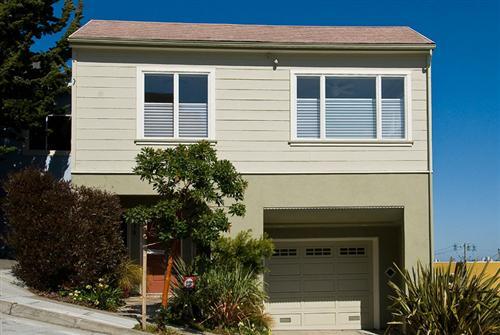
Catching up on the endless paper-work the other night, I came across that rare thing: a property that sells twice in a relatively short time with no major renovations performed in the interim.
This “sales matching” technique is what the folks at Case-Shiller use to create their Indexes of property values across the country. Part of the reason they can is that their indexes are generated for large Metropolitan Statistical Areas with lots of house sales. And even so, they use a lot of fancy foot-work to “match up” properties.
So now comes 714 Duncan Street, a beautiful 2,000 sf view home on a steep hill with fantastic city views. Listed at a disarming $1,195,000, it sold for $1,415,000 in January 2008. That was pretty much the top of the market for Noe Valley. (You can see the chart here.)
Fast-forward 18 months. The same house sells for $1,095,000 in June 2009. That’s a drop of 22.6%. My analysis of all Noe Valley sales for the same period shows a drop of just under 25% for the same period.
There’s something of a “duh, so what” to this story. But I’ve seen enough nay-sayers (on other blogs, of course!) who argue that tracking statistical medians are meaningless that I thought it was worth posting this as a powerful—and sobering — case to the contrary.
Ken Rosen is a smart guy. He’s the co-chair of the Fisher Center of Real Estate and Urban Economics at the Haas School of Business at UC Berkeley and the investment adviser of choice to some of the biggest players in real estate, from banks to insurance companies to REITS. Ken might not be able to appraise your house, but he could tell you how each sector of the real estate economy has fared anywhere in the country, and probably in many parts of the world.
Once or twice a year I spend the day in a windowless hotel conference room listening to Ken and some of the biggest heads in the real estate biz expounding on the state of real estate. These guys (and they are mostly guys) look at real estate through the lens of global macro-economics and finances. Want to know where interest rates are going? They study yield curves on T-Bills and monetary policy in the capitals of Europe. This is “the view from space.”
I reported on Ken’s predictions from November of 2008 here. (Remember, we were already in deep doo-doo, though things got worse through the first quarter of 2009.) Before moving into his predictions for 2010 and beyond, I thought it would be useful to see how well he did on on his forecasts for 2009:
The Ken Rosen Scorecard for 2009
Chance of a deep recession: 70%. Bingo.
S&P 500 at year-end under a deep recession: 850. Actual: 1115. Woops (but who said the market was rational?)
The dollar:“Will continue to do well.” Nope, it lost ground.
Not a great batting average you say? Truth is, I’m cherry-picking here. Overall, Rosen’s message in November 08 was that things were improving, but that there would be volatiility and a long, slow recovery in housing. Notwithstanding our brush with death in March — Rosen put the chance of a deep recession at 5% — his prediction on that aspect of the market seems to be holding up well. As for the dollar, given the gaping chasm that faced the global markets in the early months of 2009 – led by crashing and burning US financial institutions – the dollar’s decline shouldn’t be a surprise.
And as for the stock market and its amazing recovery, given what still seems to be looming on the horizon, I just can’t figure that one out at all.
Rosen’s Predictions for 2010
In terms of the shape of the recovery, Rosen estimates the chances of a “broken W” — read fragile recovery – at 65%. This is where I’m putting my money folks.
He estimates the chances of a more robust recovery at 25%, and that of a long , Japanese-style recession at 10%.
Expect a slow, fragile recovery, a bottoming out of the housing market, and rising long-term rates.
Estimates for the Stock Market, Year End 2010
S&P 1150; Dow 11,000
Advice for the Home-Buyer:
If there’s any good news here, it’s that Rosen thinks that the sector will come back fastest is single family housing.
Here’s the takeaway quote:
“Take advantage of the windfall tax credit and low interest rates if you’ve got a good job”
Rosen thinks that prices have bottomed (I’m not so sure). But it does appear that
REO’s (properties taken back by the banks) have declined as a percentage of all sales, and that should help to stabilize prices.
From a socio-economic perspective, housing affordability has increased significantly due to low interest rates and price declines, and that can only be viewed as good if you believe that widespread home-ownership is a public “good.” (I do.)
What could go wrong?
In a moment of brilliant serendipity, Rosen’s co-chair at the Fisher School, Bob Edelstein — no small brain himself — happened to sit next to me at lunch. In the next 30 minutes we covered everything from wine to Waziristan. His outlook was not as sanguine as Rosen’s. We didn’t get into details, but my impression was that Edelstein was more concerned than Rosen about a jobless recovery coupled with higher interest rates driven by enormous deficits.
Once again, the magic eight ball says: “Ask again later.”
Another glorious winter’s day in San Francisco. My family and I biked over the GG Bridge to Sausalito and then took the ferry back to Fisherman’s Wharf. Thirty-five years in this town and I’ve only done that ride twice. The previous time was a week ago, to celebrate my 10 year old son’s new birthday bike.
2009 was not a kind year. I feel very grateful that my family has come through in reasonable shape. It makes it easy to appreciate the fine views and the fine weather.
Exactly a year ago, I officially launched this blog. It’s been enormously gratifying writing it. First, it’s made me feel plugged into the market in ways both large and small. Secondly, because I’m a visual kinda guy, those charts that I’ve tried to make a central part of this blog have helped me understand and retain what’s going on in ways that columns of numbers just don’t. Plus, I’ve learned a heck of a lot more about Excel — and, alas, its limitations as a database — than I ever knew before.)
And finally, it’s been great to feel appreciated! Though I sometimes joke that I have a readership of 7½, it is a loyal, thoughtful and appreciative one. Well, that’s three of you anyway. 🙂
Happy New Year everyone! My best wishes to each of you, and thank you for your support.