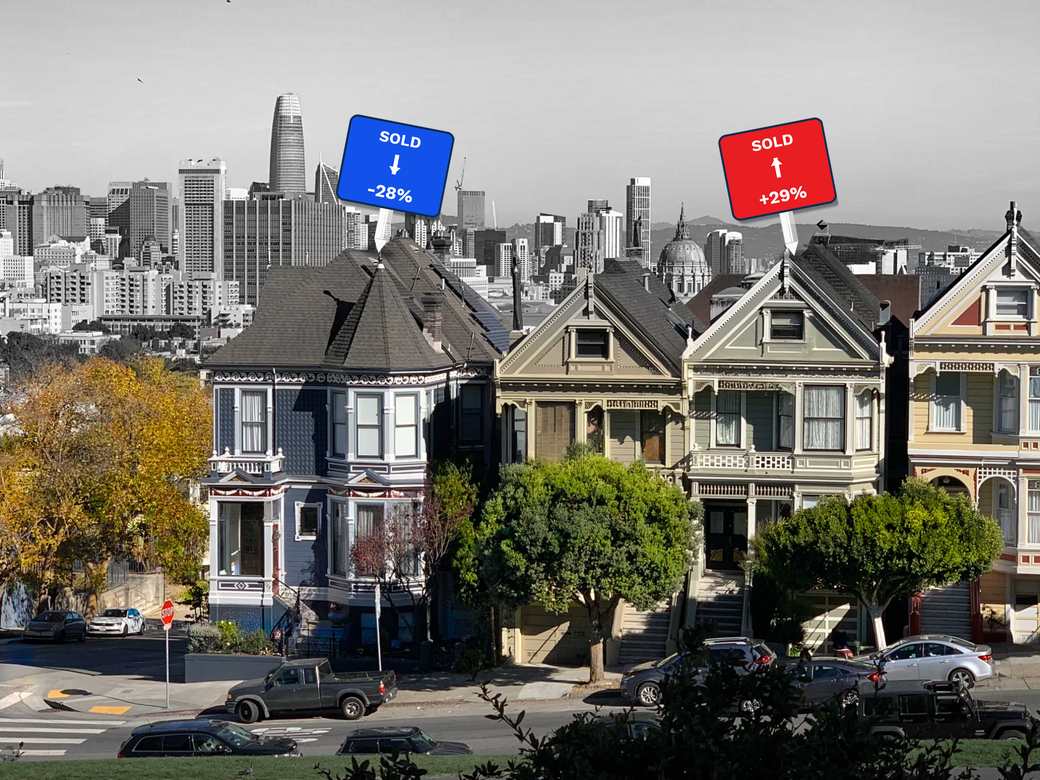
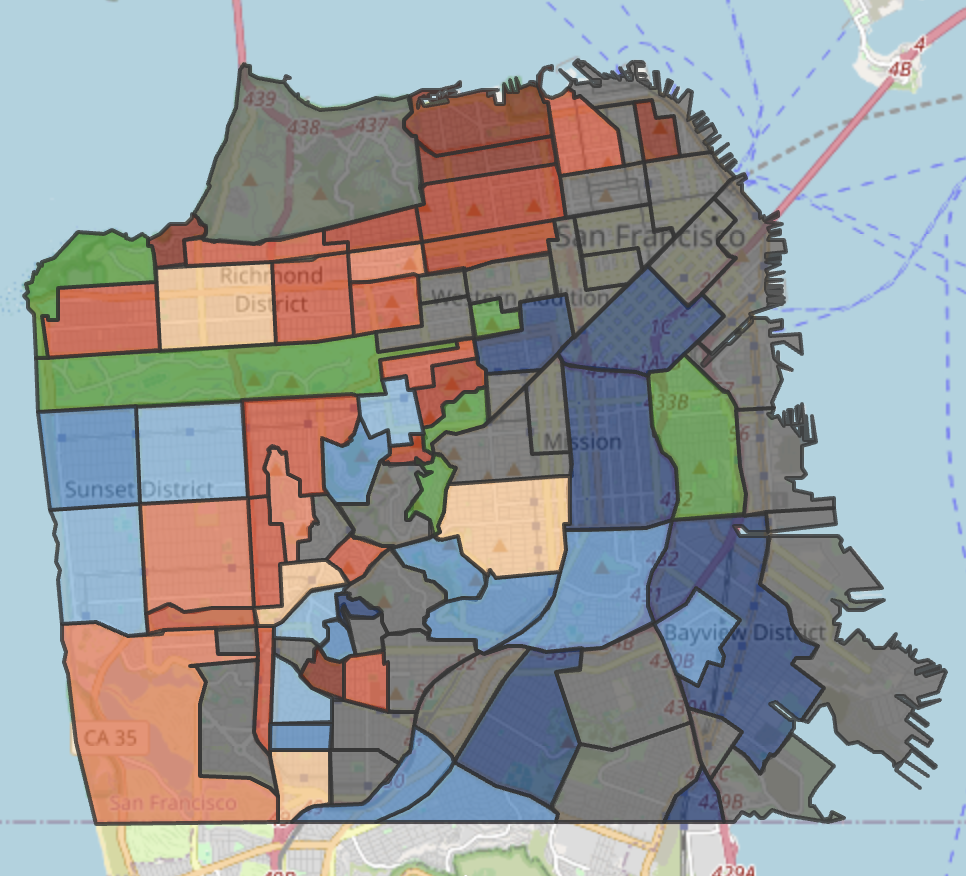
Winners and Losers: A Heat Map of San Francisco’s Neighborhoods

I’m back!  (More on this later….)

I’m so excited to present this heat map of San Francisco neighborhoods, which I believe may be the first of its kind.  I’ve been thinking about this idea for a while:  thank you Claude, and a shout-out to my son, too, who helped me bring the coding part of this project to fruition.

Be sure to click on the “fullscreen” button on the map below to expand it. We will get into the qualifications shortly, Continue reading “Winners and Losers: A Heat Map of San Francisco’s Neighborhoods”

The San Francisco Residential Real Estate Update: An Ai Generated Glimmer of Hope?


AI generated imaged
An AI Generated Glimmer of Hope

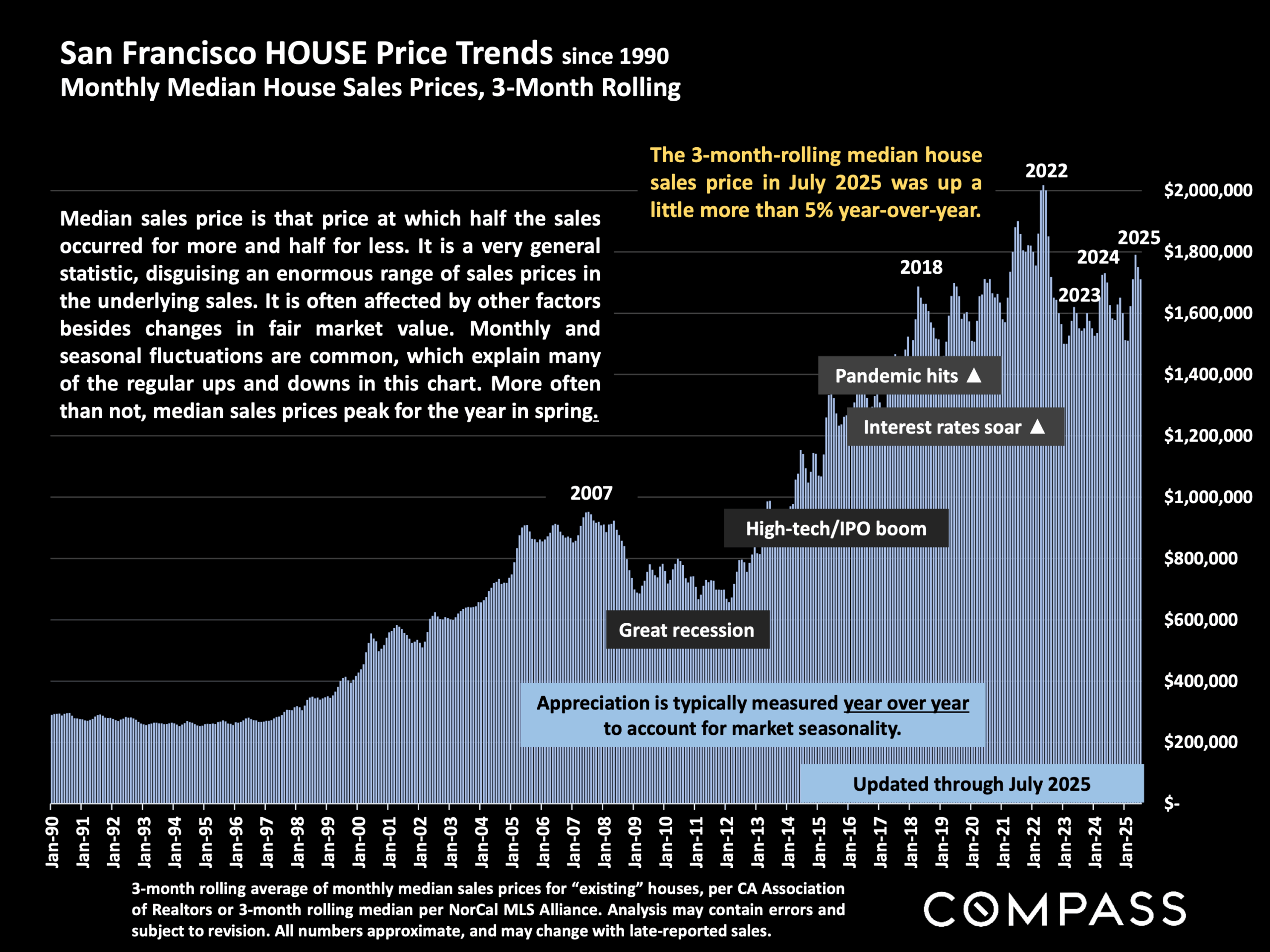
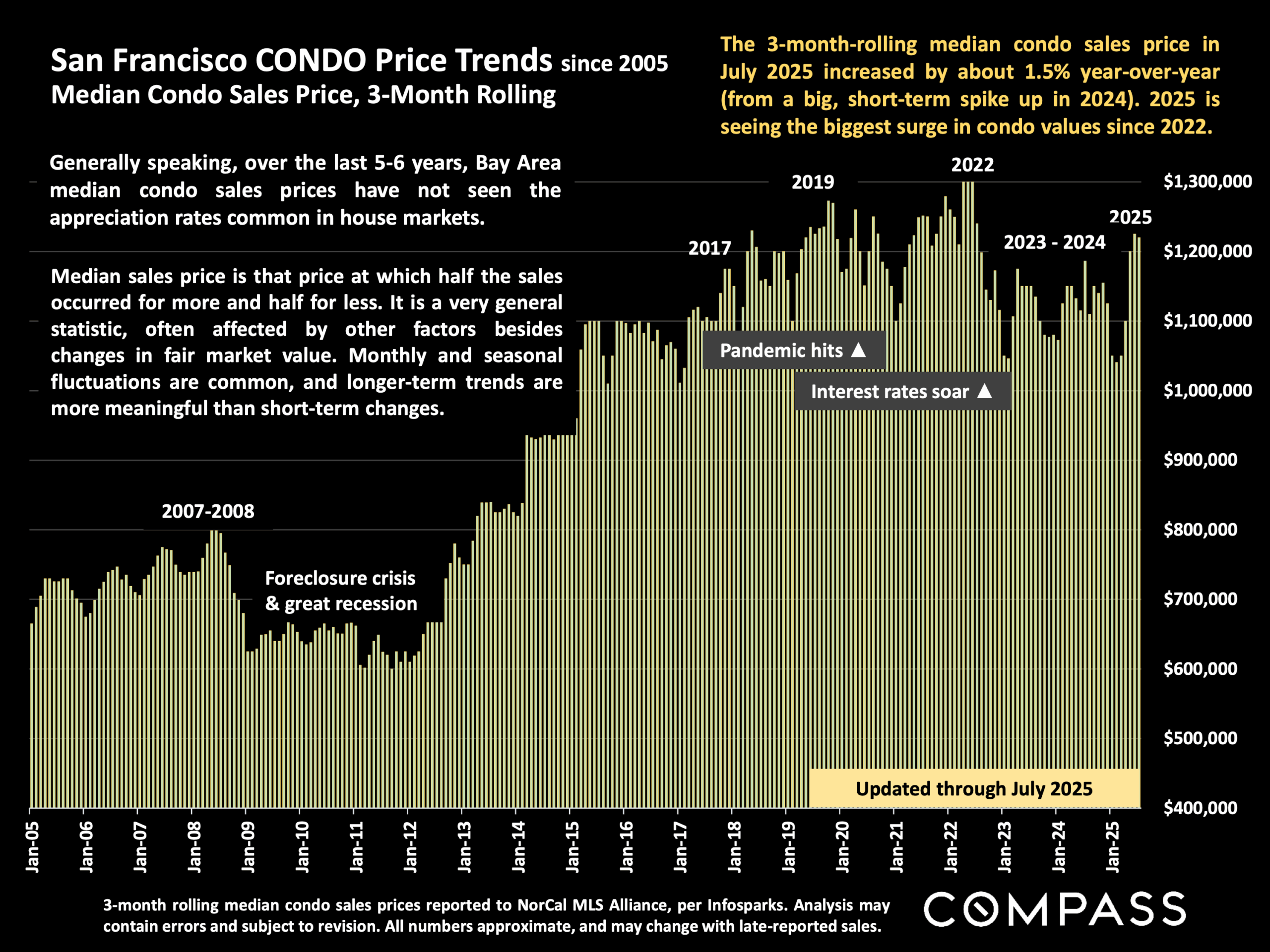
Back in May 2018, when pundits everywhere delighted in sounding the death-knell for SF’s residential market due to a host of local challenges including lack of affordability and rampant homelessness, I suggested they might be a bit premature. In the summer of 2020, months into the Covid pandemic, Zillow published data suggesting that SF was again on the skids.  Again, I suggested that “this too shall pass.”  Condo and home prices proceeded to hit record highs until 2022 when higher interest rates brought the real estate party to a stop, leaving a hangover from which much of the Bay Area — indeed the country as a whole — has yet to recover.

Interest rates are still high, albeit with indications that they may be coming down “any day now.”  Add in such challenges as the economic uncertainty engendered by Trump’s tariff wars; an enduring change in the remote/on-site work model; and a persistent narrative of SF’s “doom loop” decline, and it’s fair to ask whether SF can once again pull off a Houdini-like escape. Continue reading “The San Francisco Residential Real Estate Update: An Ai Generated Glimmer of Hope?”

Real Estate and Tax Law 101

Recently, several of my clients have asked for a quick rundown of various real estate and tax-related laws.  Here are some of the key laws any current or future home-owner should be aware of.  Note: the laws are complex.  This is intended to provide a starting point only.  Consult with your own attorney or tax advisor, or contact me for a referral.

1.  Home Mortgage Interest Deduction. 

You can deduct home mortgage interest on the first $750,000 ($375,000 if married filing separately) of indebtedness. However, higher limitations ($1 million ($500,000 if married filing separately)) apply if you are deducting mortgage interest from indebtedness incurred before December 16, 2017.  See IRS Pub 936.

2.  Excluding Tax on Capital Gain from the Sale of Your Home. 

If you have a capital gain from the sale of your home, you may be able to exclude up to $500,000 of that gain from your income if you are married and filing jointly (or $250,000 if an individual), provided that you have owned and lived in the home as your principal residence for an aggregate of at least two out of the five years before the sale.  There’s no limit on the number of times you can use this exclusion, provided that you meet the 2 year ownership and use minimums.

“Capital gain” is the home’s selling price minus deductible selling costs and minus your “tax basis” in the property.  Your “tax basis” is what you paid for the property plus some of the costs of acquiring it, plus major improvement costs you’ve incurred during your ownership, so it’s worth keeping track of them.  The best explanation I’ve found for this tax deduction is at Nolo Press’s excellent website, here. You can also take a look at the IRS’s info pamphlet here.

3. One-Time Right to Transfer your Property Tax Assessment:  Props 60 and 90.

Empty-nesters and other long-time home-owners often think about selling their home and “downsizing” so that they can simplify their lives, live closer to family, or untap the home’s increase in value for other purposes (see “Excluding Tax on Capital Gain” above). What can stop them is that they may end up paying far more in annual property tax assessments on the new home, even if it is a more modest home than their current one.  (For an explanation, see my August 2017 newsletter.)

California Proposition 60 gives homeowners 55 or older a one-time right to transfer the property tax assessment on their existing primary residence to a new one purchased for no more than the adjusted sale price of their previous one, provided both homes are located in the same county, and provided it is purchased within two years of the prior residence.

California Proposition 90 allows qualifying homeowners to transfer their property tax assessment to new homes located within eleven counties that have agreed to reciprocal transfer rights.  In the Bay Area, only San Mateo, Alameda, and Santa Clara participate, so San Francisco homeowners looking to move elsewhere are out of luck.  California Proposition 5, which appeared on the ballot in 2018, would have made property taxes transferable anywhere in the state.  It was voted down resoundingly.

4. New State-Wide Rent Control Law (AB 1482).  Effective January 1, 2020, this new law will cap rental increases to 5% plus inflation annually.  The law applies to buildings that are 15 years or older.  Most single-family homes and condominiums are excluded unless they are owned by a corporate-type entity.   

The law does not supersede more restrictive local rent control laws.  So, in San Francisco the local Rent Ordinance will continue to govern.  However, the new law will affect newer apartments with certificates of occupancy dated earlier than 2005; previously, apartments constructed after June 13, 1979 were largely exempt. 

Generally, landlords are free to raise rents to whatever they want after a tenant vacates a unit.

The new ordinance – and especially its interaction with existing San Francisco Rent Control laws – is complicated.  If you are thinking about purchasing rental income property or renting out property you already own, I urge you to consult with a qualified attorney (call or email me for a referral.). In the meantime, you can find more information from a local law firm here.

5.  Community Opportunity to Purchase Act (“COPA”).

“COPA” is a new SF law that requires owners of buildings with three or more residential units to give a right of first offer and a right of first refusal to a designated set of non-profits before they can sell their building to a third party.  I wrote about this new legislation recently.  You can read the details here.

As always, your comments, questions, and referrals are much appreciated!

Misha

San Francisco’s new “COPA” Law could turn Owners of 3+ Unit Buildings into, um, Sausage

“Coppa” with two “p’s “ is a delicious dried pork salume of Italy and Corsica.  “COPA” is a new SF law that requires owners of buildings with three or more residential units to give a right of first offer and a right of first refusal to a designated set of non-profits before they can sell their building to a third party.  If a seller fails to comply with the statutory requirements, they may well feel that they’ve been through the COPA meat-grinder.  Penalties can include disgorgement of profits and a fine equal to 10% of the sale price they received.

COPA (for “Community Opportunity to Purchase Act”) is intended to aid non-profits that are active in efforts to preserve affordable housing.  The rationale behind the Act appears to be that by providing qualified non-profits a first and second shot at buying a building subject to the Act, more buildings will come under the control of these non-profits who are then required to keep low-rent tenancies in place “in perpetuity.”  However, there’s no requirement that sellers accept below-market rate offers from the non-profits; no additional mechanism for getting more money to the non-profits so that they can compete with market-rate offers; and no proof that a market-rate sale to a private party necessarily results in evictions or rental increases anyway.  Indeed, the City has enacted numerous laws over the decades to make it increasingly hard for owners of multi-tenant buildings to increase rents (for buildings constructed before June 1979) and to permit owner move-in evictions. Buyers are already willing to pay a premium for two-unit buildings because, for the moment at least, they are not subject to San Francisco’s condo conversion moratorium whereas buildings with three or more units are.  This legislation, I suspect, will only increase the delta.  Perhaps that’s the point:  by burdening buildings of three or more units with this additional legislative hurdle to sale, they’re making them more affordable for non-profits to potentially buy. 

That kind of reasoning seems like a stretch to me.  More likely, in my view, this will result in extra fees for attorneys who have to guide sellers of these buildings through a potential minefield.  I have not researched this but I suspect the reason why non-profits are not buying up more buildings to “preserve” low-rental housing is not because they’re not aware of them being for sale but because they simply can’t compete with for-profit buyers.  This legislation does nothing to change that.

Anyone who needs more information should start with the Mayor’s Program Rules, available here.  The next step should be to consult with a qualified real estate attorney.

As always, your questions, comments and referrals are much appreciated!

How Does San Francisco Rank as a Global City?

“Home ownership has dropped, evictions and homelessness have climbed sharply, surging demand for rental units has led to a shortage, and soaring rents are fodder for daily conversation…. In the last few years, [it] has become one of the world’s 10 most expensive places to rent, ahead of cities like Tokyo, Sydney and Singapore.”

San Francisco?  Actually, Dublin, Ireland, according to a Deutsche Bank Report cited in a New York Times article a few days ago. But before you heave a sigh of relief, consider this:  Dublin ranked 8th most expensive city in the world to rent a mid-range 2 bedroom apartment, clocking in at around USD $2,000.  San Francisco came in second – just after Hong Kong and ahead of New York.  The quoted rent for SF: a whopping $3,631, down slightly from 2018.

And yet our currently foggy piece of heaven’s Quality of Life Index still ranks among the Top 10 for major global cities covered by the Report, clocking in at number 9.  The only major U.S. City that does better is Boston, at number 8.  (New York ranks 31.). Topping the global index:  Zurich.


Expensive Bad Habits and No Cheap Dates

The Report extracts its Quality of Life rankings from Numbeo.com, which covers cities large and small all over the world and bases its rankings on a combination of individual indices that include Purchasing Power, Pollution, Safety, and the like.

But the Report also includes its own quirky indexes, like the “Bad Habits Index” (cost of 5 beers and 2 packs of cigarettes), “Cheap Date Index,” and “Men’s Standard Haircut in an Expat Area Index.”  No surprise: San Francisco is expensive under all those metrics.  Surprise: San Francisco doesn’t even make the top 54 for (most expensive) Five Star Hotel Rooms with a View.  That honor goes to Milan, Madrid, and Vienna in that order.  Another surprise:  San Francisco ranks third most expensive under Monthly Internet Service, behind Dubai and Dublin.  Thank you, Silicon Valley!

But Lots of Income

One of the major takeaways of the Report: San Francisco tops the charts for both Monthly Income (after taxes) and Monthly Disposable Income After Rents.  It’s jumped 7 and 21 places, respectively, in just the last 5 years.  So, while it’s expensive to rent here, it seems that incomes have more than kept up the pace – though I can’t think of anyone who feels that way.

Boom or Gloom?

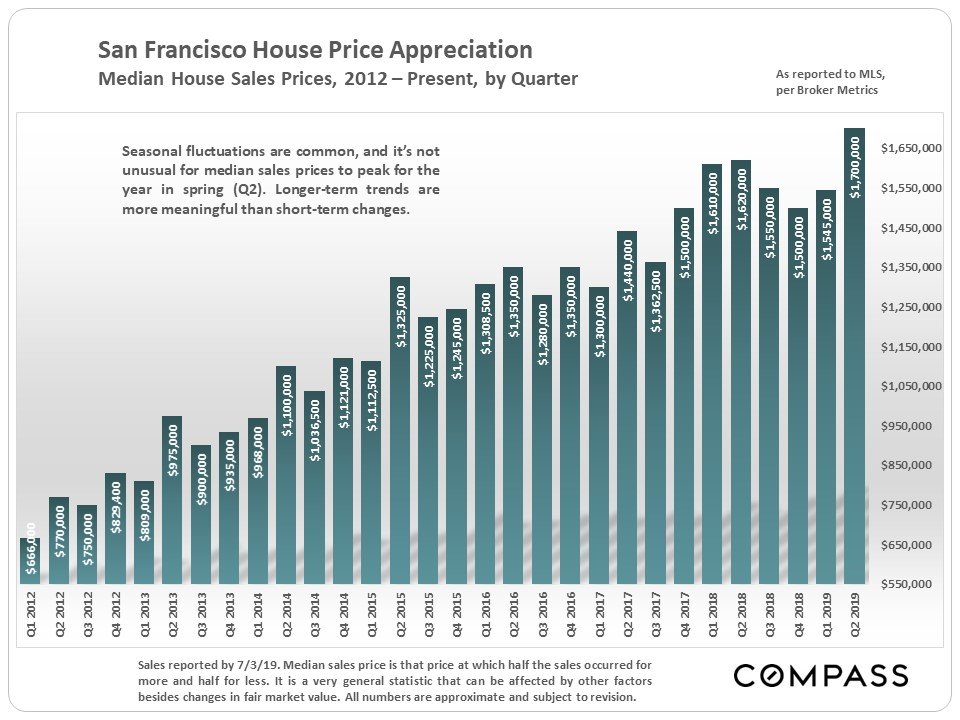
With San Francisco real estate prices recently hitting new highs (see chart below), people often ask me where I see the real estate market going.  That’s particularly true now, with so much volatility in the stock market, not to mention underlying geo-political concerns like Brexit, the trade war with China, and oil supplies coming out of the Straits of Hormuz.

Alas, I have no crystal ball.  But our global ranking is a good part of the reason why I feel bullish about San Francisco in the long-term.  We are a global city, blessed by a thriving and diversified economy; an educated work-force; stunning scenery; and a decent climate (except right now!).  While we aren’t immune from economic downturns, there’s every reason to expect that people will continue to want to live and work here – despite the expense and challenges – for the foreseeable future.

As always, your questions, comments and referrals are much appreciated!

The 2016 San Francisco Real Estate Wrap-Up: Houses on Simmer; Condos Cool

The data is now in for 2016 and we have sliced and diced it to perfection.  The results?  Single family homes are on simmer, with median prices up a “mere” 6% over last year.  City-wide,  houses hit $1,350,000 in the last quarter of 2017, an all-time high.  Meanwhile condominiums are going sideways.  At $1,078,000, they were down about $25,000 from a year previous. In fact, their median price is effectively the same as it was at the start of 2015.

Continue reading “The 2016 San Francisco Real Estate Wrap-Up: Houses on Simmer; Condos Cool”

San Francisco’s Hottest Neighborhoods: Not Where You Might Think

Noe Valley? Bernal Heights?  Those are so yesterday.  Maybe you’re thinking Bayview/Hunter’s Point as people search out more affordable housing at the city’s edges.

Well, you’re right about the edge but wrong about the direction.  Based on our recent analyses, San Francisco’s “hottest” neighborhoods are also some of its foggiest: go west to the Sunset and its more southerly counterpart, Parkside.

Now admittedly, together these comprise a lot of smaller neighborhoods.  Many would object to, say, the Inner Sunset with its vibrant retail scene centered on 9th Ave and Irving, being lumped in with the quieter environs of the Outer Sunset.  Fair enough:  our analysis is really of MLS Districts, rather than individual neighborhoods, but it’s no less telling for that. Continue reading “San Francisco’s Hottest Neighborhoods: Not Where You Might Think”

Bay Area Housing Affordability: A Grab-Bag of Charts

In my July Newsletter, I did a wrap-up of the year so far and concluded that the market, for the moment at least, seems to be going sideways. Post Labor-Day inventory has already shown a big jump in anticipation of the short buy/sell season between now and the end of November. It’s too soon to say whether the new inventory will excite buyers to loosen their wallets or simply cause them to be pickier.

So with the market on “pause,” I thought I’d put together a grab bag of charts that cover SF housing affordability, both from the standpoint of owning and renting. Many view housing affordability as a central concern for San Francisco’s long-term future. Changes in the rental Continue reading “Bay Area Housing Affordability: A Grab-Bag of Charts”