Winners and Losers: A Heat Map of San Francisco’s Neighborhoods

I’m back!  (More on this later….)

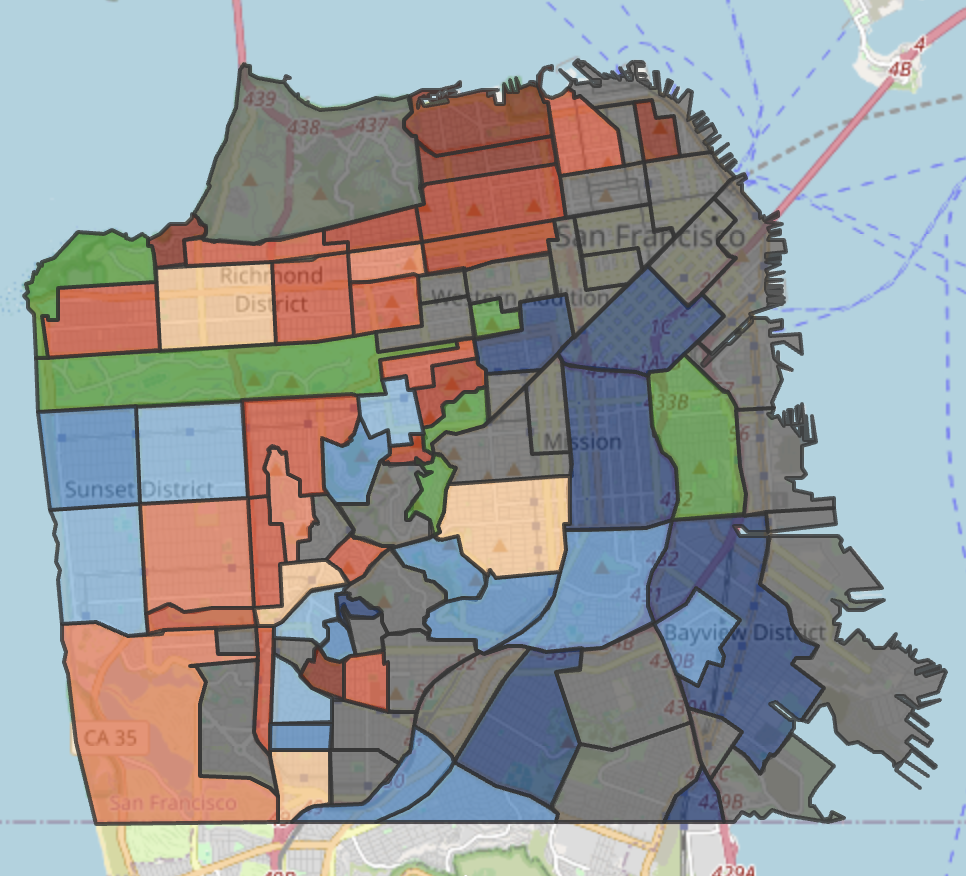
I’m so excited to present this heat map of San Francisco neighborhoods, which I believe may be the first of its kind.  I’ve been thinking about this idea for a while:  thank you Claude, and a shout-out to my son, too, who helped me bring the coding part of this project to fruition.

Be sure to click on the “fullscreen” button on the map below to expand it. We will get into the qualifications shortly, Continue reading “Winners and Losers: A Heat Map of San Francisco’s Neighborhoods”

The San Francisco Residential Real Estate Update: An Ai Generated Glimmer of Hope?


AI generated imaged
An AI Generated Glimmer of Hope

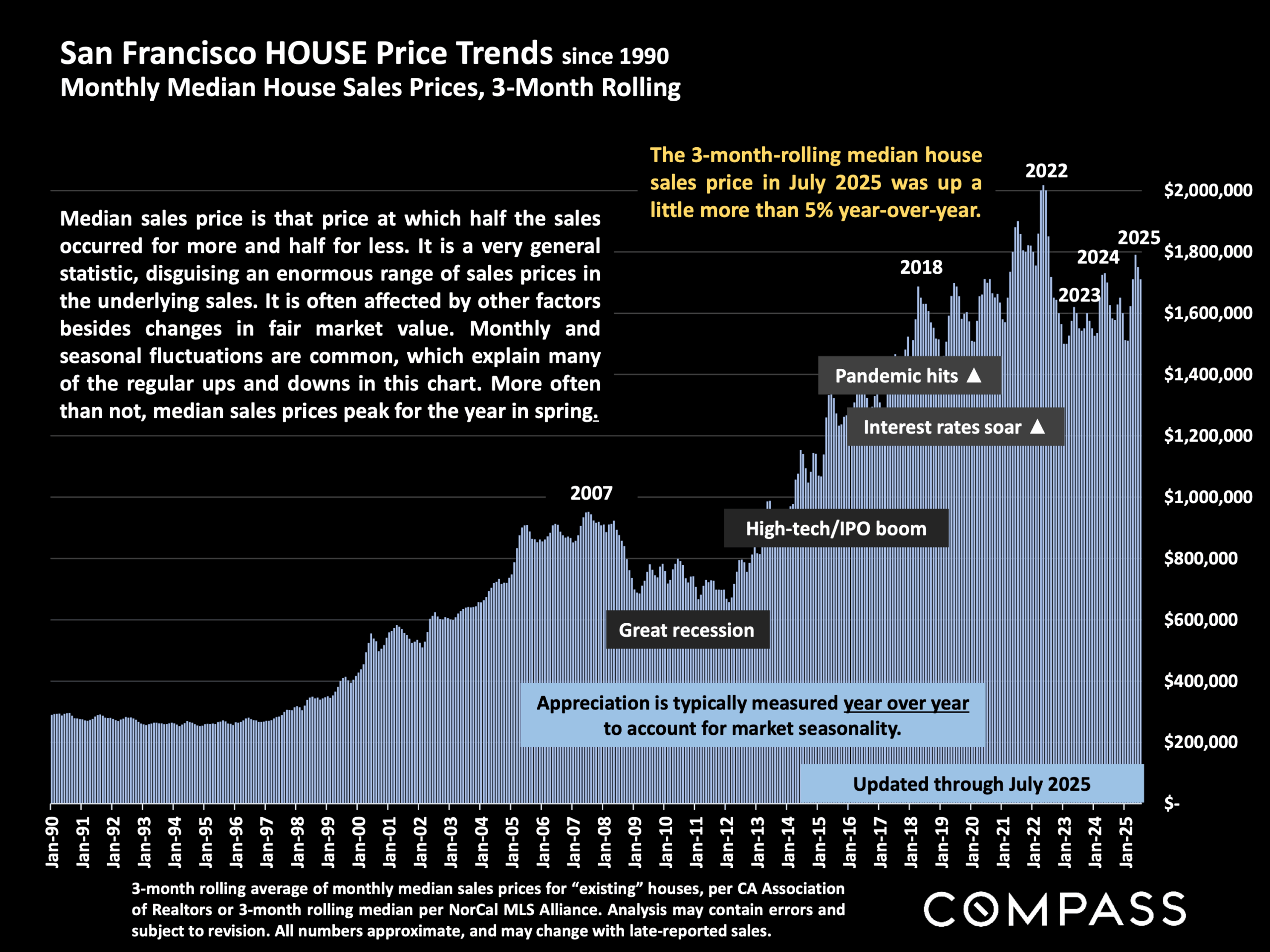
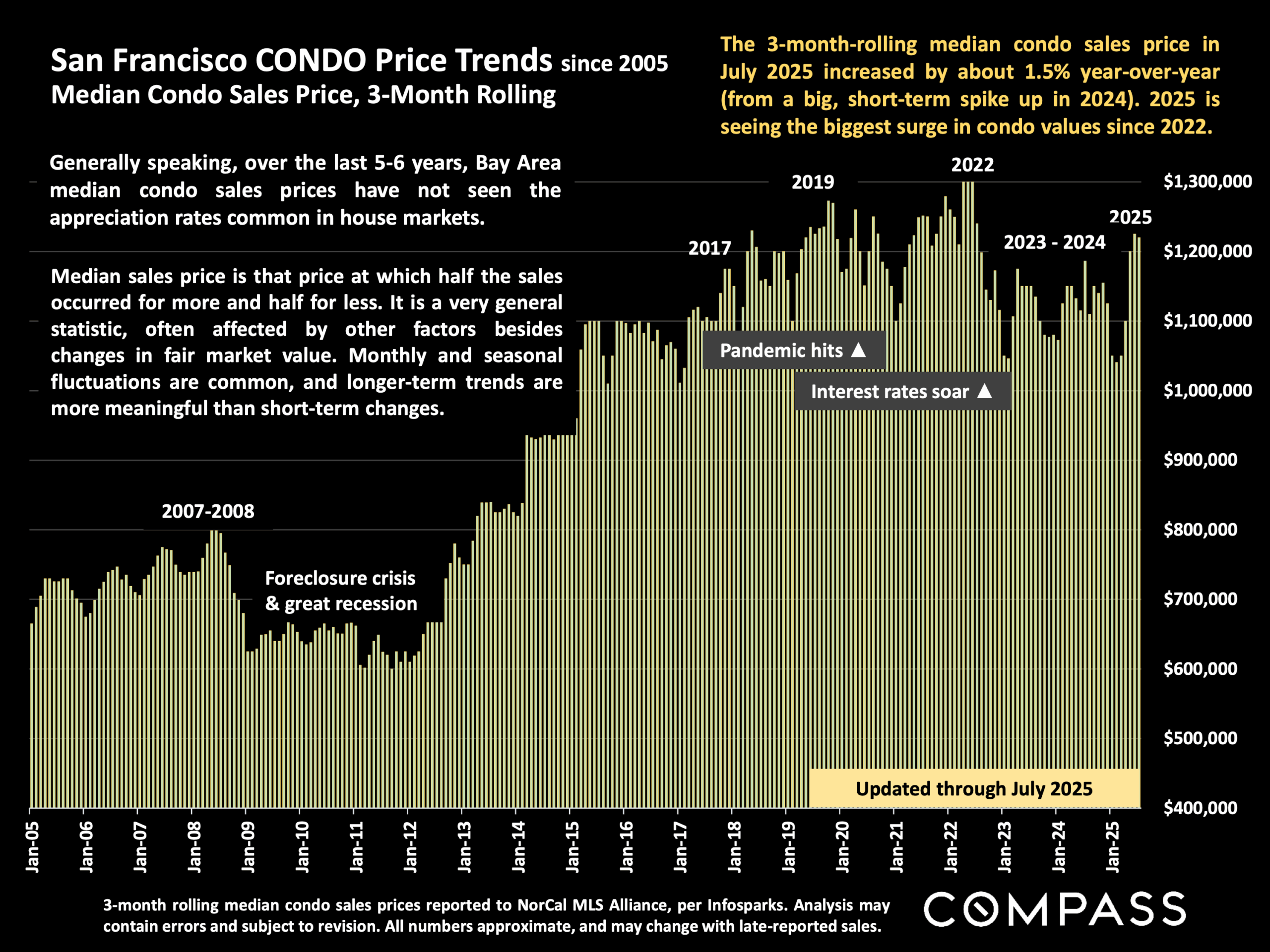
Back in May 2018, when pundits everywhere delighted in sounding the death-knell for SF’s residential market due to a host of local challenges including lack of affordability and rampant homelessness, I suggested they might be a bit premature. In the summer of 2020, months into the Covid pandemic, Zillow published data suggesting that SF was again on the skids.  Again, I suggested that “this too shall pass.”  Condo and home prices proceeded to hit record highs until 2022 when higher interest rates brought the real estate party to a stop, leaving a hangover from which much of the Bay Area — indeed the country as a whole — has yet to recover.

Interest rates are still high, albeit with indications that they may be coming down “any day now.”  Add in such challenges as the economic uncertainty engendered by Trump’s tariff wars; an enduring change in the remote/on-site work model; and a persistent narrative of SF’s “doom loop” decline, and it’s fair to ask whether SF can once again pull off a Houdini-like escape. Continue reading “The San Francisco Residential Real Estate Update: An Ai Generated Glimmer of Hope?”

San Francisco Mid-Year Real Estate Report:
It’s Not Just the Weather That’s Gloomy

(Photo courtesy of Henri Borius @ IG_Henri_Borius_Photos)

Noe Valley, where I live, is supposed to be sunny.  But I can tell you that – until this July 4 week-end’s delightful respite  — I was getting tired of waking every morning to another milky white sky and a temperature reading that seemed stuck on 50º. It’s not just the weather that’s been gloomy. One article after another seems to take delight in enumerating San Francisco’s travails.  The Economist, among other magazines, opines that downtown San Francisco may risk falling into a “doom loop.”  The San Francisco Chronicle followed up with a list of major retail vacancies after Westfield gave up its flagship property on Market Street.  And the Financial Times, in an article titled “Defaults Raise Alarm Over Stability of San Francisco’s Commercial Property,” quoted the chief executive of the company that owned two major hotels given back to their lenders as saying “San Francisco’s path to recovery remains clouded and elongated by major challenges” including “concerns over street conditions”.

Indeed.  Downtown San Francisco resembles what I remember it looking like in 2001 after the dot.com bust.   More broadly throughout the city, you’re lucky if you can find a restaurant whose kitchen stays open after 9:00 pm.  And homelessness continues to plague the city, just as it does the state more generally.  The Benioff Homelessness and Housing Initiative’s recently released report found that over 171,000 people experienced homelessness daily in California.  That’s more than 30% of the nation’s homeless population.

Shall we talk about interest rates (see below)? With 30 year fixed mortgages going for around 6.5%, we are back at rates last seen right before the 2007/2008 Financial Crisis brought the party to a close.  For anyone who’s counting, that was fifteen years ago.  And the speed of the increase has been breathtaking:  rates were at 3.25% just 18 months ago (second chart). Fed policy may not have succeeded in taming inflation yet, but it’s certainly had its effect on the housing market.  No one should be surprised.

Continue reading “San Francisco Mid-Year Real Estate Report:
It’s Not Just the Weather That’s Gloomy”

The 2022 San Francisco Residential Real Estate Wrap-Up: The Bad, The Worse, and the Ugly

Happy New Year everyone!  It’s been nearly three years since the Covid pandemic hit the world. Back in March 2020, as San Francisco’s streets became eerily quiet, it might not have been wrong to predict an apocalyptic end to the modern world and city life in particular à la Station 11, ( I highly recommend the Amazon Prime series).  As people fled the city and its density, predictions for SF’s real estate collapse propagated faster than new Covid variants.

Fast forward to mid-2022: both house and condo prices hit records of $2 and $1.3 million respectively.  For the full year, the median house price ended down just 1% from the all-time high set in 2021; condos ended down just 2% from the previous year.  Covid, Schmovid, you might say.

Continue reading “The 2022 San Francisco Residential Real Estate Wrap-Up: The Bad, The Worse, and the Ugly”

Property Tax Reminder and Two Charts on the State of the Market

A quick reminder that Property Taxes are technically deemed delinquent if received after 5 pm on December 10. Since that falls on a Saturday this year, you’re probably ok if they receive payment by Monday at 5 pm or your payment is postmarked before that time. At least that’s the case in Sonoma County and Santa Clara County. Of course, San Francisco’s website chose not to be that clear. You always have the option of paying online.

Continue reading “Property Tax Reminder and Two Charts on the State of the Market”

San Francisco’s Red-Hot Residential Market: The Times, Are They A-Changin’?

If I simply posted our most recent charts on the San Francisco residential real estate market, you could be excused for shrugging and concluding “another crazy month in San Francisco.” The median price of a single-family home hit $2.050 million in April, just $10,000 down from its all-time high of the previous month.  The median price of a condominium in April was $1.365 million, an all-time high.  Single family homes were on the market for an average of 11 days; 15 for condos. Both were near record lows. To put things in perspective, take a look at the table below to see how things compared to April 2020, just after the pandemic hit, and last month.

Continue reading “San Francisco’s Red-Hot Residential Market: The Times, Are They A-Changin’?”

The 2021 San Francisco Residential Wrap-Up: Pandemic? What Pandemic?

A very happy New Year to my loyal readers and apologies for the long delay between my last newsletter and now.  Between a death in the family and a very busy end-of-year, my newsletter got put on the backburner, if not taken off the stove altogether.

But enough of that.  Let’s dig into the data! 

The Executive Summary

For those that want the big picture fast, the table below summarizes key metrics for the market as a whole.

While the price data may be interesting, what really strikes me is the absolute explosion in Dollar Sales Volume ($13.55 billion), which must have been driven by a combination of (a) a massive increase in condo sales (4590 units), (b) a very healthy increase in house sales (3075 units), and (c) huge increases in the number of properties that sold for $3 million or more (766 units at over $3 million; 203 at over $5 million).

Houses:  Still As American as Apple Pie

Despite the breathless predictions (once again) of the bottom dropping out of the San Francisco real estate market as locals fled to cheaper, cleaner, more suburban areas during or because of the pandemic, 2021 saw the city hit its highest median price for single family homes ever ($1.8 million), a 12% increase over 2020.  In fact, the last year houses had a decline in prices was in 2011 at the end of the Great Financial Crisis (second chart).

As we’ll see with condominiums, these broad metrics disguise some interesting trends. Perhaps unsurprisingly, given how well those at the top of the socio-economic levels have done notwithstanding the pandemic, luxury home sales (which we define as homes selling for $5 million or more) skyrocketed last year to more than double their pre-pandemic levels, though these remain a small fraction of overall sales (first chart below).  At the same time, median sales prices for this lofty price tier actually fell by 7.5% (second chart below).  “Months Supply of Inventory” (MSI), which is a rough ratio of available inventory to demand, returned to pre-pandemic levels for both luxury and non-luxury homes, (third chart below).  However, the luxury segment had seen an enormous increase in MSI during 2020.  Since a higher MSI suggests a “cooler” market, its return to an MSI of around 8 in 2021 might signal better price performance for luxury homes in the future.

Houses in Your Neighborhood

Here’s a table with key metrics for houses selling in various neighborhoods.  If your neighborhood isn’t included, or if you’d like a more specifically mapped area, please contact me.

Condominiums – Still a Mixed Story

I’ve previously posted about how condo prices suffered during the pandemic as their generally younger techie owners or tenants moved to areas with more outdoor space and took advantage of “remote work” opportunities.  Still, as the first chart below shows, condo prices overall suffered only a 1% decline in 2020.  And in 2021, prices were up 3% over the previous year, an increase in line with the 2% to 5% annual rates of increase we’ve generally seen since 2017.  

However, as also noted in my previous newsletter,  both the 2020 decline and the 2021 increase disguise a more complex picture of what’s going on with the condo market.  In a nutshell, newer mid- and high-rise neighborhoods like Mission Bay and China Beach where most new condo buildings are concentrated, were hit harder in the pandemic than the city as a whole and those same neighborhoods are recovering more slowly (first chart below).  And “luxury” condos (defined as selling for $2 million or more) appear to be seeing substantially better price improvement (2.7%) than those selling for under $2 million (1.3%) (second chart below).  Finally, though luxury condos, like luxury homes, represent a small fraction of total condo sales (about 13%), their sales in 2021 nearly doubled their pre-pandemic levels.  Non-luxury condo sales also increased significantly over pre-pandemic levels, as the third chart below shows.

Condominiums in Your Neighborhood

Here’s a table with key metrics for condos selling in various neighborhoods.  If your neighborhood isn’t included, or if you’d like a more specifically mapped area, please contact me.

Pandemic? What Pandemic?

The pretty robust market we’ve seen in San Francisco is, if anything, even more robust throughout other areas of California.  In the California Association of Realtors’ most recent survey, the amount of real estate activity throughout the state is exceptional.  I’ve highlighted some of the major takeaways in the slide below.  Perhaps the most astonishing of all: 60% of all offers were non-contingent (no appraisal, financing or inspection contingencies!).

Predictions.  Not.

Patrick Carlisle, Compass’s oft-quoted Chief Market Analyst, is our “secret sauce” and one of the most sophisticated residential real estate analysts working today.  Most of the charts I use for my newsletters are the results of his research.  (For those wanting even more charts, you can see Patrick’s SF Report, without commentary, here.) Patrick is generally loath to make predictions, and, while I’ll call it the way I see it and risk being wrong, right now I don’t see a clear long-term direction for the market.  In the short term, I think this Spring is going to be a very strong buying season as anticipated interest rate increases push people into the market out of FOMO.  Similarly, a strong rebound in rental rates might cause renters to re-evaluate.  And, of course, if the silver lining to the Omicron variant is to turn Covid into an endemic that we can live with, a return to something like normal life should reinvigorate the city’s appeal.

Longer term, a suddenly shaky stock market and uncertainty about the mid-term elections, the next Covid variant, Ukraine, and inflation may cause a shift that no one sees coming.  As the 8-ball says, “Ask Again Later.”

As always, your questions, comments and referrals are much appreciated!  Best wishes to all for a healthy, safe, and rewarding year to you and yours from me and mine.

Misha