


Market Snapshot: Pacific & Presidio Heights, Cow Hollow & The Marina

Here’s a look at the average sales price, dollar per square foot and median house sales price beginning in 1995. Last year we saw records highs in all three categories, take a look:


Source : http://www.parascopesf.com/market-snapshot-pacific-presidio-heights-cow-hollow-the-marina
What SF Homebuyers Bought in 2013: A Survey
Penthouses, Mansions, Short Sales & Fixer-Uppers
What Did San Francisco Homebuyers Buy in 2013?
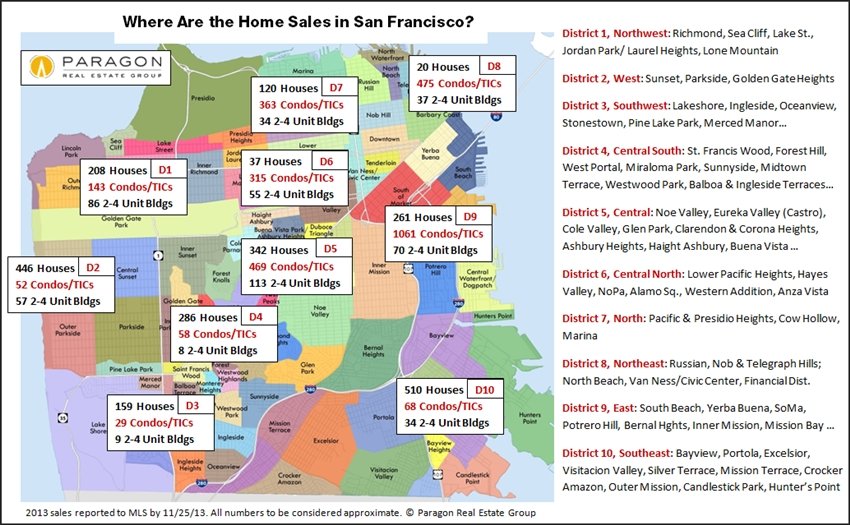
Views, prices, architecture, neighborhoods, property types and sizes, parking, probate sales and appreciation rates: We data-mined all of San Francisco’s 2013 sales reported to MLS through the end of November and charted the results below.

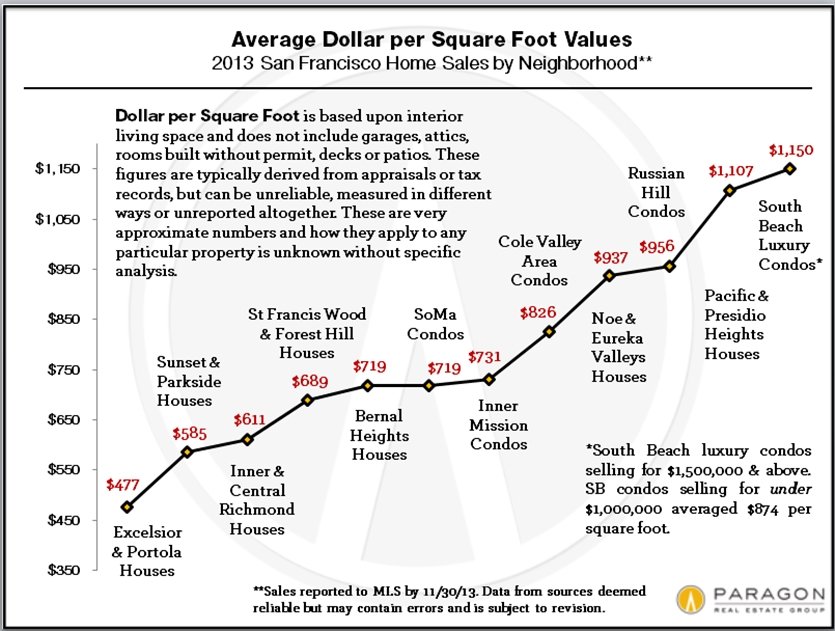
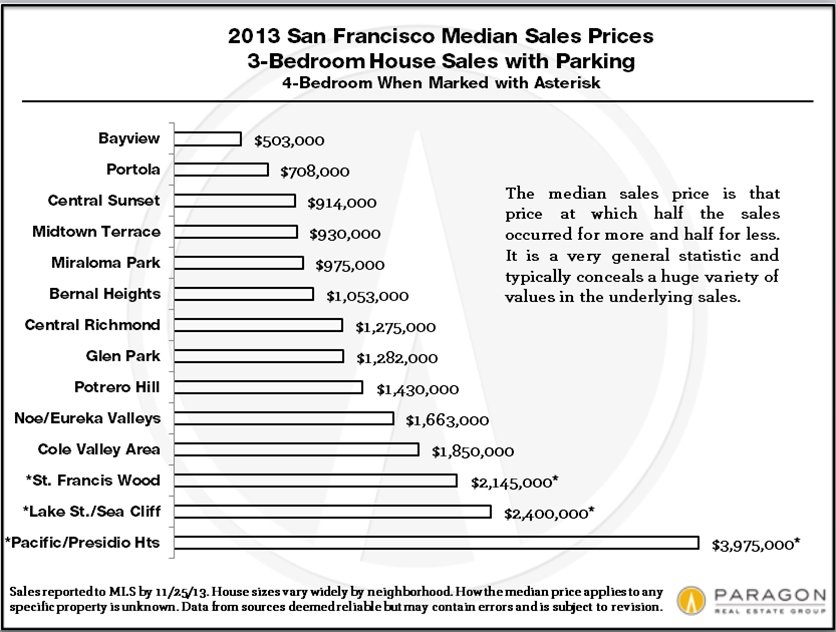
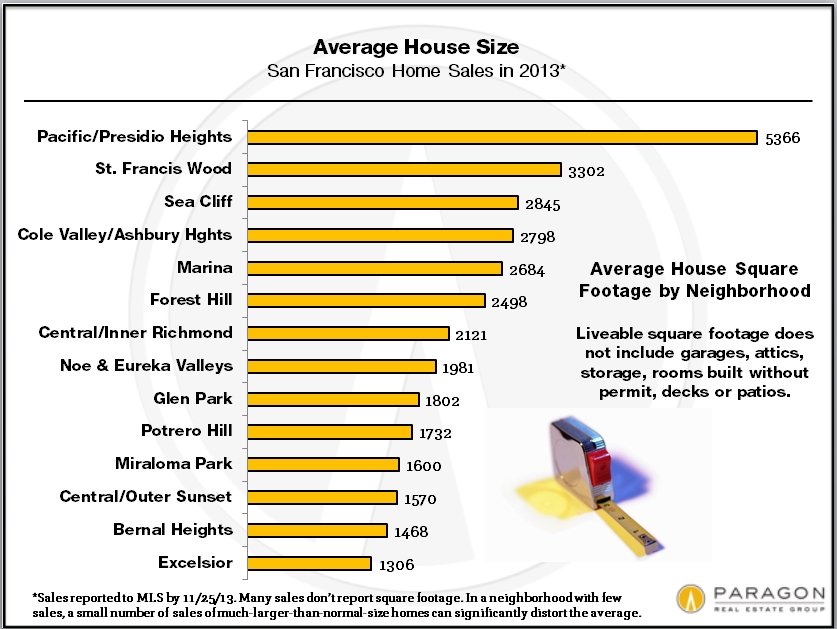
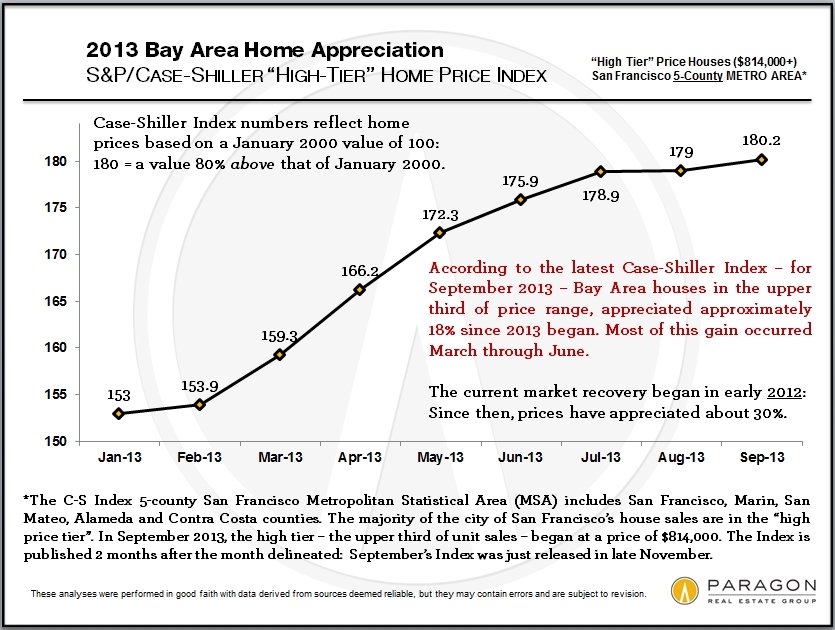
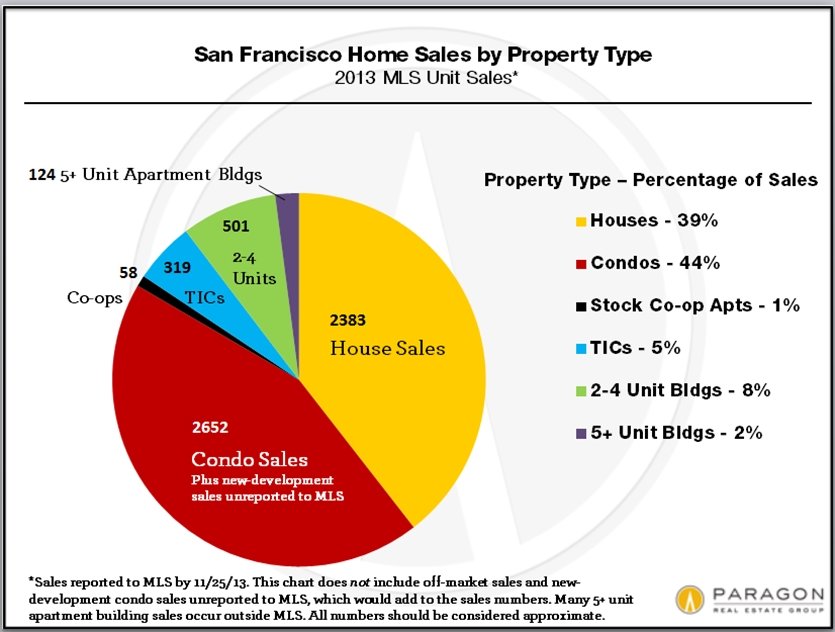
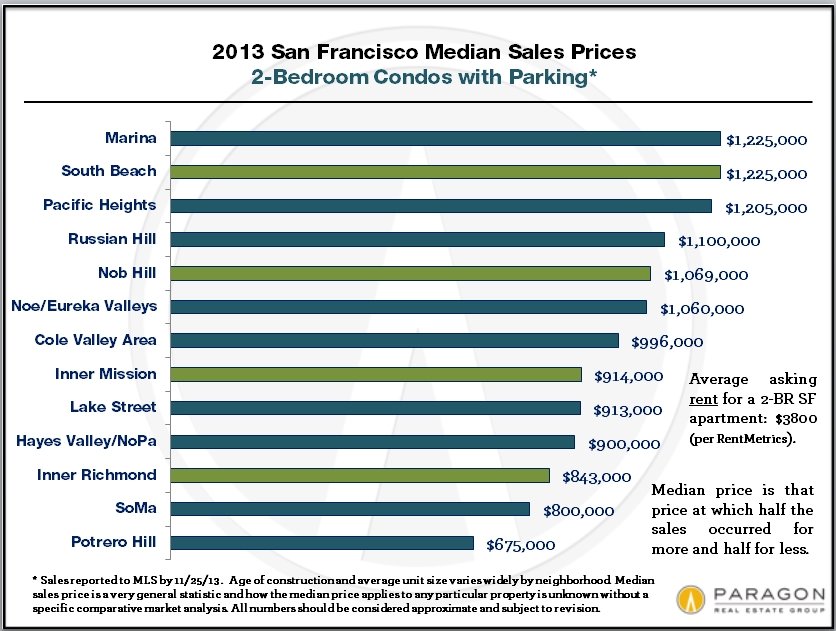
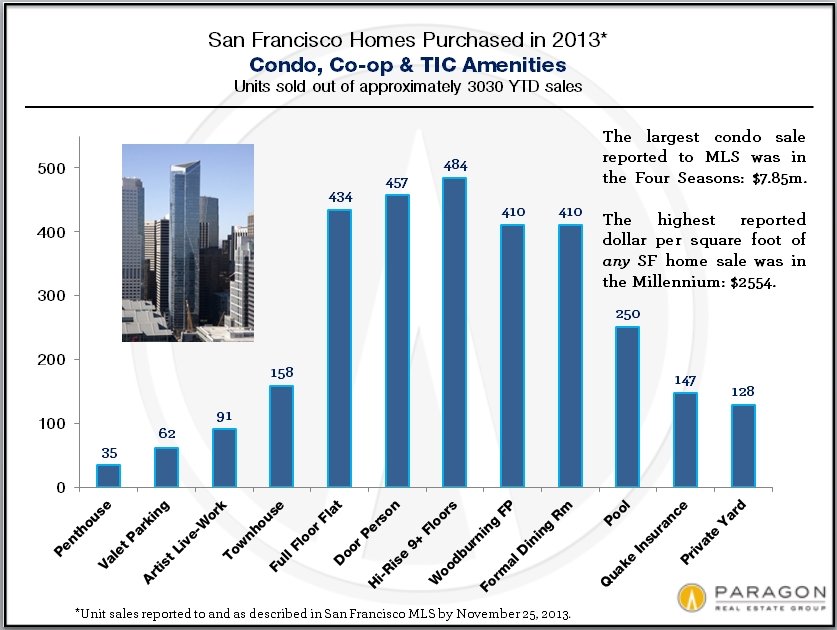
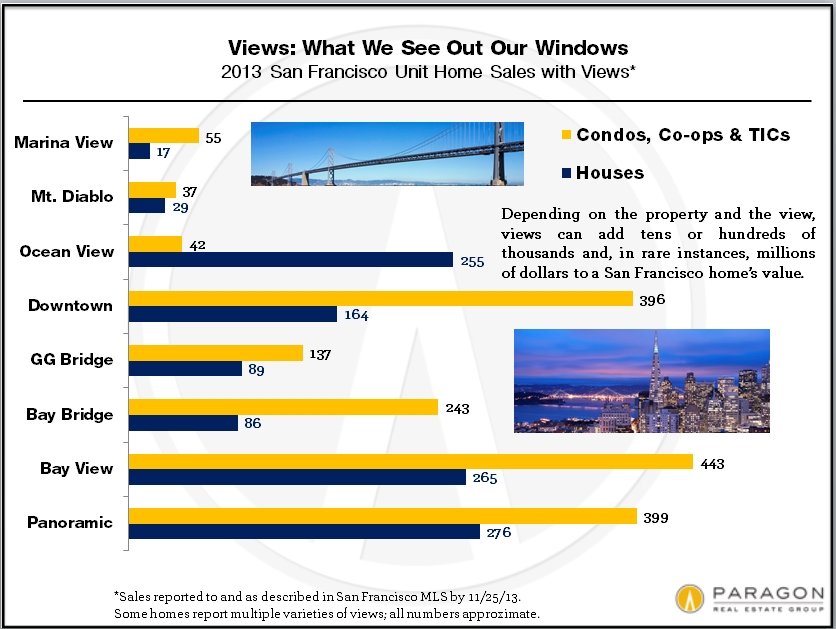
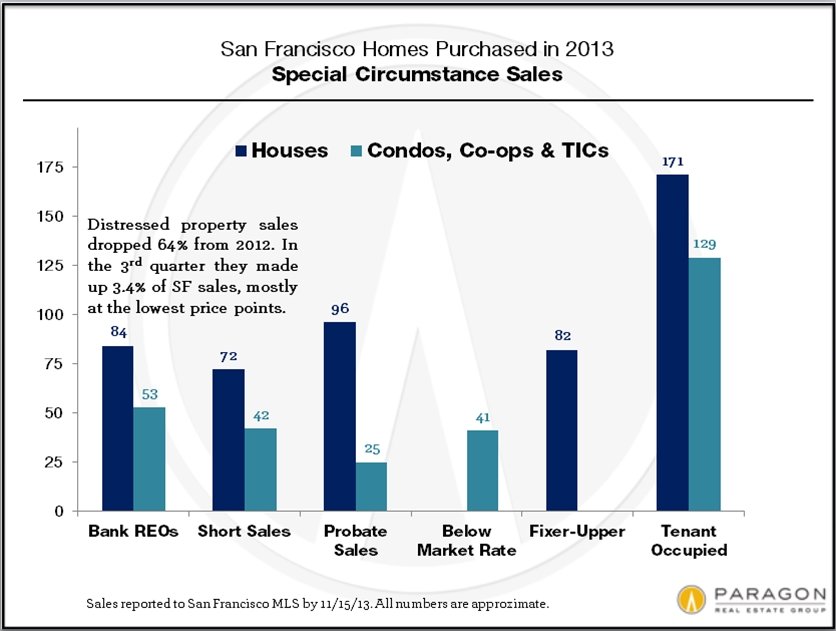
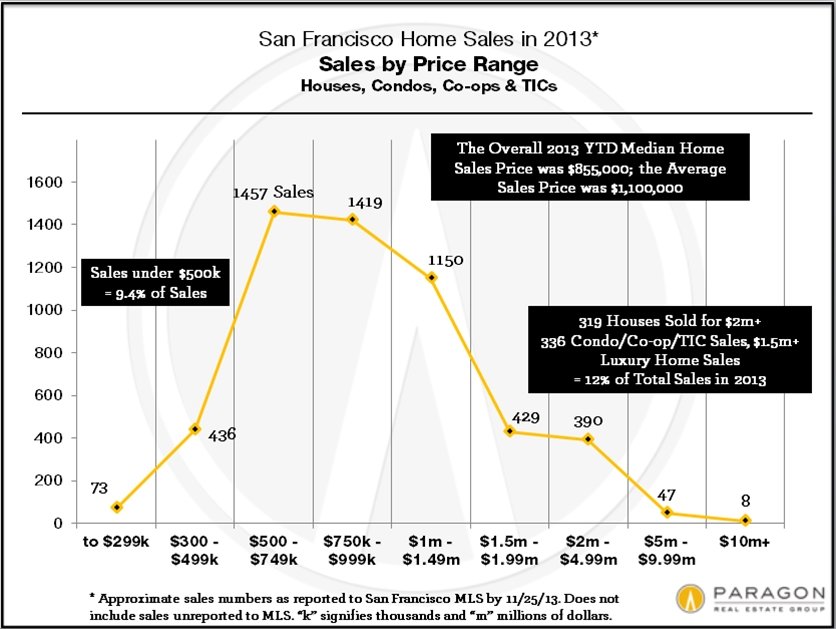

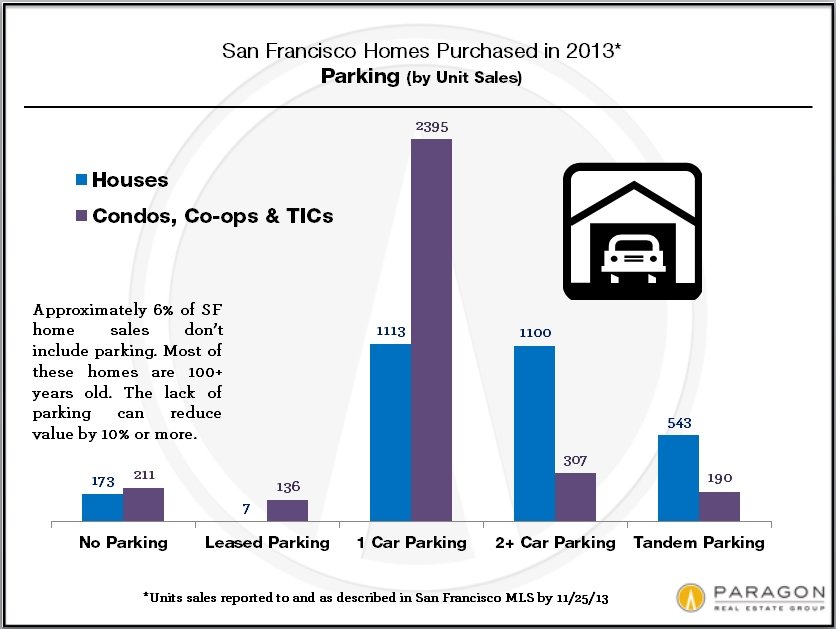
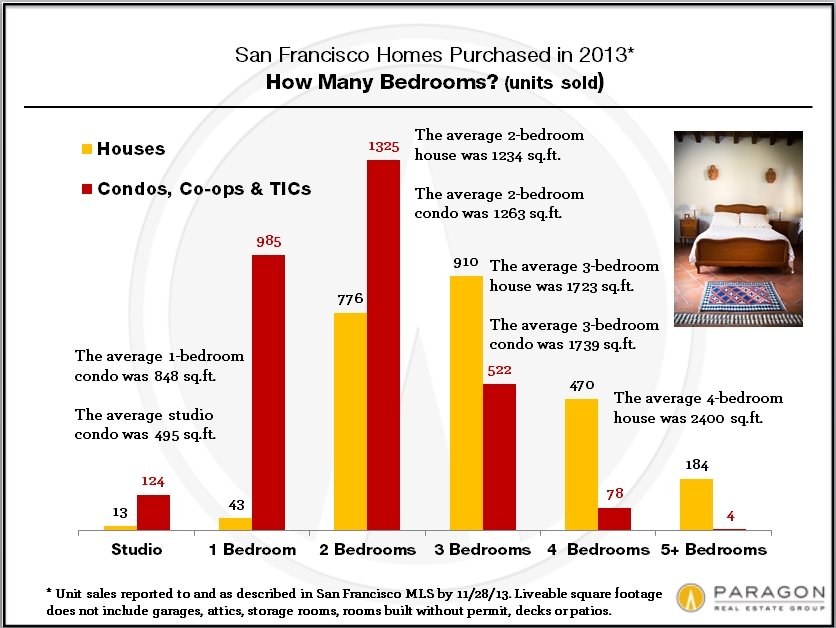
Sales as described in and reported to San Francisco MLS by 11/25/13. All data herein is from sources deemed (at least somewhat) reliable — i.e. the information input by listing agents regarding their own listings — but may contain errors and is subject to revision. These charts do not include sales unreported to MLS, such as the sale of many so-called “pocket listings” and many of the new-development condo sales that occur.
A changing market? Have SF home prices reached a plateau?
The market usually does slow down at least a little in mid-summer – a question has come up: is this possible slowdown caused by listing agents continually pushing the envelope on pricing for new listings or pricing to the last, highest, frenzied sale, a move that buyers are now finally starting to resist? It may be, that without buyer demand really slackening for homes deemed “reasonably” priced, we have come to a point, at least for the time being, that buyers are no longer willing to pay new tippet-top peak prices.

Have prices reached a plateau? Monthly median price stats are subject to fluctuation without great meaningfulness (which is why I prefer quarterly or longer periods), but after the big jump early in the year, the median sales price has been within a 4-5% spread (not a huge spread for monthly home prices) for 5 months, Including a drop from April-May. The idea of a plateau contradicts the recent Case-Shiller Index report, but the Index is about 3-5 months behind current realities, San Francisco is only a tiny part of the Index and the city has outperformed C-S since the turnaround began – having appreciated so much faster than other places, we may be due a flattening of appreciation before other areas. And that also may be true for different SF neighborhoods – since they have rebounded at different speeds, some may be plateauing and others are still appreciating.
At this point, this is speculation and it won’t be clear for a while – these things only become clear in retrospect – because spring median prices sometimes spike and summer prices drop a little as some of the higher end market checks out for the holidays. And median sales prices are not perfect correlations of changes in market value, being affected by a number of other factors, including seasonality. Anecdotally, we are hearing stories of the market not responding to homes priced at the top (even if “justified” by another recent sale), and also stories in which the winning bidder offered a huge amount, sometimes hundreds of thousands of dollars, more than what the second highest buyer was willing to pay – i.e. the winning buyer ultimately paid much more than necessary to win the deal.
The number of expired/withdrawn listings is also increasing, though not to some crazy level yet.
So it’s worth considering, that we “may” have reached a plateau or bumped into a ceiling, transitioning into a somewhat different market. If we are in a transition, the market will be schizophrenic for a while: some buyers acting one way and another growing group of buyers acting another.
Summarizing the charts above and below:
- The San Francisco Median Home Sales Price has leveled off, dropping somewhat from an April-May peak. (Chart above)
- Buyer demand is still extremely high as measured by Percentage of Listings Accepting Offers.
- Inventory is still extremely low as measured by Months Supply of Inventory and Units for Sale.
- The number of Expired & Withdrawn listings climbed in July and was about 19% higher than July of 2012 (though less than half the number of July 2011). The main reason why listings expire or are withdrawn from the market is that buyers have concluded they are priced too high.
- The July snapshot makes it clear that the market is still very strong by any reasonable measure, even if it might be on the cusp of a transition to a somewhat less fevered state.
Demand, as measured by percentage of listings accepting offers, is still very high:

Months Supply of Inventory is still very low:

The number of homes for sale is still very low:

The number of expired and withdrawn listings has been increasing:

Looking at July’s sales, mostly ratified in June, the market is still very hot:

San Francisco Luxury Home Sales Soar in 2013
San Francisco Luxury Home Sales Soar
2nd Quarter 2013 Update
In San Francisco, no market segment has recovered as dramatically as that for high-end homes. There are a number of reasons for this: the general economic recovery, the huge local increase in high-tech wealth, an increase in the number of highly affluent foreign buyers, and the fact that, as a group, the affluent have profited most from the large rebound in stock market values in recent years. And then the general appreciation the city has experienced of 20% – 30% since 2011 has simply moved a lot of sales into a higher sales price category. Whatever the reason, there is an enormous amount of money sloshing around the Bay Area that is now being invested in homes — many of which are being purchased all-cash. At Paragon, we have seen an increase of over 100%, year over year, in the number of luxury home sales we have brokered so far in 2013.
In the first chart below, we are defining luxury homes as condos, co-ops and TICs selling for $1,500,000 and above (the vast majority of these are condo sales), and houses selling for $2,000,000 and above. These are relatively arbitrary thresholds since a $2,000,000 house in Presidio Heights can be a small-ish fixer-upper, while a home of that price in another neighborhood might be a pristine mansion. In the charts breaking down sales by neighborhood, we’ve added the price segment for houses of $1,500,000 to $2,000,000 since what is happening there is quite interesting as well.
Luxury Home Sales by Quarter

High-End Home Sales by District & Neighborhood
The first chart is for condo, co-op and TIC sales, and the three following are for house sales.


The neighborhoods listed are representative of one of the 10 Realtor Districts for San Francisco, so consider them as indications of the general area where the sales occurred. This analysis tracks sales reported to San Francisco MLS. A fair number of high-end homes sell “off-market” and are not reported, however we don’t believe these alter the general picture painted in the charts above.
Interest Rates: Is the Sky Falling on the Housing Market?
The pundits are making dramatic, even doom-laden pronouncements about what is going to happen with interest rates (and the housing market), though they’ve been wrong so many times over the past few years, these “expert” predictions might be taken with salt-shaker’s worth of salt, perhaps with lemon and a nice shot of tequila.
Obviously, interest rates are an important component of the real estate market. But this chart gives a little context to what has occurred recently: the blue column is the average 30-year interest rate for the first 5 months of 2013, when everyone was dancing with glee at how low the rates were; the black line at the end represents the interest rate on Friday, June 6th, though it is true that it briefly hit 2 tenths of a percentage point higher earlier in the week (so if you like, add the tiniest smidgeon more to the black line).
I don’t know where interest rates will go, though they will probably rise over time—and perhaps there will be an upcoming interest-rate shock. But terror seems a bit premature.

The Economist on Bubbles — Neat Interactive Chart Feature
The Economist has a good article (about the US real estate market not being in a bubble) and created a terrific interactive graph that allows you, by metro area (you have to click on San Francisco to add it to the graph), to compare home price changes in real terms over time, versus average incomes, and versus rents, from 1987 to 2013. San Francisco is at the top of the chart in percentage increase and increases in prices in real terms, but still rates right at the long-term average in home prices versus income and versus rents. The Economist was one of the very first to identify the housing bubble inflating – running strongly against the then current opinion of other pundits – so I think their opinion on whether another bubble is about to burst in the U.S. is worth hearing. (FYI: The do believe there are serious housing bubbles in certain other countries.)
”The verdict: in most markets houses are near or above their long-run values, but none looks bubbly. Price rises in Phoenix, Tampa and Miami have restored values only to their long-run averages. In Las Vegas they are still below that long-run average. Many things could trip up the housing recovery, from stalling job growth to higher mortgage rates; at the moment, a bursting bubble is not one of them.”
You can play around with the interactive chart, and you should read the article below the chart widget:
Here are 3 of their charts with San Francisco added:
Home Price Appreciation in Real Terms (Adjusting for Inflation):

Home Prices Against Average Income:

Home Prices versus Rents:

How Hot is My Valley
Real Data SF: May 2013 Newsletter
How Hot is My Valley
Noe Valley that is. The place I’ve called home since May 1991 when I bought a vacant two unit building with a monumentally dreary exterior, deeply embedded cat-pee stains in the hardwood floors, and rooms with great volume and light.
This month’s newsletter is dedicated to the Noe Valley market, and the nearby areas of Eureka Valley (aka the Castro) and Cole Valley, which have a similar feel and housing stock. Continue reading “How Hot is My Valley”