Summer’s Unflagging Demand Fuels Higher SF Home Prices

San Francisco Real Estate Market: September 2012 Update

Typically, the real estate market slows down during the summer months – a period often called the summer doldrums — but that certainly did not occur this year in San Francisco: unflagging buyer demand continued through August. The market recovery that began in some SF neighborhoods late last year has now spread throughout the city. Bay Area, state and national home markets are also showing clear, if still early signs of turnaround.
******************************

San Francisco House Values Rising

It’s rare that the 3 main statistical measurements of home value line up so perfectly, but comparing this summer’s house sales to last summer’s shows 12% increases across the board. Which doesn’t mean uniform appreciation for SF homes: changes in value vary by property and neighborhood. This analysis and the one following are for non-distressed sales in the city’s 8 northern and central districts, which generally run north of the Sloat Blvd/ Highway 280 line: The 2 southern districts were hit much harder by foreclosures and though they too are recovering quickly, mixing in their data distorts the results. During this 3-month period, house sales volume in the 8 districts was up 5% in units and 18% in dollar volume — and would be up much higher if more inventory had been available. Average days on market fell from 52 days to 39 days year over year.

San Francisco Condo Values Rising

The condo statistics don’t line up quite as neatly, but nearly so: they’re up from 9.4% to almost 12.5%, with the average being about 11%, which is very close to the 12% increase seen in houses. (Remember: these statistics are generalities regarding the sale of many hundreds of relatively unique homes.) Closed sales follow the time when new listings hit the market and offers are negotiated by 4 to 10 weeks, so these charts reflect the market from April through July. Non-distressed condo sales volume in the 8 northern/central city districts during this 3-month period is up 41% in units and 54% in dollar volume from last summer, and average days on market dropped from 69 days to 47 days.

Most Listings Selling At or Over Asking Price

San Francisco is currently seeing remarkable percentages of homes selling above and sometimes far above the asking price: 64% of house sales and 45% of condo sales in August closed at above list price, and solid percentages sold at 10% higher or more. This is perhaps as good a snapshot as any of the ferocious heat of buyer demand right now. (Sales that were within a quarter percent of 100% were considered “At List Price.”)

Percentage of Listings Accepting Offers

No summer slowdown is showing up in this important metric of supply and demand.

Price Reductions, Sales Price Percentages, Time on Market

Over two thirds of SF listings are selling quickly at an average of almost 4% over the asking price. Those listings that go through one or more price reductions take much longer to sell (over 2 1?2 months longer on average) to close at a significant discount to original price. For every listing selling after a price reduction, another listing expires or is withdrawn without selling, typically due to being perceived as overpriced. The keys to getting the best price for your home: price it right to begin with; prepare it to show at its absolute best; comprehensively market it to buyers and agents; negotiate offers aggressively. And it doesn’t hurt to take advantage of a low inventory/high demand market.

Distressed House Sales Declining

Distressed house sales – bank-owned and short sales – are clustered in the city’s two southern districts, running from Bayview to Oceanview. However, these listings are rapidly declining as the market turns around and values increase: distressed house sales have dropped from 20% of sales in 2011 to 12% in August 2012. This becomes a virtuous circle of market recovery: higher values mean fewer distressed listings; fewer distressed listings lessen their (significant) negative effect on neighborhood home values.

Distressed Condo Sales Sinking

The distressed condo segment of the SF market is dwindling rapidly both as a percentage of total sales (from 20% in 2011 to 14% YTD, and 10% in August 2012), and even more dramatically, as a percentage of listings for sale (down to only 4% as of August 31). The greatest number of distressed condo sales has been in the greater SoMa/ South Beach area, where so many of the new, big developments were built over the past 10-15 years, but the impact of these sales is shrinking very quickly everywhere in the city.

Unit Sales Up

Condo and 2-4 unit building unit sales are up over 20% from last year this time – this time comparing a six-month period of each year. House sales — and indeed sales of all types — would certainly be up by a much greater percentage if there were simply more listings for buyers to purchase.

Inventory Way Down

There’s no ambiguity in this chart: An inadequate number of new listings and extremely high demand have kept the inventory of listings available to choose from on any given day lower than at any time in recent memory. It’s not unusual for September to bring a large burst of new listings to fuel the autumn sales season: in this chart, you can see the big jump in September 2010 and the smaller surge in September 2011. Buyers and their agents are certainly praying for a surge in inventory to alleviate the intense competition for available homes.

Days on Market Continue to Decline

The trend is clear: listings are selling much more quickly. Though 37 days as an average is very, very low — nationally, there’s excitement that the figure just fell to 69 days — many new listings in the city are accepting offers within 7-10 days of coming on market.

Values by Neighborhood, Property Type & Bedroom Count

We just completed our detailed semi-annual survey of SF home values. This is one of seven charts: the complete report can be found by clicking on the Market Dynamics Charts link in the footer below and then selecting Neighborhood Values from the sections listed on the upper left of the webpage.

What’s A Better Value in San Francisco, A Condo or a Home? (Part 2)

In my last post, I included a chart that showed both single family homes and condos stuck in relatively narrow price ranges over the last 18 months or so.  At the end of 2010 the median price of a single family home ($744,000) was about $80,000 more than that for a condo/TIC.

But that doesn’t tell us anything about “value.”  Now, let me count the ways we could argue about what “value” means, but I think we’d agree that how each property type has weathered the market battering over the last few years has to be relevant.   Take a look at this table: Continue reading “What’s A Better Value in San Francisco, A Condo or a Home? (Part 2)”

2010 San Francisco Residential Wrap-Up: Why condo owners may not be celebrating.

Given the amount of bad news coming out of the housing market these days, you’d think that San Francisco condo and TIC owners would be celebrating the fact that values increased 4.5% in 2010.

If no one feels like popping corks, it may be because prices have been stuck in a narrow range since they hit their post-bubble bottom two years ago.  Take a look (click to enlarge):

Continue reading “2010 San Francisco Residential Wrap-Up: Why condo owners may not be celebrating.”

Noe Valley: The Condo/TIC market

At long last, here’s the promised data on Noe Valley condos and TIC’s.

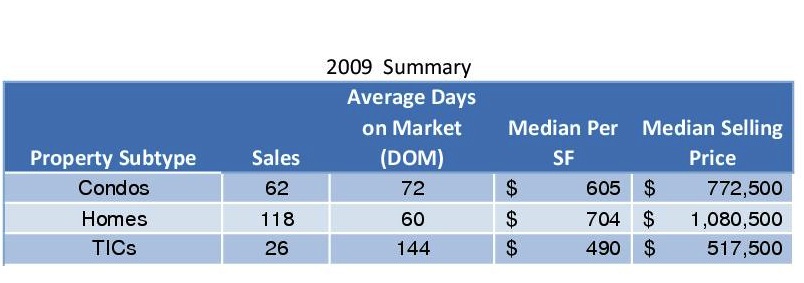
First, a look back (in anger?) at the make-up of Noe Valley sales in 2009.

Note that there were more than twice as many condos sold as TICs, and more homes sold than condos and TICs put together. (What’s a TIC?  — Check out my series of posts on Tenancy-In-Common Interests, starting here.)

Also, that absurdly long DOM for TICs was distorted by 3 TICs at 201 Hoffman that took 410 days to sell.  Still, without those sales, DOM for TICs (tired of the acronyms yet?) was still 99 days.  And I’d be somewhat skeptical of the whopping difference in price between TICs and condos as well:  TICs sales often don’t have a price per square foot listed, so there are very few data points — and there are very few sales to begin with.

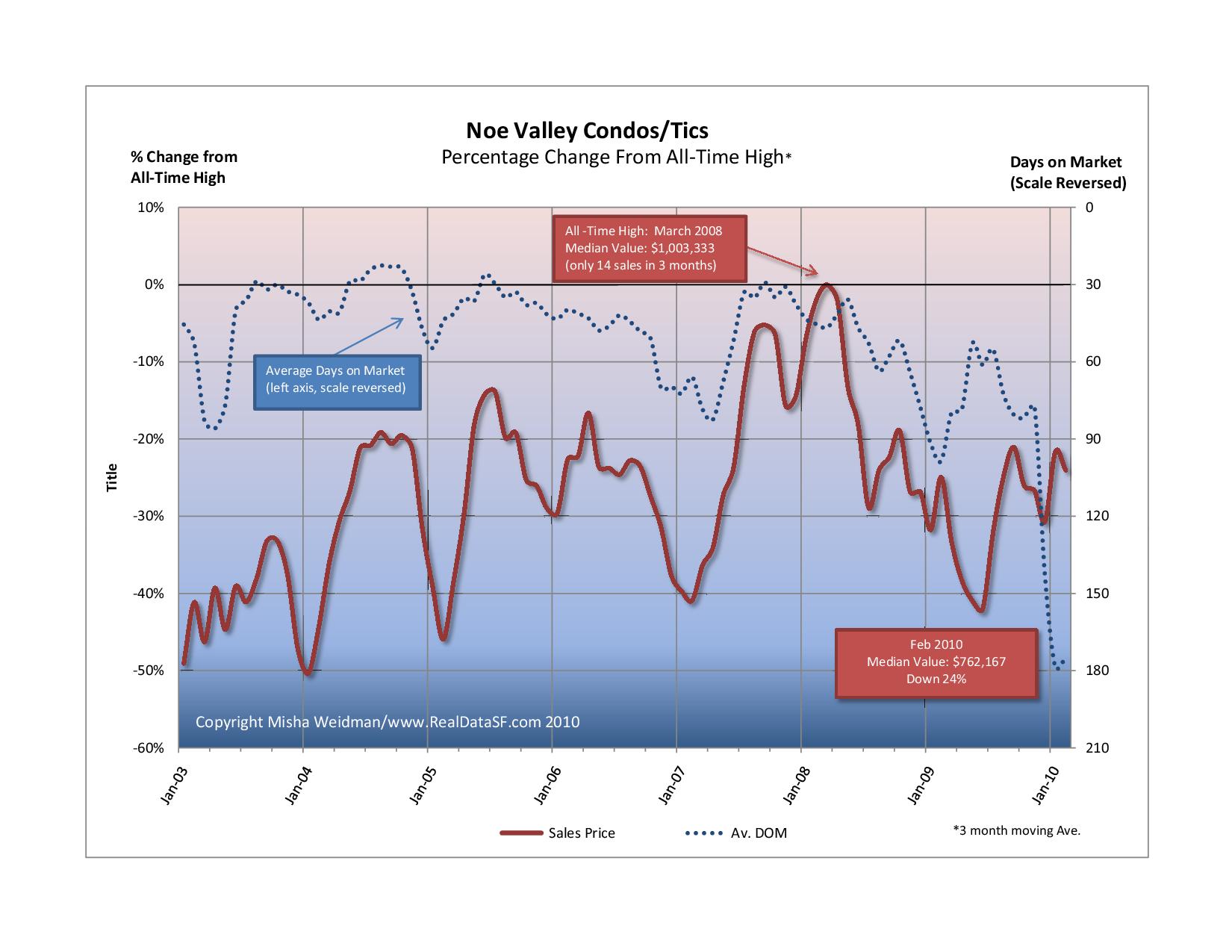
Here’s how condos and TICs have been doing as a combined group, versus their all-time highs.

That precipitous plunge (actually a huge increase since the scale is reversed) in DOM at the end of 2009 was also due to the lingering effects of 201 Hoffman.

For a shorter term view, prices through February 2010 are up 11% from January 2009 and are up a whopping 31% from the trough of June 2009.  Since I use trailing 3 month averages, I think this is a belated reflection of the deep credit freeze of Spring 2009 when we thought the world might come to an end.

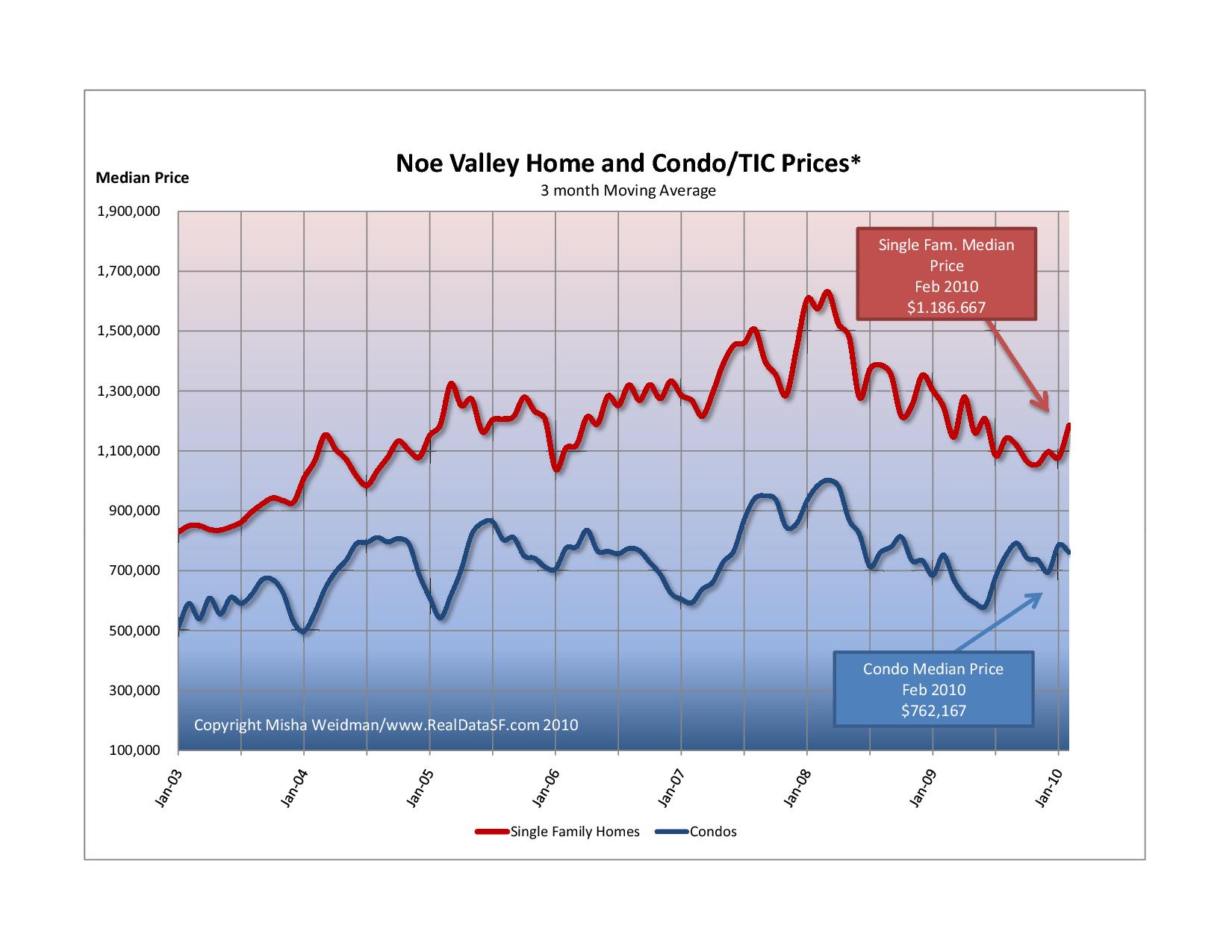
And here’s how condos and TICs stacked up against homes.

For what it’s worth, it feels like spring has really sprung.  Nice-looking condos/tics are swarming with people and are moving fast — no kidding.  Whether it will last is anybody’s guess.

Looking Back at 2009: Condos/TICs

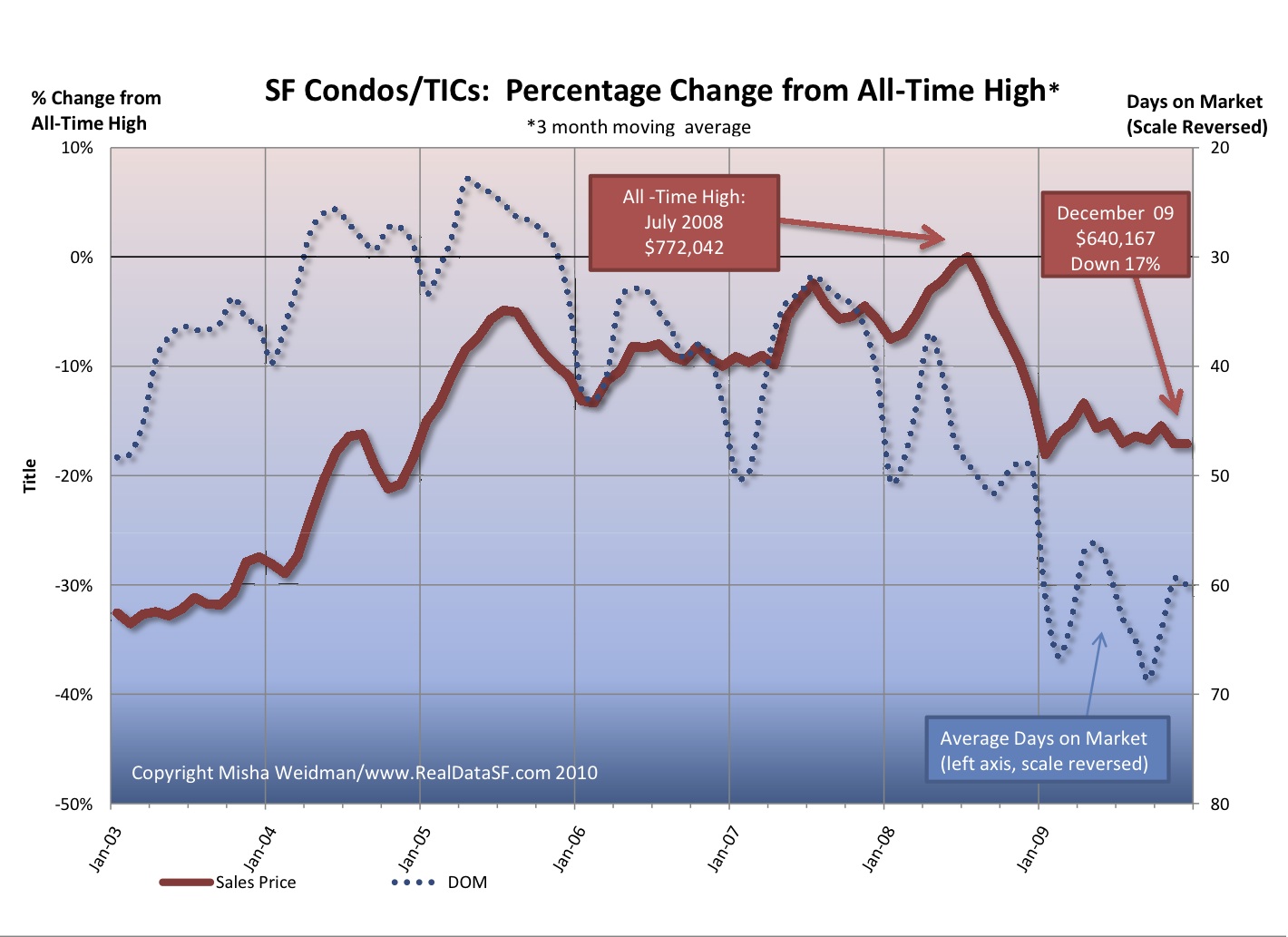
Pretty much everything I said about how single family homes fared in 2009 also applies to the condo/TIC market.   (TIC’s, aka Tenancy In Commons are similar to condos.  For more information on TICs, see my three-part series starting here.)

Condo/TICs hit their all-time highs about a year later than homes did — in July 2008.  But they’ve fallen from their highs almost exactly as much as homes have.  Condos/TICs were down 17%, just one percent better than single family homes.

For those who prefer their data on a per square foot basis, the picture is pretty much the same.  The all-time high was $711 — reached in November 2008 and the price per square foot stood at $592 at year’s end, also a drop of 17%.

While condos/TICs ended the year at the same point, the pattern has not been the same. Condos/TICs have been stuck near the bottom of their 2009 range after bouncing up in the first quarter. Homes, on the other hand, appear to have bounced up and stayed up.

What’s in store for 2010 remains anybody’s guess, but on the streets it certainly feels like spring is in the air.  There are more listings coming onto the market and more people looking at them.  Will that translate into sales and higher prices?  That’ll depend on macro-economic trends I’ve discussed elsewhere, but one thing’s pretty clear:  interest rates are heading higher, as evidenced by the Fed’s recent increase in the discount rate. If the economy continues to strengthen, that trend will continue.  And, for many people, that will result in less buying power and reduced affordability.

TICs, San Francisco’s Involuntary Reflex — Part 3: The Condo Premium Per Square Foot? Or not…

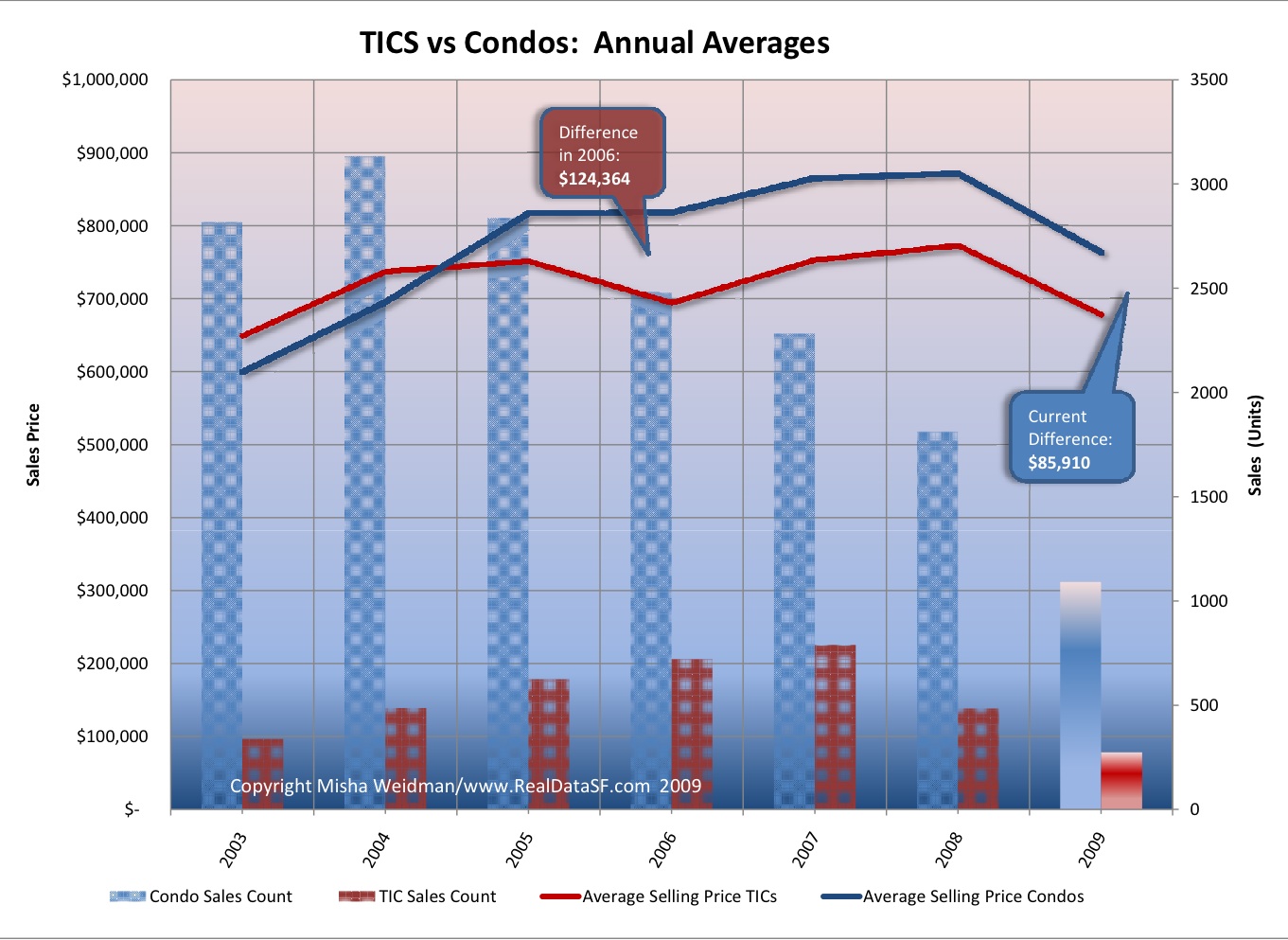
Last post, we determined that the current difference between the average (annual) price of a condo and that of a TIC is  $86,000, down from a high of $124,364 in 2006.  (That’s a 30%+ drop, by the way.)  Here’s the chart again (sorry for the funky transparency on the sales volume bars).

Condos vs. Tics Annual Average Sales Prices

That’s useful if you’re looking at an average-priced TIC and you’re curious about how much of a premium you’d have to pay for an average-priced condo.  But how about reducing that to a per square foot premium?

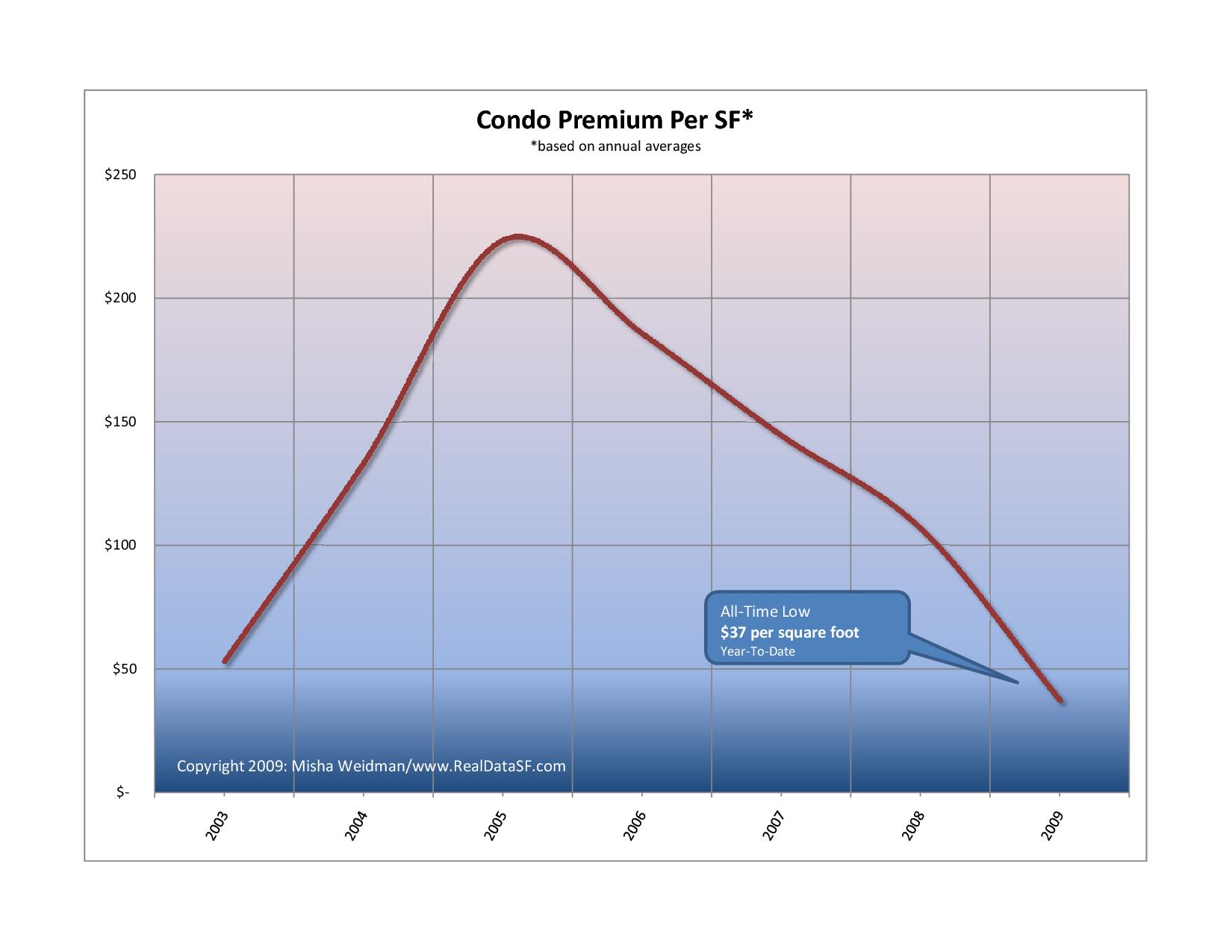
For those who just want the bottom line, here’s the answer, but it’s worth reading on for the caveats.

Simple Condo Premium Per SF

$37 a foot doesn’t sound like much of a condo premium to me, that’s for sure.  And as my astute readers will note, the drop in price on a per square foot (from around $225 per sf) is obviously much more than the drop in median sales prices shown in the previous chart.

What’s going on?  It’s really simple:  there’s a lot less information on sales price per square foot for TICs.

All my data comes from the MLS (Multiple Listing Service) that real estate brokers use to find and market properties.  When a sale’s completed, they are required to enter the sales price.  If there’s information on the square footage of the property — provided by the owner or more frequently from the property records — the database calculates a per square foot price.  Roughly 80% of condo sales have a recorded price per square foot in the MLS.  Only 45% of TIC sales have a recorded price per square foot. How bad is that? In September 09, there were just 27 TIC sales.  Only 9 of them had a recorded price per square foot.  For all of 2009 through September, there were 275 TIC sales.  Only 113 – 41% – show a per square foot price.

There are lots of people — mostly on other blogs 🙂  — who love to trash statistics and say they’re meaningless.  Medians don’t reflect home values, etc etc.  I disagree.  Provided you have enough data  and you understand what you’re measuring, statistics help make sense out of what is otherwise undifferentiated data.  But I am afraid that in the case of measuring the condo premium on a per square foot basis, we are in dangerous low on data.

One final reminder:  For this series of posts, my TIC data includes the handful of stock cooperative sales that occur in this market.

And thanks for sticking with me on this long series of posts….


TICs, San Francisco’s Involuntary Reflex: Part 2 — The Data

There are weeks when I look through the new listings on the MLS (Multiple Listing Service) and it seems like there are more TICs for sale than condominiums.  Turns out, this just isn’t true.  Here’s a chart showing relative sales volumes since 2003 (click to enlarge).

Units Sold By Month
Look at that!  Excluding those wonderfully regular dips every Xmas, condo sales are generally at around 200 units per month.  TICs rarely break 40.

Here’s how TIC and condo median prices stack up against each other on a monthly basis.

Condo vs TICs Median Prices By Month
Dueling spaghetti you say?  That was my reaction, too.  The huge variability in prices from month to month on the TIC line is a direct result of the paucity of sales.  And this chart certainly doesn’t help get at the key question, which is this:

Given that TICs are riskier and less flexible than condos, what’s the premium that you pay for buying a condo vs.  a TIC?

In fact many TIC buyers do so with the hope of being able to realize this “premium” by converting their TICs into condos down the road.  Fat chance unless you’re buying a TIC in a two unit building which — for now at least — remain exempt from San Francisco’s byzantine annual lottery system.

Luckily, I have a bona fide statistician mathematical genius phd for a wife, and she always lends a hand on methodology when I need it.  She suggested that where one set of data (condos) is so much larger than another, using averages provides a more reliable “apples to apples” comparison than medians.   Also, with so few monthly TIC sales, I decided to look at annual rather than monthly trends.

Here’s attempt number two.

Condos vs. Tics Annual Average Sales Prices

Much more useful!  (By the way, the fact that TICs were more expensive than condos in 2003 and 2004 can be explained by a few massively (in excess of $8 million) expensive TIC sales in those years.  This is a great example of how using medians or averages can really affect the results.)

So, can we drill down further and come up with a condo premium per square foot? Stay tuned….