Focus on Noe Valley

It’s been a few months since I took a look at my own stompin’ ground, Noe Valley, and how prices have been doing compared to the city as a whole.  We dispensed with the notion that Noe Valley was somehow “immune” some time ago.  Sadly — at least for home-owners — and happily for buyers, Noe hasn’t bounced back over the last few months, even though city-wide median prices have improved.

Noe Valley Vs. SF All Districts Percent change August 09

Bear in mind that “Noe Valley” means a very small area.  What’s more, there were only 7 sales in August, down from 14 in May and June, and 22 in July.   Sure, there’s been a bit of an improvement over the previous month, but there’s still an 11% difference between how far prices have fallen for the city as a whole (19%) versus Noe Valley (30%).

Arrian Binnings over at Inside SF Real Estate also did a recent update on Noe Valley, looking at median prices in a different way.  (I’ve forgiven him for appropriating my term, “getting granular” to discuss what I now have to refer to as “focusing” on a particular area. Sniff.)  Here’s one of his charts.

insidesfrealestate_01-sep-01-18-55

Not much comfort there either.

People will continue to point out that this doesn’t mean that your beloved home has fallen in value as far as the data suggests  — and that’s probably true, unless you bought a median-priced home at the top of the market.  Still, Noe Valley seems unseasonably cold right now, and it’s not just the fog whipping down off Diamond Heights.

Alphabet Soup: What Shape Will the Recovery Take?

CB005684

On the anniversary of Lehman Brothers’ demise and the near-collapse of global markets, it seems appropriate to take a step back from our little corner of heaven for a wider view.

Given where we were a year ago, the world seems to have heaved a huge, if cautious, sigh of relief.  During the chill days of February, the stock market had lost more than half it’s value.  Now it’s down “only” 35%.

San Francisco home prices have also improved.  In January home prices were down 37% from their all-time highs. By July prices had recovered 11%. In August, however, prices fell back 2%.  That’s a pretty stiff drop. (Click the chart for a big version.)

S&P 500 vs SF Home Sales

A sign of things to come?  Who knows.  Everyone seems to have a different letter of the alphabet – or at least the nether end of it — to describe the shape the recovery will take.

Ben Bernanke’s is a long, flat “U”: he thinks we’re on the way, but it’s going to be slow going.

Liz Ann Sonders, Schwab’s chief forecaster and one credited with having seen the train-wreck coming, holds out the possibility of a “V”, in which the economy bounces back like a “coiled spring,” propelled by low inventories and a recovering housing market.  You can dismiss that view as self-serving, but I prefer to give her the benefit of the doubt, especially since she’s been right before. Though I’m not sure she’s right this time.

The one that worries me the most, though, is the “W” , otherwise known as the dead-cat bounce or “double-dip” to cat-lovers.  Nouriel Roubini, no slouch at forecasting himself, has recently said that there’s a “small probability but rising” that we’ll not only run out of steam but fall back again, victim to enormous deficits and the premature closing of global cash spigots, among a host of other ailments.  To that rosy picture, he adds the specter of stagflation, as unsustainable budget deficits lead ultimately to higher interest rates while the economy remains weak.  Perhaps that’s the “X” scenario.

As for San Francisco, the housing market certainly seems sunnier these days, with volume at decent levels.  But I wouldn’t be surprised to see it turning colder, along with the weather.

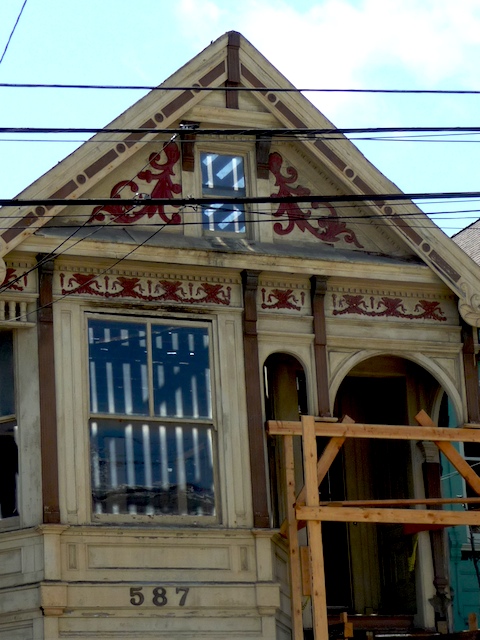
Beautiful Wreck: 587 Jersey, Noe Valley

Walking my dog, yesterday afternoon and I was brought up short by this beautiful wreck around the corner from where we live.

P1010087

Light and shadow from the rafters seemed to make the windows glow like cardboard cut-outs.

P1010088

Here’s the scoop:  Listed in mid-May for $799,000, sold on June 25 for $700,000.  1360 square feet of original detail.  $515 bucks a foot.

I quote from the listing:  “All inside doors, most hardware, some light fixtures appear original and possibly pre-1900.”

Not any more, it seems….

Update on What $2.1 Million Buys in Noe Valley — (now it’s under $2 million)

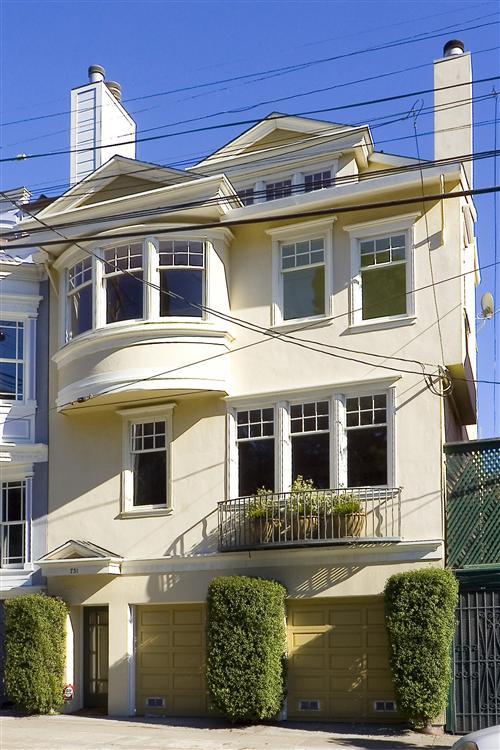
Back in February I posted about two $2.1 million homes offered for sale in my ‘hood. 731 Douglass had 3,000 square feet of good, livable space and the sorts of finishes and flourishes  you’d expect.  But it had no back yard and was located on the fairly busy corner of 24th Street and Douglass, with a Muni stop and Noe Valley Courts’ sand-pit within spitting distance of the front windows.

731-douglass-now
731 Douglass

Meanwhile 110 Hoffman, offered at just $2,000 less than Douglass, had a little less space and a vertical, less user-friendly lay-out.  But, location it had in spades, on one of Noe’s best and quietest streets.  Plus it had a spacious back yard with a lovely mature tree.

110 Hoffman
110 Hoffman

My good friend and blogging critic, Mike Dashe  — the American part of the Franco-American wine-making duo who own Dashe Cellars — recently took me to task for not doing what any good story-teller does: tell ’em how it ends.  So here’s the final chapter folks.

731 Douglass came in first, selling for a respectable $1.85 million, or 85% of the listing price after just 48 days.  Good show!  Though it’s worth noting that this was a cool $100,000 LESS than it sold for back in March 2005, when it was on the market for just 18 days.  (There’s more proof of the correlation between price and DOM — days on market — see my previous post.)

110 Hoffman had a more torturous ride to the finish-line.  Originally listed at $2.395 million, it suffered two price drops and was ultimately withdrawn from the market 102 days later when it failed to sell at $2.148. Fast-forward five months to July and it’s back on the market at $1.995.  And, after falling in and out of contract, and back in —  it sells for….

$1,995,000.  Full list price and all within 10 days if the MLS Database can be believed.

That’s a cool $100k more than 731 Douglass.

What went on here?  I honestly don’t think this was a case of location trumping space.  Instead, it’s about timing.  731 Douglass went on the market in January and sold in March.  Prices generally fall somewhat during winter months.  But much more importantly, does anyone remember how the financial world was coming to an end right at that time? The stock market was dropping like a stone and no one knew where it would end.  (In fact, the S&P 500 hit bottom on March 9.)

I remember when I had the misfortune of putting the first property I ever owned on the market not long after 9/11/01.  I’m convinced that it sold for around $300k less than it would have at any other time.

Seen in this light, it sure seems like the owners (and the agent) of 110 Hoffman made the right decision to bide their time.  A few months later, the sun breaks out literally and metaphorically and things are moving again. Here’s a case where the tortoise beat the hare.

And speaking of odd-looking creatures, let’s get back to Dashe Cellars and their beautiful wines (you gotta try their single vineyard Zins.)  Mike, would you care to explain what’s with the monkey and the, ahem, “whale?”

Picture 5

San Francisco’s Luxury Home Market

chateau-chenonceau

Every time there’s a housing slump, there’s discussion about whether the top end or the bottom end is fairing better or worse.  Here’s a June 2009 article from The Examiner, declaring that luxury home prices in SF are picking up.  And here’s a report published by First Republic Bank, which puts out a so-called “prestige home index,” for various cities in California, stating that luxury home prices in San Francisco continue to fall.  Here’s the accompanying chart from First Republic.

prestige-sf

And around the beginning of the year, the folks at Paragon Real Estate published an interesting report, How_Much_Have_San_Francisco_Home_Values_Declined_Feb_09,  that broke down price declines based on price range.

But what really constitutes “the luxury market” in a town where you can’t buy a shack for less than half a mill and where the average price for a home was over $1 million in July?

To begin to answer these questions, I first looked at the distribution of sales prices over the last few years. I wanted to create a “snapshot” of the overall market, while including enough data to make the results meaningful.  Here’s a chart that shows how sales were distributed in each price category.

Luxury Market price ranges

Clearly, and not surprisingly, the vast majority of properties sold in the $501,000 to $1.5 million range.  In fact, out of 5,532 home sales over a two-and-a-half year period, only 489, or 8.8% sold for over $2 million.  Over $5 million?  Just 64 sales.

Again, not surprising.  $5 million is a lot of mullah in anybody’s language, though this is a pretty toney town and looking at the mansions up at Pac Heights and Seacliffe (I added the “e”, thank you very much), I expected that there would be more sales in the stratospheric range.

But there aren’t, so whadyagoingtodo?  First, you’re going to be very careful about jumping to any conclusions, because there just isn’t a lot of data.  What’s more, properties at these price levels really do tend to be “unique” – that’s part of their value — and they don’t turn over frequently. This increases the difficulty of reaching meaningful conclusions about price fluctuations in this high-flying, thinly traded market.

Now that we’re done with the disclaimers, let’s see what I came up with.  I picked a minimum sales price of $5 million as fitting the definition of “luxury” rather than just very expensive.

First, I looked at sales volume, another of those metrics frequently discussed in the context of price fluctuations.  The assumption is that when there are a lot of sales prices tend to go up; fewer sales, prices go down.

Luxury Market - Sales v Price

Clearly, sales volume is down for 2009 on an annualized basis, but prices have nevertheless increased from 2008.  Not much of a correlation there.

Next I looked at the average number of days on the market (“DOM”) for these properties to sell.  In a previous post, I’ve argued that this metric really does seem to have a strong inverse correlation with price:  if it’s taking longer for houses to sell, prices tend to go down; if houses are selling quickly, prices tend to go up. The following chart shows DOM plotted on the right-hand axis with the time-scale reversed so that longer time periods are at the bottom and shorter periods are at the top.  I’ve also shown the number of units sold per year.

Luxury Market - Sales v DOM

Here things seem to line up pretty well.  In 2009 so far, there’s been a shortening of DOM and prices have recovered somewhat from 2008.  But again, we’re working with very small numbers of sales, so I’d be careful drawing any definitive conclusions.  In fact, if you just focus on the median sales price, it seems to me that prices have remained pretty much within the same band of value since 2004, except for a spike in 2007 when the overall market was at its hottest.

So, gentle reader, next time you’re shopping for that $5 million house, don’t expect to pick it up at fire sale prices.

As for the rest of us, the truth is that pretty much anyone who can afford a house in San Francisco is already living in luxury.

Homes vs. Condominiums: How much extra do you pay?

Recently, I blogged about the fact that condominiums seemed to be holding up better than single family homes in terms of their decline from their all-time highs.

At the same time, I noted that there was only about $100,000 difference in median value between condos and homes.  That seemed like a small delta and I was interested to see whether it was, historically speaking.  Turns out that it is.

Since, until recently (ahem!), home prices along with everything else have tended to go up, I decided not to look simply at the difference in price between condos and homes.  Instead, I converted the price difference to a percentage of the median value of condos sales for the given period.  This represents the “premium” for owning a home rather than a condo.  Here’s the result.

Average Premium for Home vs Condo

Sure enough, you’d normally expect to pay around 20% more for a home than for a condo.  But starting in 2008, the home “premium” started dropping significantly.  I believe that drop was a direct reflection of the housing market decline that began with homes and only subsequently spread to condos.  As I postulated in my blog, condo values possibly held up for longer as people got squeezed out of the single family home market by tightening credit standards.

But what about 2009?  The chart above shows the premium based on all sales for the year to date.  The picture looks a little different if you look at values on a monthly basis.

Average Premium for Home vs Condo 2009

Again this is consistent with my previous blog.  It suggests while that condo values may have held up longer, they too have fallen so that the premium paid for a home is now heading back to its historic norm.  Of course, the other possibility is that home prices are beginning to recover.  It may well be that both explanations are true.

Heat Map of San Francisco Foreclosures

There’s been a fair bit of discussion on various real estate blogs about the state of foreclosures in San Francisco.  Here’s a picture of SF, courtesy of Hotpads, on our little patch of heaven.

Picture 2

Core SF neighborhoods seem to be doing OK, though worse than “average” — not defined by Hotpads as best as I could tell.  Outer neighborhoods are not doing so well.

The big surprise is the amount of red over in Marin, including toney areas like Sausalito and Mill Valley.  Frankly, I’m skeptical; it just doesn’t add up.  There’s not a lot of information on the free part of their website on their methodology though I believe they’re using data from Realtytrac, which has its own fee-based foreclosure radar website.  If I come up with better information I’ll update this posting.

The Worst May Be Over According to Big Brain, Ken Rosen

male_brain

Ken Rosen, Chair of the Fisher School For Urban Economics over at UC Berkeley, has good news for San Francisco home owners.  “The recent rise in home prices and sales activity lead us to believe that the worst part of the correction in home prices is behind us and that housing market conditions are showing signs of improvement.”

This report, based on June results, is the first of what will be a monthly analysis of the San Francisco real estate market undertaken by The  Rosen Consulting Group on behalf of The San Francisco Association of Realtors.  You can download it here.

I’m a big fan of Rosen.   I listen to him speak once or twice a year at a real estate symposium put on by the Fisher School; he and others bring a level of sophistication and breadth of view to the analysis of the real estate market that is hard to find when we are toiling in our own back yards.  I blogged on his predictions about the market  in a couple of posts entitled The View From Space at the end of last year.  Does that mean you won’t be needing me to crunch the numbers any more, gentle reader?  Not necessarily:  I believe the report miscalculated the median year-over-year price change for single family homes from June 08 to 09.  Rosen says it’s 6.8% down.  SFAR’s own numbers put it at 4.9%.  (I have us down 5.7%:  some discrepancies, alas, are inevitable — a result of delays in agents and brokers putting “sold” information into the MLS system from which all this data is derived.)  Anyway, I’ve notified SFAR — we’ll see what happens.  Besides, I’ll continue to try to get as fine-grained as I can in my analyses.  Rosen is a big picture guy.

Quibbles notwithstanding, Rosen makes some interesting points and one of them has caused me to rethink a previous post of mine.

His report points out that nearly a quarter of active and closed sales in June were in District 10, which encompasses “distressed” areas like the Bayview and Hunters Point.  Back in May, I argued against the commonly-heard thesis that District 10, along with District 3, were dragging down values in the city as a whole.  My chart showed that the City taken as a whole was about as far off its all-time high as Districts 3 and 10 were off of theirs.  Well, I was right.  And wrong.

It turns out that both statements are true:  Districts 3 and 10 were doing no worse than the city as a whole in terms of where they were relative to their all-time highs.  But it’s also true that the high volume of low-priced sales in those districts, combined with many fewer sales at the top end of the market, did pull down the median value for the City as a whole.   How did I miss it?  I didn’t look at the distribution of sales across the various districts. Rather, I compared the medians for each data set without looking at relative sales volumes.

Data analysis is tricky stuff.  It’s easy to pick and choose your metrics to match your agenda.  But it’s just as easy to miss a detail that changes the picture considerably.

Here are some more tidbits from the report:

  • Despite the concentration of low-price sales in Districts 10, there has been a significant jump in sales volume in high priced Districts 5 and 7, which encompass neighborhoods like Noe Valley and the Marina.
  • The large number of condos on the market from new down-town and SOMA high rise projects is continuing to put downward pressure on condo values.
  • Rosen expects home prices to be soft but to continue to improve through the remainder of the year.  “With for-sale inventory still at elevated levels and expectations for a continued rise in the unemployment rate through the end of this year, buyers will still have good purchasing opportunities.”

I got that part right.