February Case-Shiller Report Released

The small decline in the Index reading from December 2012 to January/February 2013 is due to seasonal market factors, not a decline in values, and occurs every year. Generally speaking, January and February sales reflect offers accepted in the holiday season period from Thanksgiving to early January, and since the higher end of the market tends to check out for this period, sales prices in the first 2 months of the year are typically lower. Based on the heat of the market since the year began, we expect to see a similar pop in C-S values in March and April that we have already seen in median sales prices.

Note: The numbers on the 2 charts below are based upon the January 2000 value of homes being calculated at 100. Thus the number 144 signifies a value 44% above that of January 2000; the number 184 signifies 84% above January 2000. However, a decline from 184 to 144 equals a 22% decline in value from one point to the other.

Before trying to apply Case-Shiller Index trends to specific cities, neighborhoods and homes — which can be deeply misleading — please read the explanation of how the Index works: http://www.paragon-re.com/Case_Shiller_Index_Deciphered_for_SF

San Francisco home values have significantly out-performed the overall Case-Shiller Index metro area over the past 12 to 18 months.

1

2

TICs, San Francisco’s Involuntary Reflex — Part 3: The Condo Premium Per Square Foot? Or not…

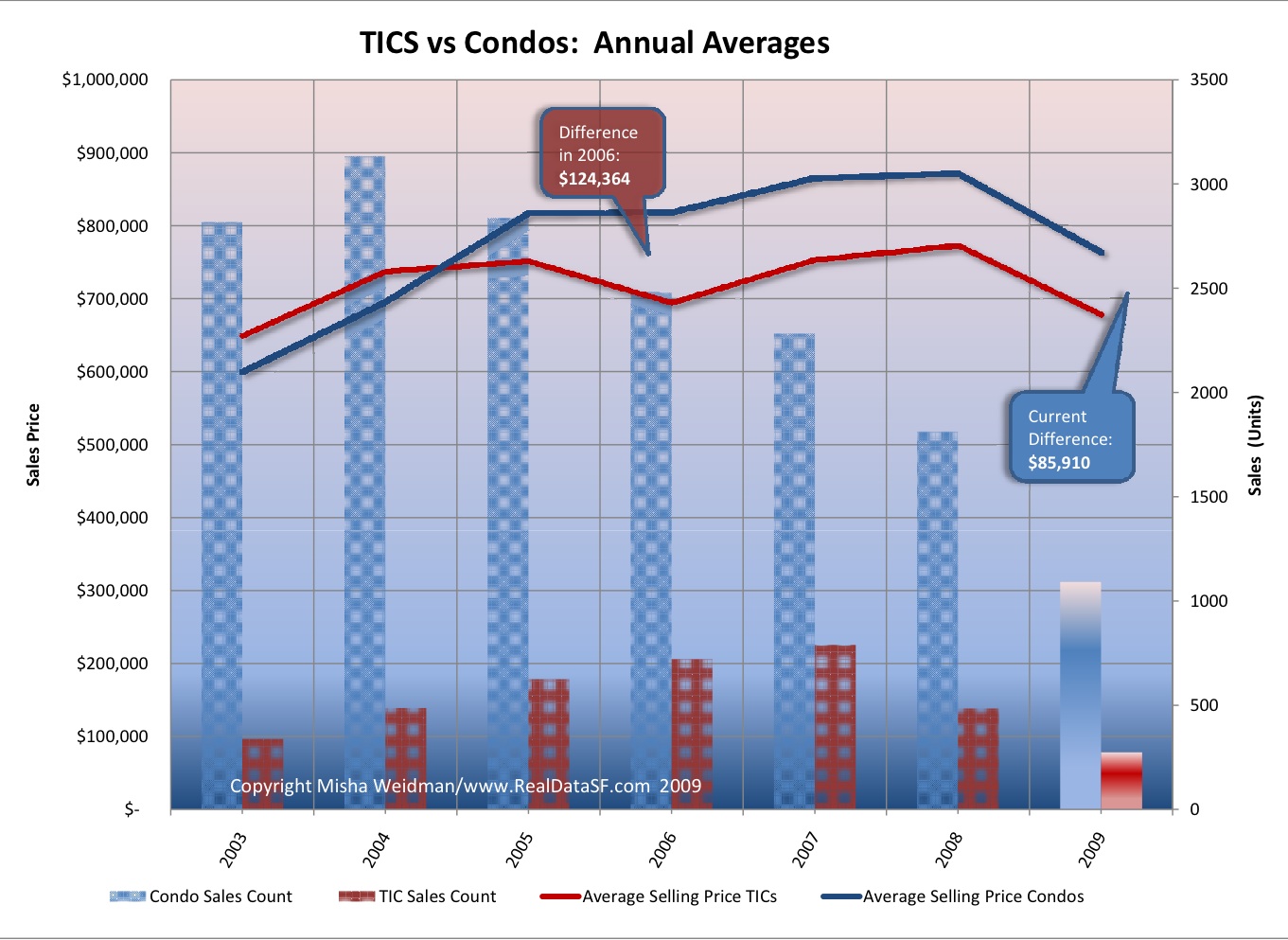
Last post, we determined that the current difference between the average (annual) price of a condo and that of a TIC is  $86,000, down from a high of $124,364 in 2006.  (That’s a 30%+ drop, by the way.)  Here’s the chart again (sorry for the funky transparency on the sales volume bars).

Condos vs. Tics Annual Average Sales Prices

That’s useful if you’re looking at an average-priced TIC and you’re curious about how much of a premium you’d have to pay for an average-priced condo.  But how about reducing that to a per square foot premium?

For those who just want the bottom line, here’s the answer, but it’s worth reading on for the caveats.

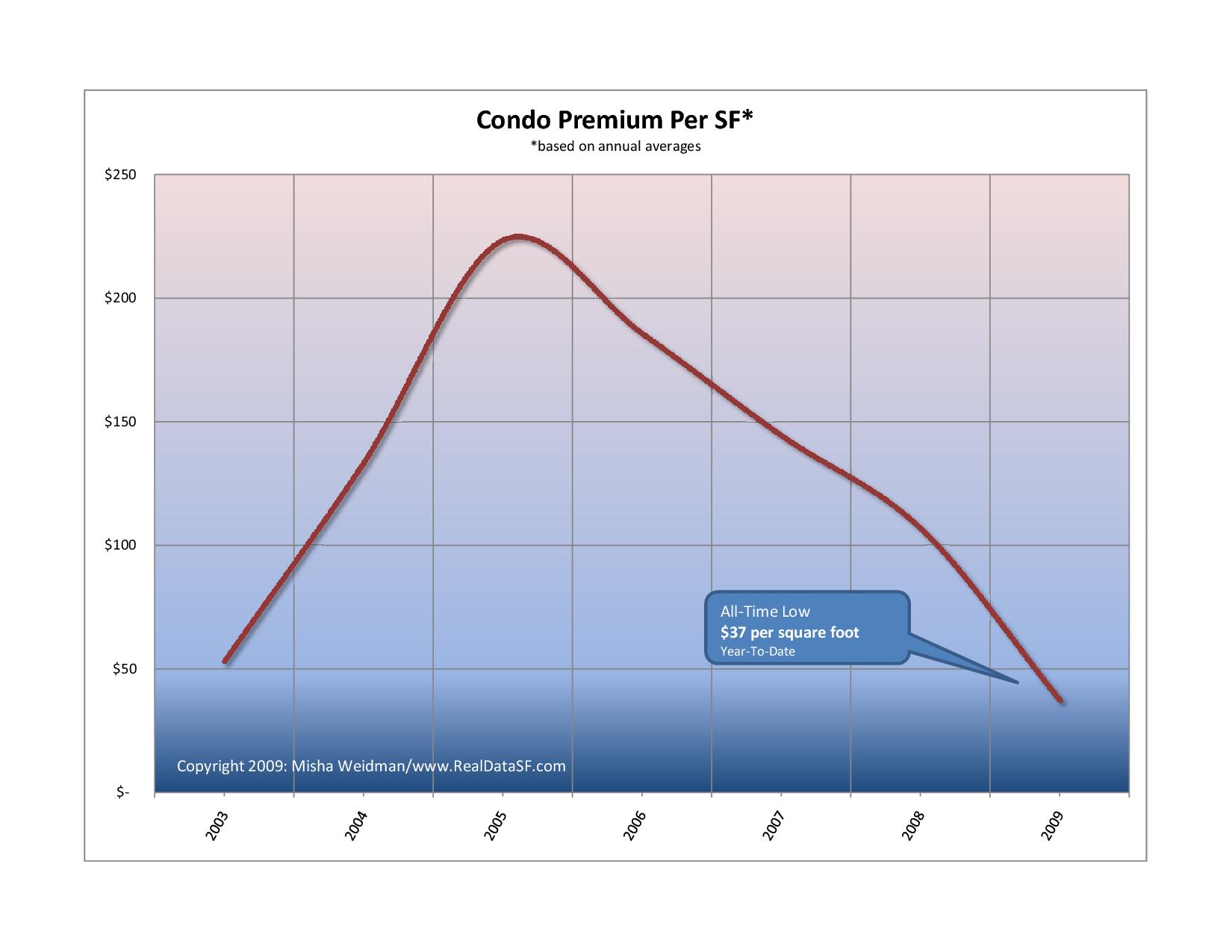
Simple Condo Premium Per SF

$37 a foot doesn’t sound like much of a condo premium to me, that’s for sure.  And as my astute readers will note, the drop in price on a per square foot (from around $225 per sf) is obviously much more than the drop in median sales prices shown in the previous chart.

What’s going on?  It’s really simple:  there’s a lot less information on sales price per square foot for TICs.

All my data comes from the MLS (Multiple Listing Service) that real estate brokers use to find and market properties.  When a sale’s completed, they are required to enter the sales price.  If there’s information on the square footage of the property — provided by the owner or more frequently from the property records — the database calculates a per square foot price.  Roughly 80% of condo sales have a recorded price per square foot in the MLS.  Only 45% of TIC sales have a recorded price per square foot. How bad is that? In September 09, there were just 27 TIC sales.  Only 9 of them had a recorded price per square foot.  For all of 2009 through September, there were 275 TIC sales.  Only 113 – 41% – show a per square foot price.

There are lots of people — mostly on other blogs 🙂  — who love to trash statistics and say they’re meaningless.  Medians don’t reflect home values, etc etc.  I disagree.  Provided you have enough data  and you understand what you’re measuring, statistics help make sense out of what is otherwise undifferentiated data.  But I am afraid that in the case of measuring the condo premium on a per square foot basis, we are in dangerous low on data.

One final reminder:  For this series of posts, my TIC data includes the handful of stock cooperative sales that occur in this market.

And thanks for sticking with me on this long series of posts….