

Happy New Year everyone! As promised, here is a link to Paragon’s comprehensive analysis of trends in the San Francisco residential market and beyond in 2012. You’ll find 19 incredible charts and maps covering a host of metrics and I highly recommend a quick scan of the online newsletter to find the stuff that might interest you. I’m going to cherry-pick just a handful of my favorites to discuss below.
Home Sales by Price Segment
San Francisco Neighborhood Home Prices by Price Segment
These charts show the breakdown of San Francisco home sales as reported to the Multiple Listing Service in the first six months of 2012. The analyses are sorted by city district by the number of transactions in different price segments. The star on each map corresponds to the district being analyzed.
Whether you are considering a home purchase within a certain price range or contemplating the sale of your property in a certain neighborhood, this may give a sense of what sells for how much where in San Francisco.


The San Francisco Luxury Home Market
A Market Overview
The luxury home market in San Francisco – typically defined as houses, condos, co-ops and TICs selling for $1,500,000 or more – experienced a big surge in activity in the second quarter of 2012. Below are a handful of charts analyzing sales by San Francisco district over the past 12 months, breaking the luxury house market in particular into three different price segments.
Our complete report can be found online here: SF Luxury Home Market Report
******************************
San Francisco Luxury HOUSE Sales by District and Price Range
SF HOUSES Selling for $1,500,000 to $1,999,999

SF HOUSES Selling for $2,000,000 to $4,999,999

SF HOUSES Selling for $5,000,000 or More

SF CONDOS, CO-OPS & TICs Selling for $1,500,000 or More

San Francisco Luxury Home Unit Sales
The second quarter of 2012 saw a substantial jump in the sales of expensive homes.

Average House Sales Price, Prestige Northern Neighborhoods
This is a sample of the many area specific analyses we perform. This chart includes a wide range of prestigious northern neighborhoods of differing values, so the numbers should be considered very general approximations. The reason why we put them all in the same basket is to get a large enough number of sales to be meaningful statistically.

Sales not reported to MLS – such as many new-development condo sales and a fair number of high-end off-market sales – are not included in this analysis. All figures are derived from sources deemed reliable, but may contain errors and omissions, and are subject to revision.
Absorption R.I.P.
After talking to people about my last post on Absorption Rates and the lack of a correlation between slower absorption and lower median prices (or faster absorption and higher prices), I got the impression that there was some curiosity — skepticism? — about the underlying numbers. So I thought a post mortem of sorts was in order. Here’s a chart that simply tracks total listings and total sales over a little more than the two years covered by the Absorption Rate chart.
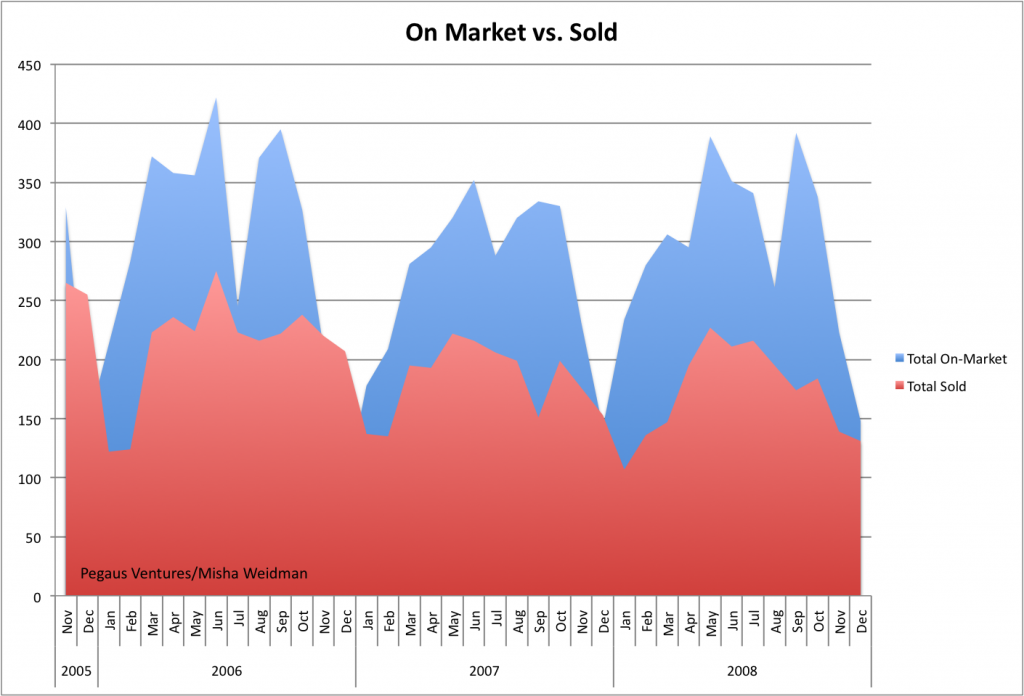
Total listings is defined as new listings plus anything that’s under contract but still “contingent” in the parlance of realtors. Total sales is exactly that. The chart reflects the raw monthly numbers with no averaging. This really highlights the seasonal fluctations: ie. the very evident drop-off in activity at the end/beginning of each year.
Other than the seasonal dips, maybe you can conclude that both listings and sales are trending downward, but I sure don’t see any evidence of a major change of direction in either.
A couple of closing thoughts. My absorption rate conclusions were based on an analysis of single family homes only. It’s possible that the conclusion would be different if I’d included condos and TIC’s as well. ie. Looking at the broader market might change the results.
On the other hand, it’s possible that correlations between absorption and price would appear if we looked at finer segments of the market. For example, we might find that absorption rates are longer at the high end of the market and that in fact prices have come down as we’d expect for that portion of the market.
Alas, the MLS database that’s the repository for sales information for brokers/realtors simply doesn’t allow you to do this sort of data-mining easily, so we’ll never know.
I stand by my previous conclusions: First, San Francisco just isn’t that overbuilt a market. Second, if you take out the seasonal fluctuations, the absorption rate doesn’t seem to have moved that much anyway. Finally, and perhaps most importantly, absorption rate doesn’t tell you how much activity (offers) each available listing is generating — in the end, just one property gets sold.
The question is whether there are other metrics that do a better job of tracking whether the market’s “hot.” Stay tuned.