Looking Back at 2009: Condos/TICs

Pretty much everything I said about how single family homes fared in 2009 also applies to the condo/TIC market.   (TIC’s, aka Tenancy In Commons are similar to condos.  For more information on TICs, see my three-part series starting here.)

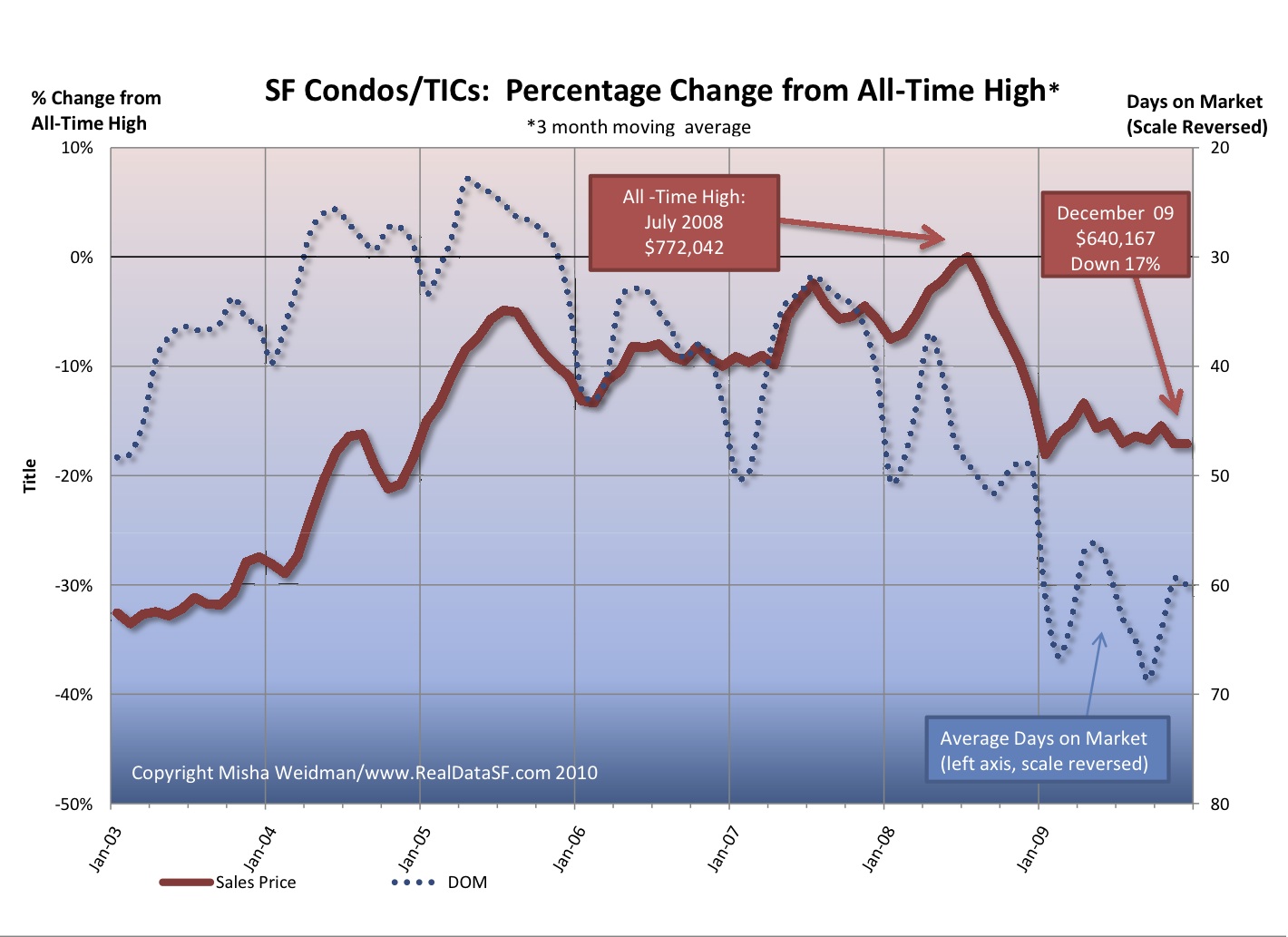
Condo/TICs hit their all-time highs about a year later than homes did — in July 2008.  But they’ve fallen from their highs almost exactly as much as homes have.  Condos/TICs were down 17%, just one percent better than single family homes.

For those who prefer their data on a per square foot basis, the picture is pretty much the same.  The all-time high was $711 — reached in November 2008 and the price per square foot stood at $592 at year’s end, also a drop of 17%.

While condos/TICs ended the year at the same point, the pattern has not been the same. Condos/TICs have been stuck near the bottom of their 2009 range after bouncing up in the first quarter. Homes, on the other hand, appear to have bounced up and stayed up.

What’s in store for 2010 remains anybody’s guess, but on the streets it certainly feels like spring is in the air.  There are more listings coming onto the market and more people looking at them.  Will that translate into sales and higher prices?  That’ll depend on macro-economic trends I’ve discussed elsewhere, but one thing’s pretty clear:  interest rates are heading higher, as evidenced by the Fed’s recent increase in the discount rate. If the economy continues to strengthen, that trend will continue.  And, for many people, that will result in less buying power and reduced affordability.

TICs, San Francisco’s Involuntary Reflex — Part 3: The Condo Premium Per Square Foot? Or not…

Last post, we determined that the current difference between the average (annual) price of a condo and that of a TIC is  $86,000, down from a high of $124,364 in 2006.  (That’s a 30%+ drop, by the way.)  Here’s the chart again (sorry for the funky transparency on the sales volume bars).
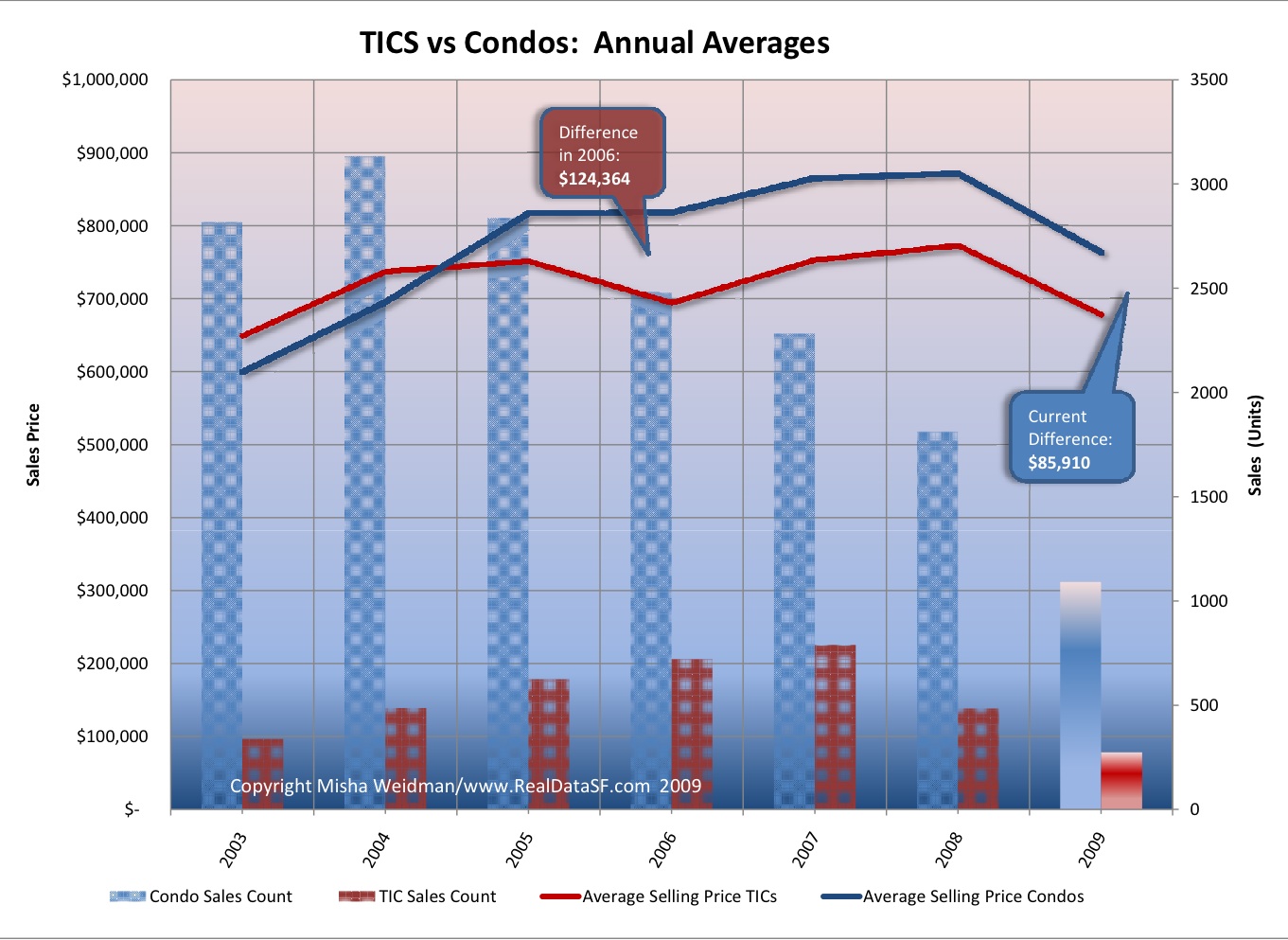
Condos vs. Tics Annual Average Sales Prices

That’s useful if you’re looking at an average-priced TIC and you’re curious about how much of a premium you’d have to pay for an average-priced condo.  But how about reducing that to a per square foot premium?

For those who just want the bottom line, here’s the answer, but it’s worth reading on for the caveats.
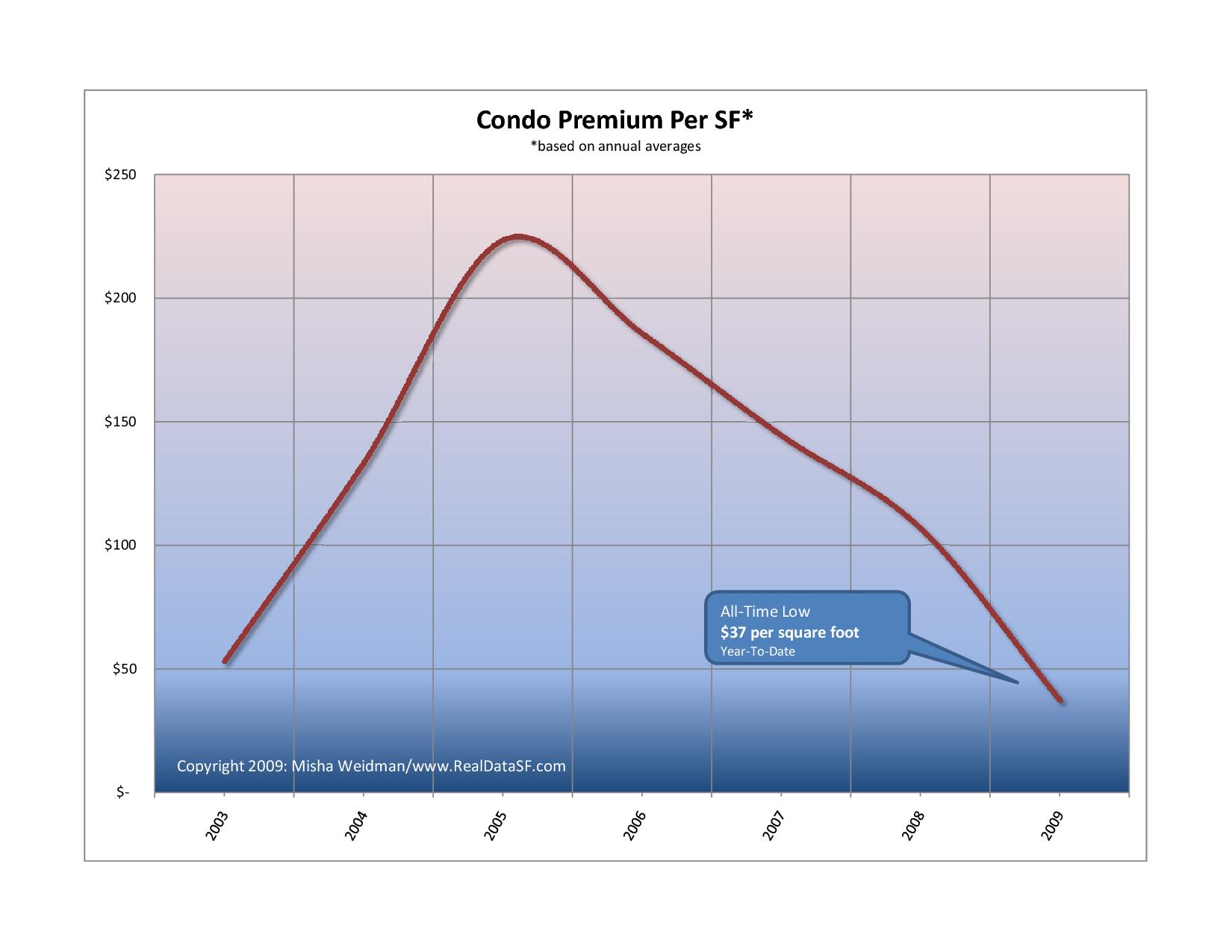
Simple Condo Premium Per SF

$37 a foot doesn’t sound like much of a condo premium to me, that’s for sure.  And as my astute readers will note, the drop in price on a per square foot (from around $225 per sf) is obviously much more than the drop in median sales prices shown in the previous chart.

What’s going on?  It’s really simple:  there’s a lot less information on sales price per square foot for TICs.

All my data comes from the MLS (Multiple Listing Service) that real estate brokers use to find and market properties.  When a sale’s completed, they are required to enter the sales price.  If there’s information on the square footage of the property — provided by the owner or more frequently from the property records — the database calculates a per square foot price.  Roughly 80% of condo sales have a recorded price per square foot in the MLS.  Only 45% of TIC sales have a recorded price per square foot. How bad is that? In September 09, there were just 27 TIC sales.  Only 9 of them had a recorded price per square foot.  For all of 2009 through September, there were 275 TIC sales.  Only 113 – 41% – show a per square foot price.

There are lots of people — mostly on other blogs 🙂  — who love to trash statistics and say they’re meaningless.  Medians don’t reflect home values, etc etc.  I disagree.  Provided you have enough data  and you understand what you’re measuring, statistics help make sense out of what is otherwise undifferentiated data.  But I am afraid that in the case of measuring the condo premium on a per square foot basis, we are in dangerous low on data.

One final reminder:  For this series of posts, my TIC data includes the handful of stock cooperative sales that occur in this market.

And thanks for sticking with me on this long series of posts….


TICs, San Francisco’s Involuntary Reflex: Part 1

Inconvenient and Ugly

A tic is an involuntary and habitual muscle spasm, frequently in the face.  If you live in San Francisco, a TIC is also what many people end up with when they buy a flat in one of San Francisco’s classic 2-4 unit buildings.  Like the medical condition, TICs are inconvenient at best and can be downright ugly at worst.

TIC stands for “Tenancy-In-Common,” a form of legal title by which multiple owners take title to a single property.  In San Francisco, this form of taking title has come to be used as an end-run around the City’s restrictions against converting multi-tenant buildings into condominiums.

When you buy a condominium, you’re basically buying your particular unit and that’s all. But when you buy a TIC interest, you’re buying an interest in the building as a whole, along with your other TIC owners.

Lawyering Has Its Limits

Why does it matter?  Because buying a roof over your head is expensive.  Most of us need to borrow money to do it.  And the major disadvantages of TICs over condominium ownership relate to financing issues.

  • When you buy a condo, you get a loan on your unit and that’s all.  If you don’t pay your loan and the bank forecloses, they have the right to sell your condo to get repaid, but they don’t have the right to sell the building the condo is in.
  • But when you buy a TIC, in the vast majority of cases you and your co-owners become co-signers on a loan for the entire building.  You qualify for the loan together and you are “on the hook” together for repaying it.  If one of the co-owners stops paying his share of the loan and the others don’t feel inclined to make up the difference, the bank has the right to sell the entire property at a foreclosure sale.  That itself would be enough to give many prospective buyers a twitch or two.
  • There are a few banks that will finance separate TIC interests.  This pretty much puts the TIC on a par with a condo.  But interest rates are higher than on a regular condominium loan; and the building itself needs to “qualify” for the program.  Also, although these kinds of loans have been around for a while and seem to have survived the credit crunch, there’s no guarantee that they’ll continue to be around.
  • Selling a TIC interest can also be more difficult than selling a condo. If the lender doesn’t permit the buyer to take the seller’s place as a co-signer on the loan, the owners may be forced to take out a new loan to accommodate the new buyer.  If the lending environment isn’t good, that can kill the sale.  Or the bank can use the sale to try to extract better terms for itself.

It’s true that clever lawyers – and I say that without any irony – have developed legal structures to mitigate these risks.  Andy Sirkin and Andrew Zacks are two prominent attorneys who specialize in this stuff.  (See their websites for excellent in-depth material on TICs.) But TICs remain inherently riskier and more complicated than condominiums, and no amount of legal engineering can fix that.

Tomorrow we look at the market data for TICS and condos.