Real Estate and Tax Law 101

Recently, several of my clients have asked for a quick rundown of various real estate and tax-related laws.  Here are some of the key laws any current or future home-owner should be aware of.  Note: the laws are complex.  This is intended to provide a starting point only.  Consult with your own attorney or tax advisor, or contact me for a referral.

1.  Home Mortgage Interest Deduction. 

You can deduct home mortgage interest on the first $750,000 ($375,000 if married filing separately) of indebtedness. However, higher limitations ($1 million ($500,000 if married filing separately)) apply if you are deducting mortgage interest from indebtedness incurred before December 16, 2017.  See IRS Pub 936.

2.  Excluding Tax on Capital Gain from the Sale of Your Home. 

If you have a capital gain from the sale of your home, you may be able to exclude up to $500,000 of that gain from your income if you are married and filing jointly (or $250,000 if an individual), provided that you have owned and lived in the home as your principal residence for an aggregate of at least two out of the five years before the sale.  There’s no limit on the number of times you can use this exclusion, provided that you meet the 2 year ownership and use minimums.

“Capital gain” is the home’s selling price minus deductible selling costs and minus your “tax basis” in the property.  Your “tax basis” is what you paid for the property plus some of the costs of acquiring it, plus major improvement costs you’ve incurred during your ownership, so it’s worth keeping track of them.  The best explanation I’ve found for this tax deduction is at Nolo Press’s excellent website, here. You can also take a look at the IRS’s info pamphlet here.

3. One-Time Right to Transfer your Property Tax Assessment:  Props 60 and 90.

Empty-nesters and other long-time home-owners often think about selling their home and “downsizing” so that they can simplify their lives, live closer to family, or untap the home’s increase in value for other purposes (see “Excluding Tax on Capital Gain” above). What can stop them is that they may end up paying far more in annual property tax assessments on the new home, even if it is a more modest home than their current one.  (For an explanation, see my August 2017 newsletter.)

California Proposition 60 gives homeowners 55 or older a one-time right to transfer the property tax assessment on their existing primary residence to a new one purchased for no more than the adjusted sale price of their previous one, provided both homes are located in the same county, and provided it is purchased within two years of the prior residence.

California Proposition 90 allows qualifying homeowners to transfer their property tax assessment to new homes located within eleven counties that have agreed to reciprocal transfer rights.  In the Bay Area, only San Mateo, Alameda, and Santa Clara participate, so San Francisco homeowners looking to move elsewhere are out of luck.  California Proposition 5, which appeared on the ballot in 2018, would have made property taxes transferable anywhere in the state.  It was voted down resoundingly.

4. New State-Wide Rent Control Law (AB 1482).  Effective January 1, 2020, this new law will cap rental increases to 5% plus inflation annually.  The law applies to buildings that are 15 years or older.  Most single-family homes and condominiums are excluded unless they are owned by a corporate-type entity.   

The law does not supersede more restrictive local rent control laws.  So, in San Francisco the local Rent Ordinance will continue to govern.  However, the new law will affect newer apartments with certificates of occupancy dated earlier than 2005; previously, apartments constructed after June 13, 1979 were largely exempt. 

Generally, landlords are free to raise rents to whatever they want after a tenant vacates a unit.

The new ordinance – and especially its interaction with existing San Francisco Rent Control laws – is complicated.  If you are thinking about purchasing rental income property or renting out property you already own, I urge you to consult with a qualified attorney (call or email me for a referral.). In the meantime, you can find more information from a local law firm here.

5.  Community Opportunity to Purchase Act (“COPA”).

“COPA” is a new SF law that requires owners of buildings with three or more residential units to give a right of first offer and a right of first refusal to a designated set of non-profits before they can sell their building to a third party.  I wrote about this new legislation recently.  You can read the details here.

As always, your comments, questions, and referrals are much appreciated!

Misha

San Francisco Real Estate: Doom and Gloom or Vroom and Boom?

Driving with one eye on the rear-view mirror is a good thing.  Driving with both eyes on it is likely to get you into a crash.

At a recent sales meeting where 40 or so agents discussed their impressions of the autumn sales market which opened on Labor Day, quite a few bemoaned the lack of agents showing up on brokers’ tour on Tuesdays and Wednesdays.  Others said that they’d had Sunday open houses with nary a visitor.  Agent and client fatigue?  The “flood” of new listings on the market (though that’s typical for this time of year)? An ominous sign of things to come? 

Another agent got up and spoke about how over 100 people had showed up at her Sunday open house in the Outer Sunset.  Someone else talked about the 1,500 square foot condo that went into contract at 30% over list price.  Another mused that maybe the market was diverging for properties below $2 million (strong) and those above $2 million (weakening).

A recent article in the SF Examiner quoted data produced by our own Chief Market Analyst Patrick Carlisle and concluded that, right now, it’s anybody’s guess which way the market is headed.  The metrics are pointing every which-way. I liked the closing quote, which reflects what I’ve told my clients for years:

If your aim is to keep living where you’ve been living, if you’ve been sitting on a property for more than 10 years or if you plan to buy a house and hang onto it for awhile, all of this should be white noise to you.

What makes predicting where the market is headed so difficult is that all our data points backwards to where we’ve been, not where we’re going.  September’s sales numbers reflect contracts that were entered into 20 to 40 days previous, on properties that might have hit the market 10 to 30 days before that, thus reflecting a summer market whose own dynamics are different and usually slower than the autumn “big-surge-before-winter-shuts-everything down” market we are in today.  If you think there’s any reliable leading indicator for what’s going to happen, please – please! – let me know.

Here are some selected charts from Patrick’s most recent newsletter (email me if you want the full version), starting with a snapshot of Q3 compared to the last three years.

Prices for single family homes eked out a 1.8% gain year-over-year.  That still leaves home prices up 16% from Q3 2017.  Meanwhile condos are up a healthy 7.6% over last year, but up “merely” 11% from Q3 2017.

If there are any warning signs here it may be that both the number of sales and the percentage of listings sold are stalling.  Is this the buyer and agent fatigue that agents mentioned in our sales meeting?  Remember, the chart above shows what happened July – September, whereas discussions at our recent sales meeting reflect current sentiment.  If that sentiment shows up in this quarter’s numbers too, then maybe – just maybe – we are looking at a slowing market.

Here’s another chart that suggests a bit of a plateau in home prices – but only because we’re used to a stream of double-digit gains.

Price reductions, however, which can obviously indicate a slowing market, do not seem to be signaling an imminent slowdown; they’re about the same as last year and maybe a tad lower than earlier years.

And “Days on Market,” which signals very directly the “heat” of the market, seems to show a continuing and robust sellers’ market when compared to recent years.

And for what it’s worth, from a global perspective, some analyses suggest that San Francisco may be over-valued but is not in bubble territory.  Here’s a chart from a recent UBS report on global cities (email me if you want a copy of the full report). A recent article in The Economist also concluded. that prices in San Francisco had room to run.

My personal view is – as the 8-ball so wisely says – “Ask again later.”  There’s nothing in these numbers that suggest that we’re heading into the kind of feeding frenzy that the IPO’s of Lyft, Uber and the like were predicted not long ago to ignite.  (I got that one right.) Nor is there evidence that suggests things are going to change dramatically for the worse in the near term. 

That said, if you’re thinking of selling I wouldn’t wait. Despite the (rear-view) numbers, I’d say there’s more downside risk then upside potential ahead. Prepare your home as well as possible for sale (I can help, and Compass Concierge can help pay for the costs upfront) and price it right. Homes that “check the boxes” and are move-in ready continue to sell well.

Conversely, if you’re a buyer, think about focusing on properties that have been on the market for three weeks or more and may not be “perfect.” That’s where you’ll find the values.

As always, your questions, comments and referrals are much appreciated!

Misha


San Francisco’s new “COPA” Law could turn Owners of 3+ Unit Buildings into, um, Sausage

“Coppa” with two “p’s “ is a delicious dried pork salume of Italy and Corsica.  “COPA” is a new SF law that requires owners of buildings with three or more residential units to give a right of first offer and a right of first refusal to a designated set of non-profits before they can sell their building to a third party.  If a seller fails to comply with the statutory requirements, they may well feel that they’ve been through the COPA meat-grinder.  Penalties can include disgorgement of profits and a fine equal to 10% of the sale price they received.

COPA (for “Community Opportunity to Purchase Act”) is intended to aid non-profits that are active in efforts to preserve affordable housing.  The rationale behind the Act appears to be that by providing qualified non-profits a first and second shot at buying a building subject to the Act, more buildings will come under the control of these non-profits who are then required to keep low-rent tenancies in place “in perpetuity.”  However, there’s no requirement that sellers accept below-market rate offers from the non-profits; no additional mechanism for getting more money to the non-profits so that they can compete with market-rate offers; and no proof that a market-rate sale to a private party necessarily results in evictions or rental increases anyway.  Indeed, the City has enacted numerous laws over the decades to make it increasingly hard for owners of multi-tenant buildings to increase rents (for buildings constructed before June 1979) and to permit owner move-in evictions. Buyers are already willing to pay a premium for two-unit buildings because, for the moment at least, they are not subject to San Francisco’s condo conversion moratorium whereas buildings with three or more units are.  This legislation, I suspect, will only increase the delta.  Perhaps that’s the point:  by burdening buildings of three or more units with this additional legislative hurdle to sale, they’re making them more affordable for non-profits to potentially buy. 

That kind of reasoning seems like a stretch to me.  More likely, in my view, this will result in extra fees for attorneys who have to guide sellers of these buildings through a potential minefield.  I have not researched this but I suspect the reason why non-profits are not buying up more buildings to “preserve” low-rental housing is not because they’re not aware of them being for sale but because they simply can’t compete with for-profit buyers.  This legislation does nothing to change that.

Anyone who needs more information should start with the Mayor’s Program Rules, available here.  The next step should be to consult with a qualified real estate attorney.

As always, your questions, comments and referrals are much appreciated!

How Does San Francisco Rank as a Global City?

“Home ownership has dropped, evictions and homelessness have climbed sharply, surging demand for rental units has led to a shortage, and soaring rents are fodder for daily conversation…. In the last few years, [it] has become one of the world’s 10 most expensive places to rent, ahead of cities like Tokyo, Sydney and Singapore.”

San Francisco?  Actually, Dublin, Ireland, according to a Deutsche Bank Report cited in a New York Times article a few days ago. But before you heave a sigh of relief, consider this:  Dublin ranked 8th most expensive city in the world to rent a mid-range 2 bedroom apartment, clocking in at around USD $2,000.  San Francisco came in second – just after Hong Kong and ahead of New York.  The quoted rent for SF: a whopping $3,631, down slightly from 2018.

And yet our currently foggy piece of heaven’s Quality of Life Index still ranks among the Top 10 for major global cities covered by the Report, clocking in at number 9.  The only major U.S. City that does better is Boston, at number 8.  (New York ranks 31.). Topping the global index:  Zurich.


Expensive Bad Habits and No Cheap Dates

The Report extracts its Quality of Life rankings from Numbeo.com, which covers cities large and small all over the world and bases its rankings on a combination of individual indices that include Purchasing Power, Pollution, Safety, and the like.

But the Report also includes its own quirky indexes, like the “Bad Habits Index” (cost of 5 beers and 2 packs of cigarettes), “Cheap Date Index,” and “Men’s Standard Haircut in an Expat Area Index.”  No surprise: San Francisco is expensive under all those metrics.  Surprise: San Francisco doesn’t even make the top 54 for (most expensive) Five Star Hotel Rooms with a View.  That honor goes to Milan, Madrid, and Vienna in that order.  Another surprise:  San Francisco ranks third most expensive under Monthly Internet Service, behind Dubai and Dublin.  Thank you, Silicon Valley!

But Lots of Income

One of the major takeaways of the Report: San Francisco tops the charts for both Monthly Income (after taxes) and Monthly Disposable Income After Rents.  It’s jumped 7 and 21 places, respectively, in just the last 5 years.  So, while it’s expensive to rent here, it seems that incomes have more than kept up the pace – though I can’t think of anyone who feels that way.

Boom or Gloom?

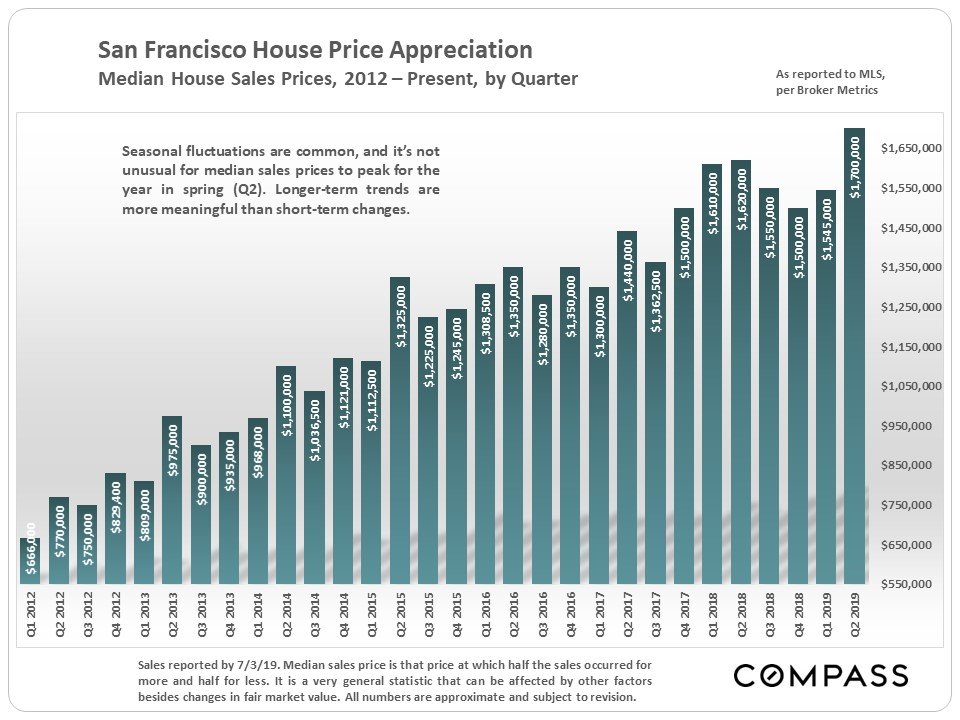
With San Francisco real estate prices recently hitting new highs (see chart below), people often ask me where I see the real estate market going.  That’s particularly true now, with so much volatility in the stock market, not to mention underlying geo-political concerns like Brexit, the trade war with China, and oil supplies coming out of the Straits of Hormuz.

Alas, I have no crystal ball.  But our global ranking is a good part of the reason why I feel bullish about San Francisco in the long-term.  We are a global city, blessed by a thriving and diversified economy; an educated work-force; stunning scenery; and a decent climate (except right now!).  While we aren’t immune from economic downturns, there’s every reason to expect that people will continue to want to live and work here – despite the expense and challenges – for the foreseeable future.

As always, your questions, comments and referrals are much appreciated!

Which San Francisco Neighborhoods Have Appreciated the Most?

A client of mine recently opined that he thought that Pacific Heights and other luxury neighborhoods were “overdue for a bump” in home prices. He thought that well-heeled Millennials and Gen-Z-ers were neglecting the north side of the city in favor of hipper locations like Mission/Valencia Street, Duboce Triangle, Hayes Valley and, of course, the perennial favorite Noe Valley.

As someone who has lived and worked in SF for over 30 years, I’ve witnessed my share of cycles where people bid up the “up and coming” neighborhoods (Bernal Heights is the poster child) as they get priced out of their “A-list” neighborhoods. However, when the market turns down, those same neighborhoods tend to get hit hard as buyers shift their attention back to their first choice. So, my hunch was that over the long-term, neighborhood appreciation rates would be about the same.

It turns out that I’m mostly right. The chart below shows both total appreciation and compound annual appreciation for various neighborhoods in the city within their MLS (Multiple Listing Service) Districts over the last 20 years.


While the Inner Mission and Bernal Heights have in fact appreciated more and faster than elsewhere, most city neighborhoods are right at around a 7.5% increase year over year. This fits with my general view that you could buy a single family home pretty much anywhere in the city and do alright over the long-term.

Why? First and foremost, SF is always going to be a popular place to live – notwithstanding its challenges. Secondly, single family homes are a shrinking part of the housing market. “Land,” as Will Rogers famously said, “they ain’t making any more of it.” The city’s stock of single family homes is constrained by geography – but demand continues to grow.

In fact, as I’ve described elsewhere, sales inventory is actually falling as more and more people choose to “age in place” for financial and lifestyle reasons.

But back to our first chart and rates of appreciation. The big exception is the cluster of luxury neighborhoods in MLS District 7: Pacific and Presidio Heights, Cow Hollow, and the Marina. Here, the rate of appreciation is significantly lower than elsewhere. Why? Well, consider that the base starting price is significantly higher. Back in 1998, you needed $1.6 million to buy a house in those neighborhoods – three to five times what you needed for other neighborhoods. I’m no economist, but I suspect that these neighborhoods will always approach the upper limit of what people are prepared to pay for a home. There’s simply less headroom for them to move up in price.

It’s also worth remembering that cumulative appreciation over a long period can obscure short-term fluctuations, as the following chart shows. That’s why I generally counsel my clients not to buy a home if they’re not planning on holding onto it for at least 5 to 7 years.

Here’s a comparative look at median home price trends in select neighborhoods, updated through 2018.

And while I believe that it is folly to base an offer on statistical averages for “list” to “sale” prices, the following chart does reflect which neighborhoods are seeing a lot of buyer interest. Here’s the takeaway: just as you’d expect in a mature “up” market, it’s the more affordable neighborhoods that are seeing the highest level of interest as buyers are priced out of the more expensive ones.

I have a comprehensive table of median home prices by neighborhood and bedroom count for every MLS District in the city, updated through May 2019, as well as a similar table for condos.  Unfortunately, there’s no easy way for me to display it in my newsletter.  If you’d like a PDF of the table or are curious about a specific neighborhood, please email me and I’ll be happy to send it to you.

As always, your questions, comments and referrals are much appreciated!

Misha

Spring has Sprung: How about the SF Housing Market?

First, let me thank everyone for their positive feedback on my last newsletter regarding Unicorns, IPO’s, big press headlines, and the likely effects of all of that on San Francisco home prices.  With Lyft down 30% from its opening price, Uber looking less “über alles”, and the stock market gyrating on news of a trade war – or just, um, war – we are already in the realm of larger forces potentially swamping whatever IPO effect was so breathlessly anticipated. 

That said, after a very slow start to the typically strong spring season – and by “strong” I mean heavy buyer demand and higher prices – the residential market has notably recovered from the “weakness” of the last half of 2018.  (For more on that, check out my 2018 Real Estate Wrap-Up.)

And let’s be clear about what I mean by “weakness.”  Real estate sales typically cool during the winter months after Thanksgiving anyway.  In 2018, the “cooling” might have started a little earlier in the autumn  — exacerbated by a volatile stock market – and continued longer into the new year – perhaps as a result of all the rain we’ve had — but overall the last couple of quarters don’t look significantly different from a year earlier.  Median house prices reached an all-time high of $1.7 million in February 2018; we haven’t surpassed that point for a year now, but with March and April results hovering at around $1.65, we are not far off either.  And to put this into further perspective, Spring of 2018 was one of the hottest Spring markets in SF history.

The table below shows the same thing broken down by many key metrics.  “Negligible change” seems to be a fitting description.

“Word on the street” suggests a mostly positive environment, especially at the more affordable end, and especially for single family homes, which are an increasingly small share of the market.  Open houses are well-attended; those properties that “check the boxes” are receiving multiple offers, though more frequently by the handful than by the dozen as was the case a few years ago.  At the more expensive end of the market – let’s say above $4 million for single family homes — properties are sitting a little longer and listing agents are complaining that buyers are increasingly picky – they want a “move-in” ready home.  For $4+ million you can hardly blame them.

Below are some general metrics on various neighborhoods grouped by MLS District for both single family homes and condos. Note that these are for the preceding 12 months so they do not reflect any short-term movements.

As always, your questions, comments and referrals are much appreciated.  And please consider following me on Facebook, LinkedIn, Twitter and/or Instagram as I intend to post short pieces on items of interest on a more frequent basis than this once-a-month newsletter.

All the best,

Misha

The IPO Thing: Will Lyft and Uber take Real Estate Prices for a Ryde?

I don’t think I have ever been pinged so often as I was shortly after the New York Times published “When Uber and Airbnb Go Public, San Francisco Will Drown in Millionaires.” In the Styles Section, no less.  Certainly, the idea that San Francisco, where so many IPO companies are headquartered, could see upward pressure on home prices makes sense.  As the NY Times article notes, there were only about 5,600 home sales in San Francisco in 2018 and less than half of those were single family homes.  So it makes intuitive sense that a few thousand newly minted millionaires could move the market with their new-found fortunes. (I made the same point months before the NY Times article but sadly they didn’t quote me.)

The reality may be more nuanced than the attention-grabbing headlines.  In February, Zillow published its own analysis of what it described as “the Facebook Effect.”  It tracked home price increases back in 2012 after FB went public in census tracts with an unusual number of FB employees and found that “every 10 Facebook employees living in a given census tract at the time of Facebook’s IPO in May 2012 were associated with an additional 1.6 percentage points of home value increase over that year.”   Bay Area wide, census tracts with a particularly heavy presence of FB employees saw home price increases of 21% vs the non-FB heavy tracts of 17%  between March 2012 and March 2013.

That 4% difference is nothing to be sneezed at, and I can see people rubbing their hands as they point out that the Uber IPO alone will dwarf FB’s, not to mention the effect of all the other smaller IPOs (see below).  And they could be right, particularly if, as is likely, so many more of the IPO companies have concentrations of employees in the tiny geographical area called San Francisco than was the case with FB’s IPO back in 2012.

But Zillow’s takeaway is notably cautious:

“While we still expect this year’s tech IPOs to impact the local housing market, it may be more about easing the fall than acting as a springboard for accelerated future growth.”

And that’s approximately where I come out.  While the significant new influx of money cannot be ignored, it is just one factor at play among other forces.  Those include:

  • What happens to the value of those IPO stocks after they go public?  (Lyft opened at $88.60 and closed today at $67.40 –  a drop of 24%.)
  • What’s happening to the economy and employment generally?
  • What’s happening to interest rates?
  • What’s happening in the real estate market overall?

I’d venture to say that while the fate of the IPO stock price may most directly affect both the pocket-book and, equally importantly, the confidence of the new home-buying millionaire, the other three factors will have a much broader influence on home prices over the course of the next few years. 

Here’s a hypothesis for you (and please post your thoughts here to continue the conversation):  If the market warms up again after going a bit cold at the end of 2018 (see my last newsletter), the IPO effect will accelerate price growth in the city, as the nouveau riche have the means and confidence to buy up what they want.  However, if the market continues to slow,  the IPO effect may soften the decline but not by much.

Why?  When a property is perceived as being over-priced, people just don’t want to overpay.  Nobody wants to be taken for a chump — even when they can afford to be.

And, speaking of young and upwardly mobile, take a look at this great new townhome in Mission Bay that I will be bringing to market this week-end. Absolutely perfect 2BR/2.5 BA pad, right off Mission Creek, in one of the hippest, most vibrant neighborhoods in the city: www.235berry-unit-112.com.

As always, your questions, comments and referrals are much appreciated!

Misha

“What Goes Up Just Might Be Coming Down.” The 2018 San Francisco Residential Real Estate Wrap-Up

Off to the Races

In 2018, San Francisco’s median house sales price was $1.6 million.  That’s an increase of 13% over the previous year.  Meanwhile, the median condominium sales price increased about 5% to $1,210,000.

If the chart above was the only one you consulted on SF real estate, you could be forgiven for thinking that since the 2012 recovery from the Great Financial Crisis, the city’s real estate prices have been rocketing inexorably upward. 

Slow Finish

But you’d be wrong.  As Mark Twain said, quoting Benjamin Disraeli: “There’s lies, damn lies, and statistics.”  In 2018, the year had two very distinct halves.  And if you don’t look at the statistics for those two halves, you’ll miss the real story here – which is that single family home prices fell precipitously over the last two quarters. The chart below shows price changes by quarter.

In a nutshell, the median price of a single family home in the last quarter of 2018 was essentially the same as it was a year earlier – $1.5 million.  Homes lost $120,000 in 2 quarters.  That’s a 7% drop in value.  (Condos, meanwhile, remained basically flat.)

While our Chief Market Analyst, Patrick Carlisle, judiciously hedges his bets by pointing out that quarterly fluctuations are not unusual and also reflect seasonal variations, other data also supports the notion that we may – operative word, “may” – have reached some sort of inflection point. 

Less Frenzied Over-Bidding

For example, “overbidding” – the difference between the list price and the ultimate sale price – dropped dramatically for single family homes in the last half of the year, even though it remains at high levels.  Interestingly, the last time overbids declined significantly was from late 2015 through 2017; that may correlate with the massive drop in annual appreciation for 2016 and 2017 to single digits, whereas the previous three years’ returns were between 16 and 20% (see second chart below).

More Price Reductions

Another indicator: Price reductions in the fourth quarter hit their highest levels in over five years.

Still, Mixed Signals

Not all the statistics point clearly to a softening market.  For starters, supply remains constrained and at historically low levels.  I’ve described this elsewhere as a secular shift, reflecting, perhaps, an aging population that chooses to age in place rather than to move.

In addition, Average Days on Market (DOM) remains very low for most single family homes as the following charts shows.  While DOM for the most expensive homes rose significantly in the last two quarters, there are so few sales in this segment that statistics tend to be volatile anyway.

If we see any current weakness in the market, however, it’s in high-end condos ($3+ million) where new construction in recent years has created oversupply. The next chart shows that DOM for this segment has been between 40 and 60 days for two years.  Most other markets would love to have a DOM statistic of 60 days.  In San Francisco, that’s considered l-o-n-g.

Bay Area Perspective

For a broader perspective we can look at the Case Shiller Index for the SF Metro Area.  It aggregates data for five Bay Area counties:  San Francisco, San Mateo, Alameda, Contra Costa and Marin.  San Francisco represents a tiny part of that index – only 7% of all sales.  And virtually all of those sales would fall within the “high price tier” of the Index.  Still, if there’s one thing we should have learned by now it’s that SF is not immune from broader market trends.

The first chart below confirms how, Bay Area wide, there was price slippage in all price tiers starting in the summer months of 2018. The second chart, with a longer perspective, shows how lower and mid-priced homes generally appreciate faster during run-ups and then drop faster and further during slowdowns.  The same phenomenon applies to SF itself.  As people get outbid on homes in their “A” list neighborhoods, they bid up prices in neighborhoods deemed less desirable.  When the market drops, buyers focus again on the “A” list neighborhoods and avoid the B-List , thus exacerbating the decline in the latter.

Caveats, IPO’s, and Wild Cards

It’s worth remembering that the end of 2018 saw one of the most volatile stock market rides in recent history.  That, in itself, could have contributed significantly to the weakness we saw in the real estate market in the second half of the year.  If the stock market stabilizes and returns to its bullish ways, maybe that end-of-year weakness will be just a blip. 

With a handful of high-profile Bay Area unicorns going public (including Lyft, AirBnB, and Uber), there’s speculation that the resulting crop of newly minted millionaires will bid up the market as they look for homes.  As I’ve written previously, in a market as small as San Francisco, that’s a plausible theory.  However, three studies report in a recent article in the SF Chronicle suggests that if there’s an effect at all, it’s limited.

Then there’s Brexit, Venezuela, North Korea, a trade war with China, and the possibility of another government shut-down, not to mention Robert Mueller and a certain volatile public figure who is the subject of his inquiry.

As the Chinese proverb says:  “May you live in interesting times.”  Happy New Year!

As always, your comments, questions and referrals are greatly appreciated!

Misha