Where is Bay Area Housing Headed?

In my last newsletter in late October, I suggested that despite data indicating the possibility of a slowing real estate market, it was too soon to tell.  It may still be too soon – but the evidence is mounting.

Notably, we’re seeing evidence of a slowdown across the Bay Area and, indeed, nationally.  The December 1 issue of The Economist describes a national “housing wobble”, citing declining new construction  and higher interest rates as among the contributing factors.  Nationwide, sales of existing homes were down 5.1% from the year previously and sales of new homes were down by 12%.  (interestingly, the article suggests that declines in residential purchases and homebuilding are a leading indicator of recessions, rather than the other way around.)

The message was much the same at the UC Berkeley Real Estate Symposium which I attended last month, where keynote speaker Ken Rosen — advisor to billion dollar REITs and foreign governments – opined that “we are late in the cycle.”   Locally, he thinks that we’ll need to wait till the Spring to see if higher interest rates, lower tax deductions, and an increasing number of people who are looking to move out of the Bay Area because they’re fed up with congestion and high prices will lead to a meaningful “correction” in home prices.

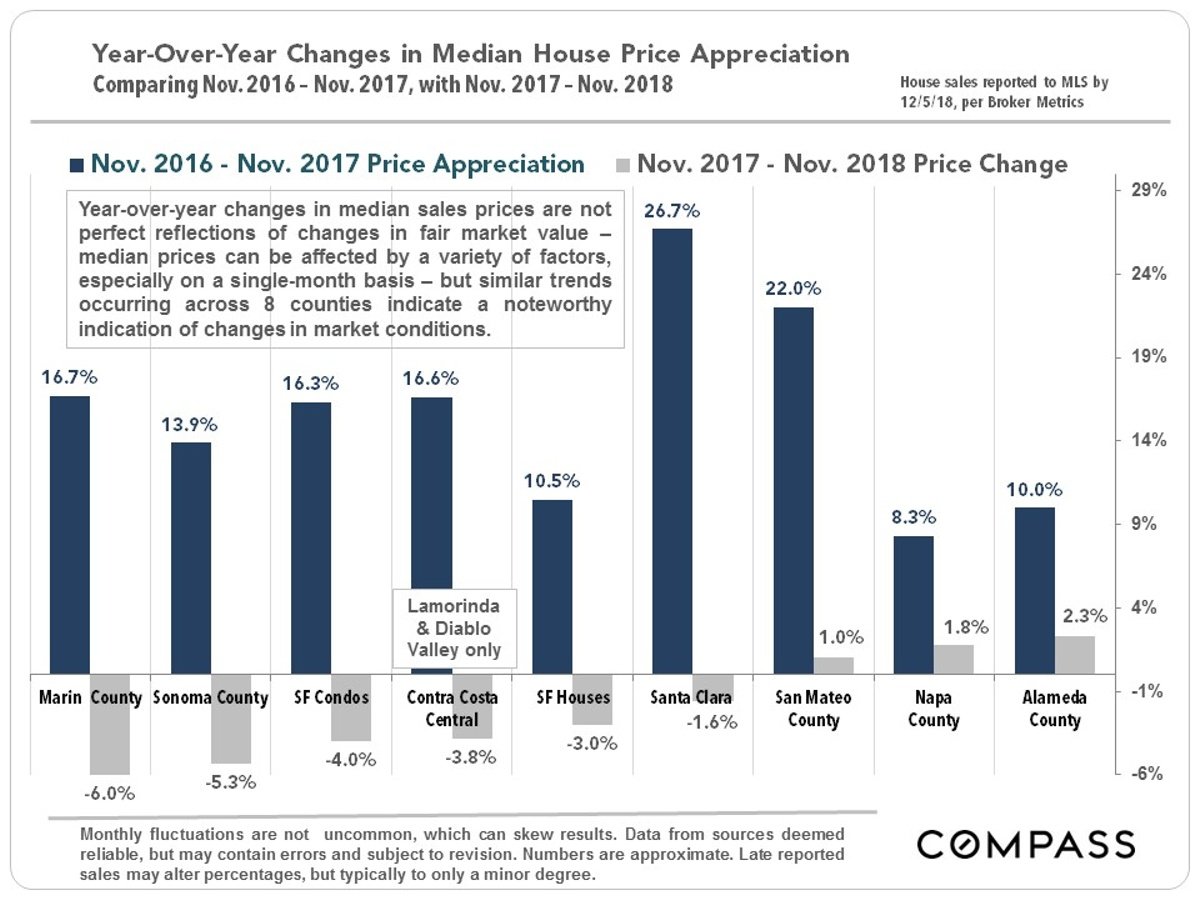
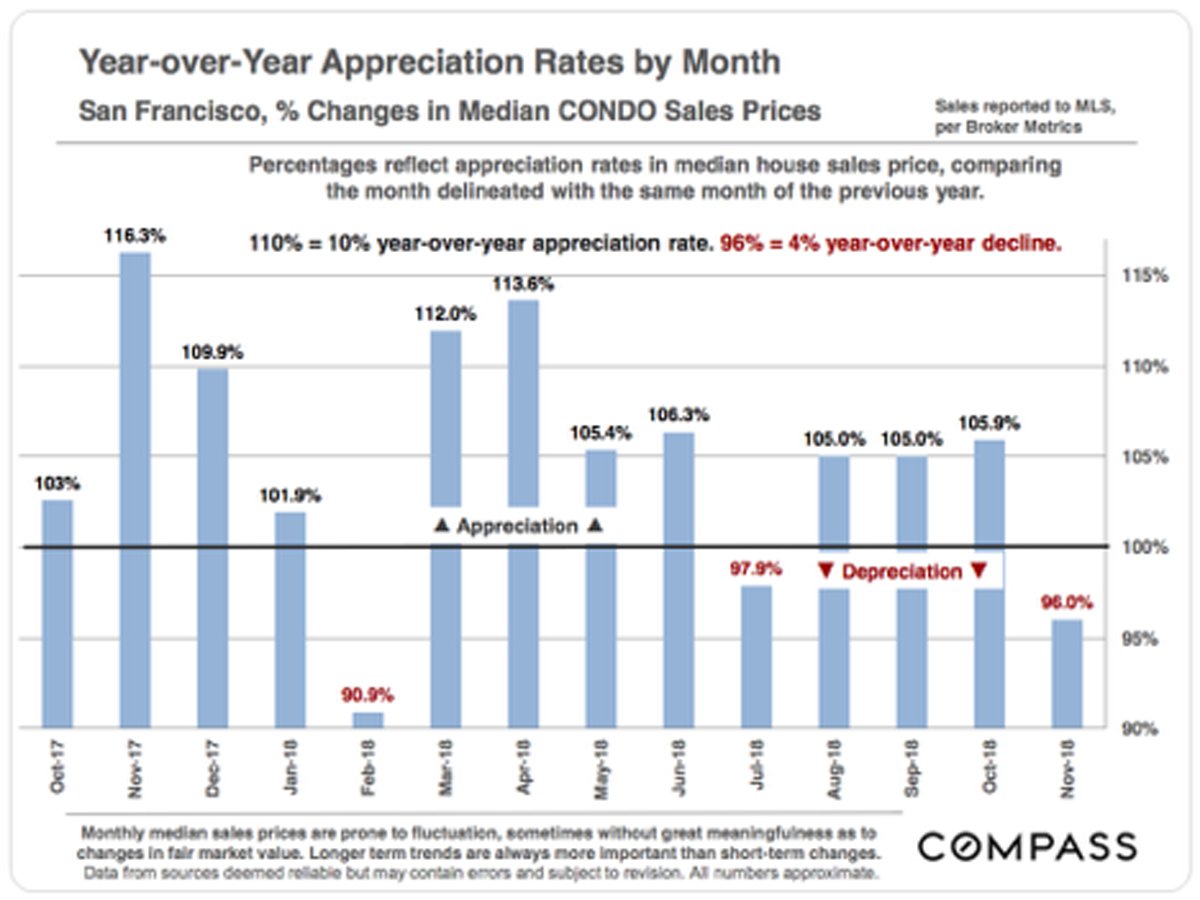
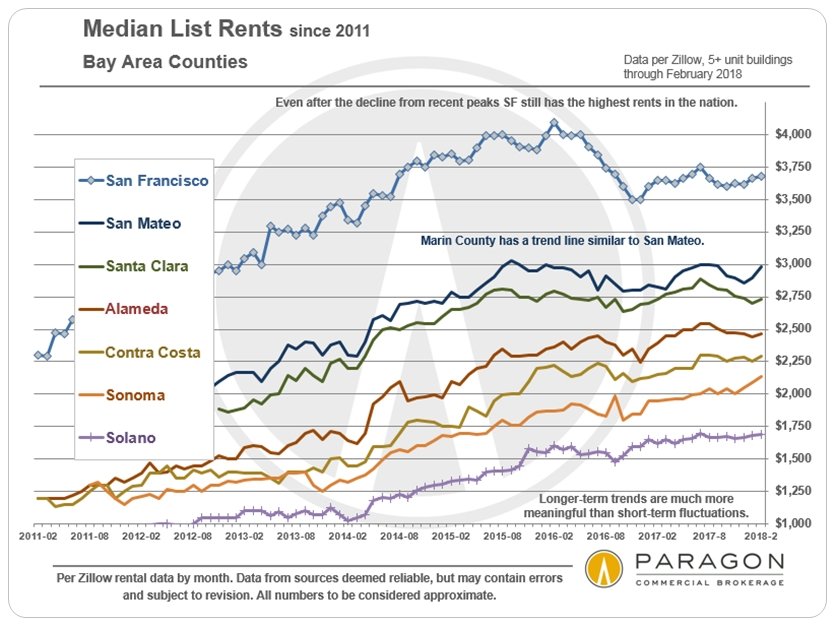
As the chart below shows, there’s been price erosion in most Bay Area counties over the last year.

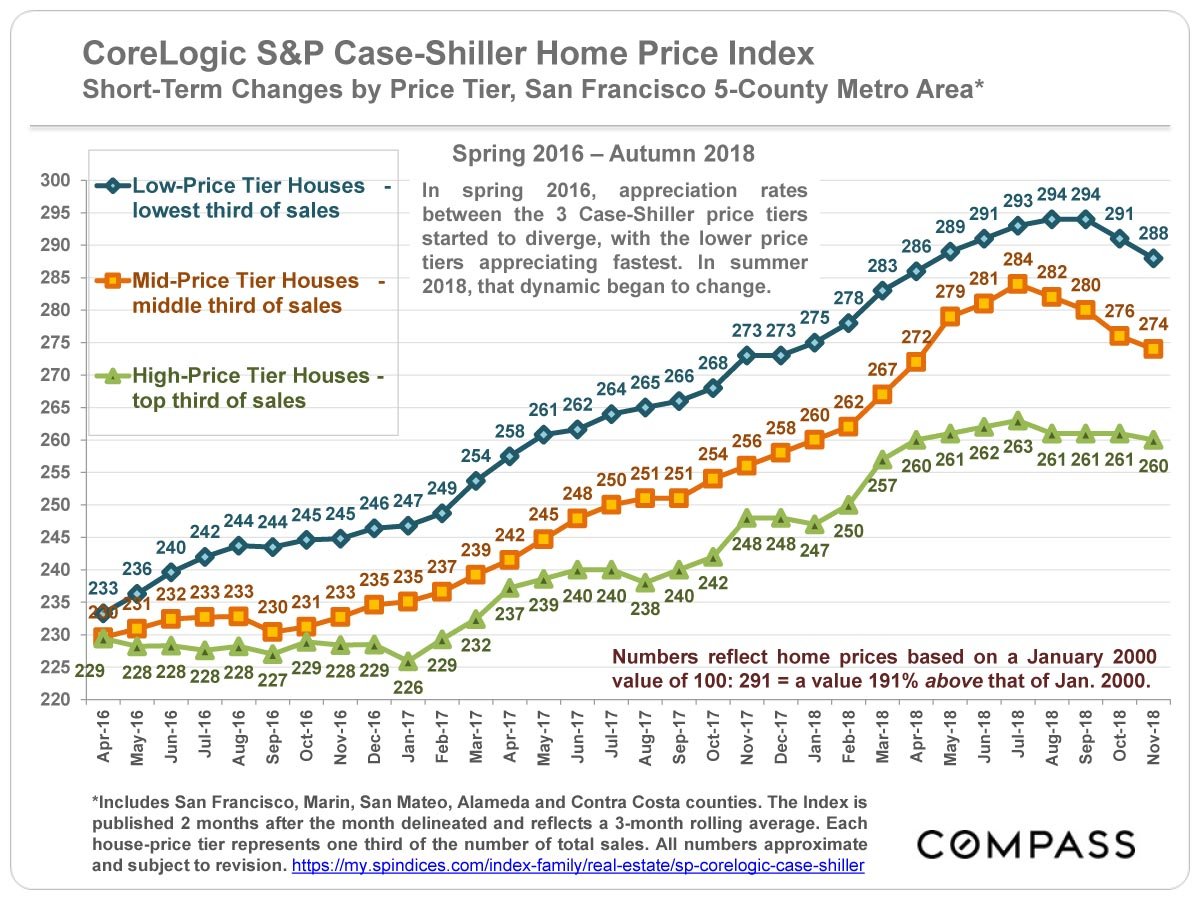
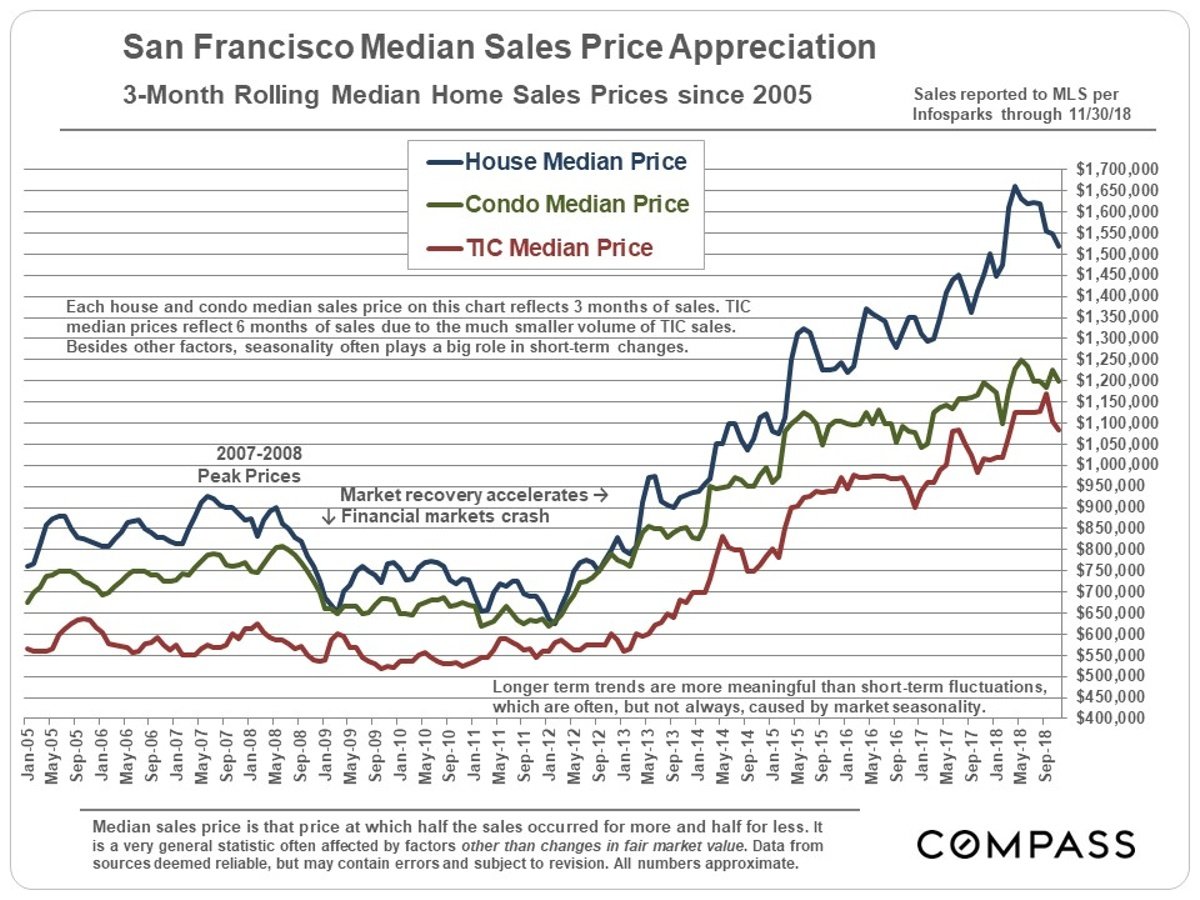
And in San Francisco, home prices had a big bump in the Spring, but have fallen back since then.  Note that the chart below tracks three month rolling averages, so I’d expect further price declines to show up as we move past the seasonally strong months of September and October.

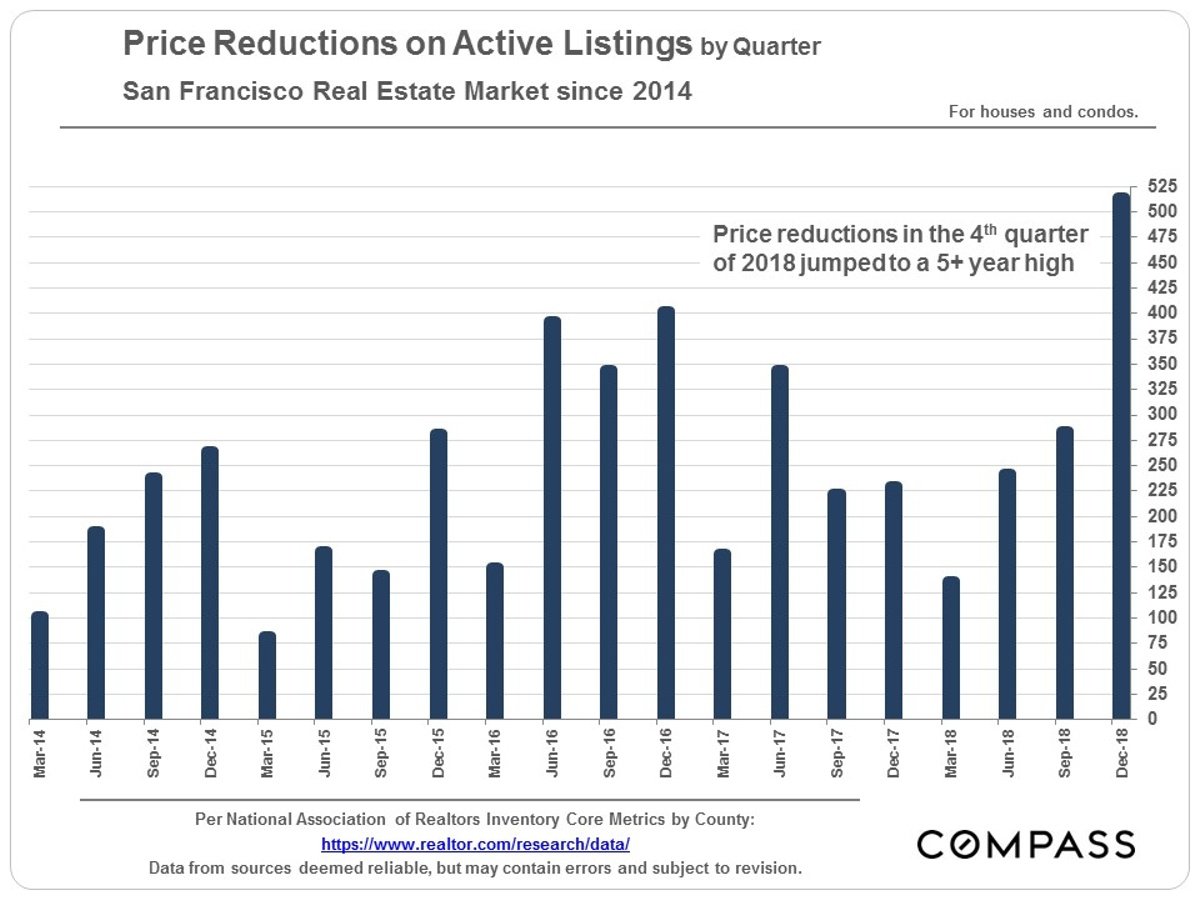
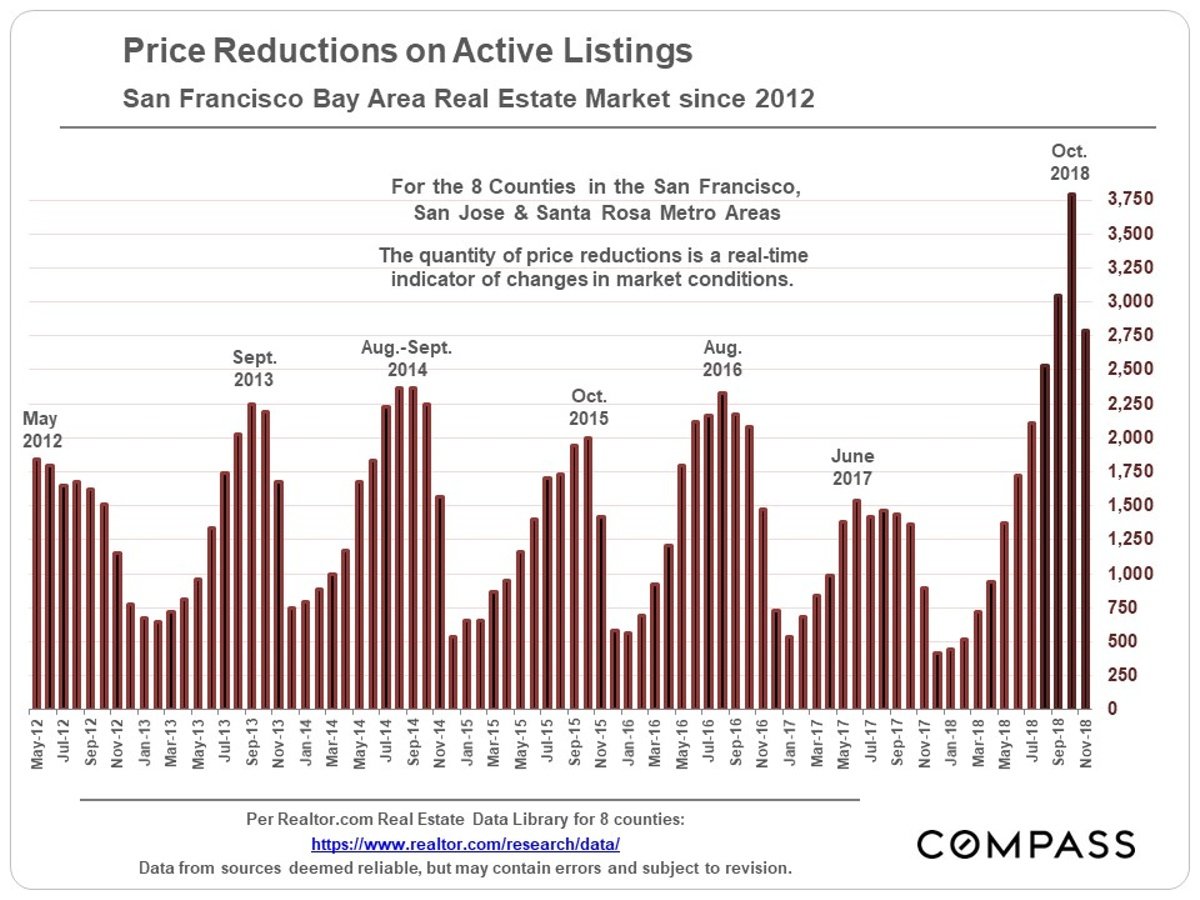
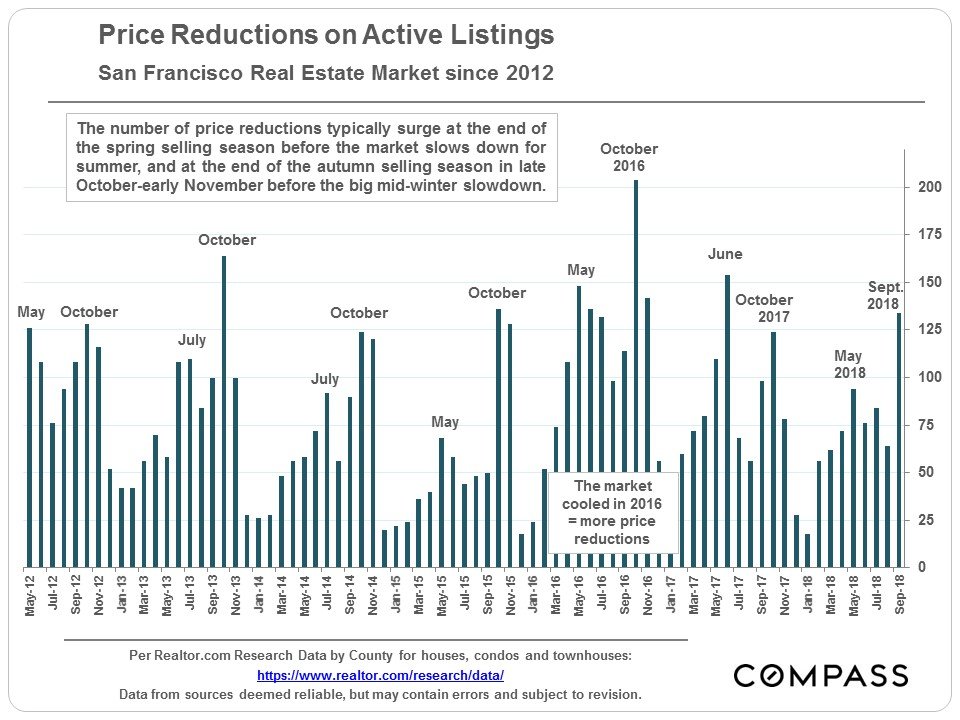
Meanwhile, price reductions on active listings in the last couple of months are up well above previous years and so seem to be showing more than the usual seasonal increase we expect towards year’s end.

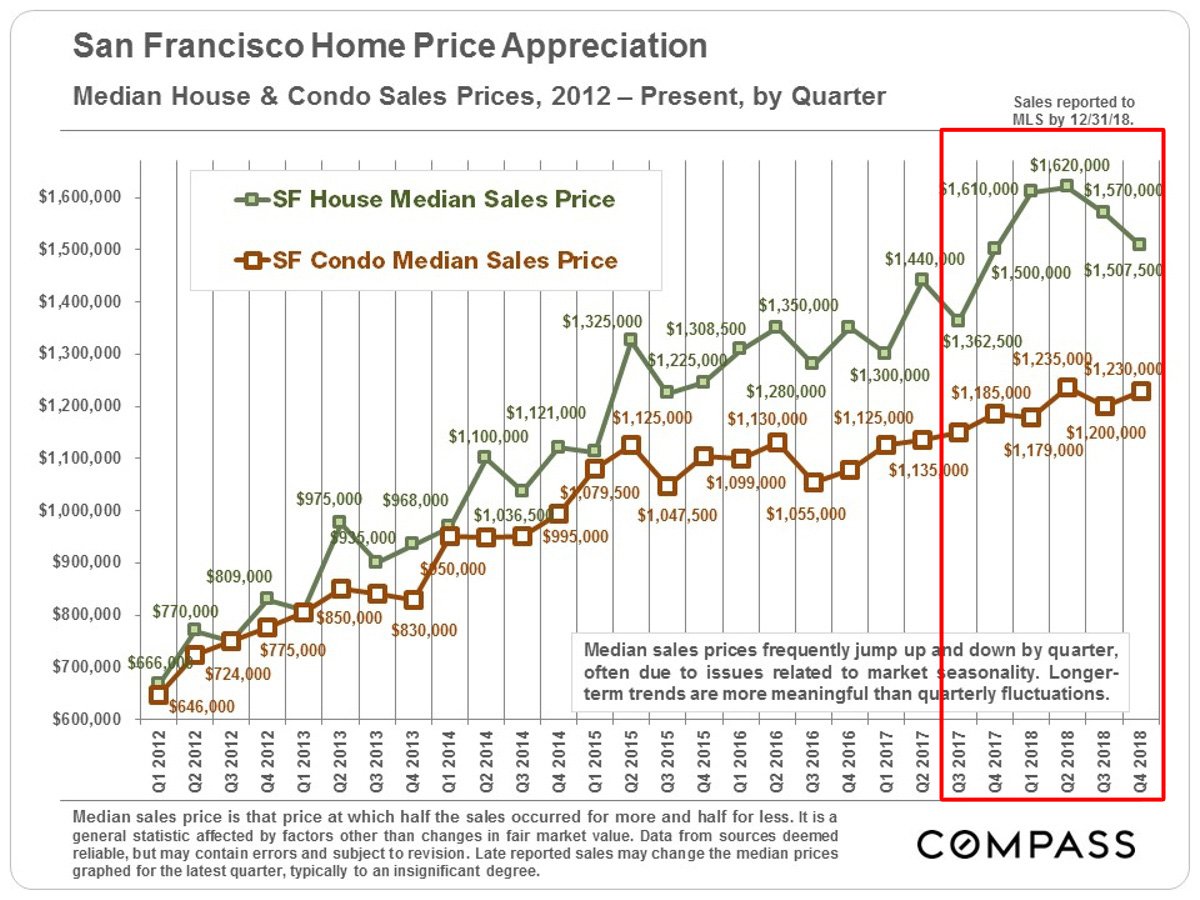
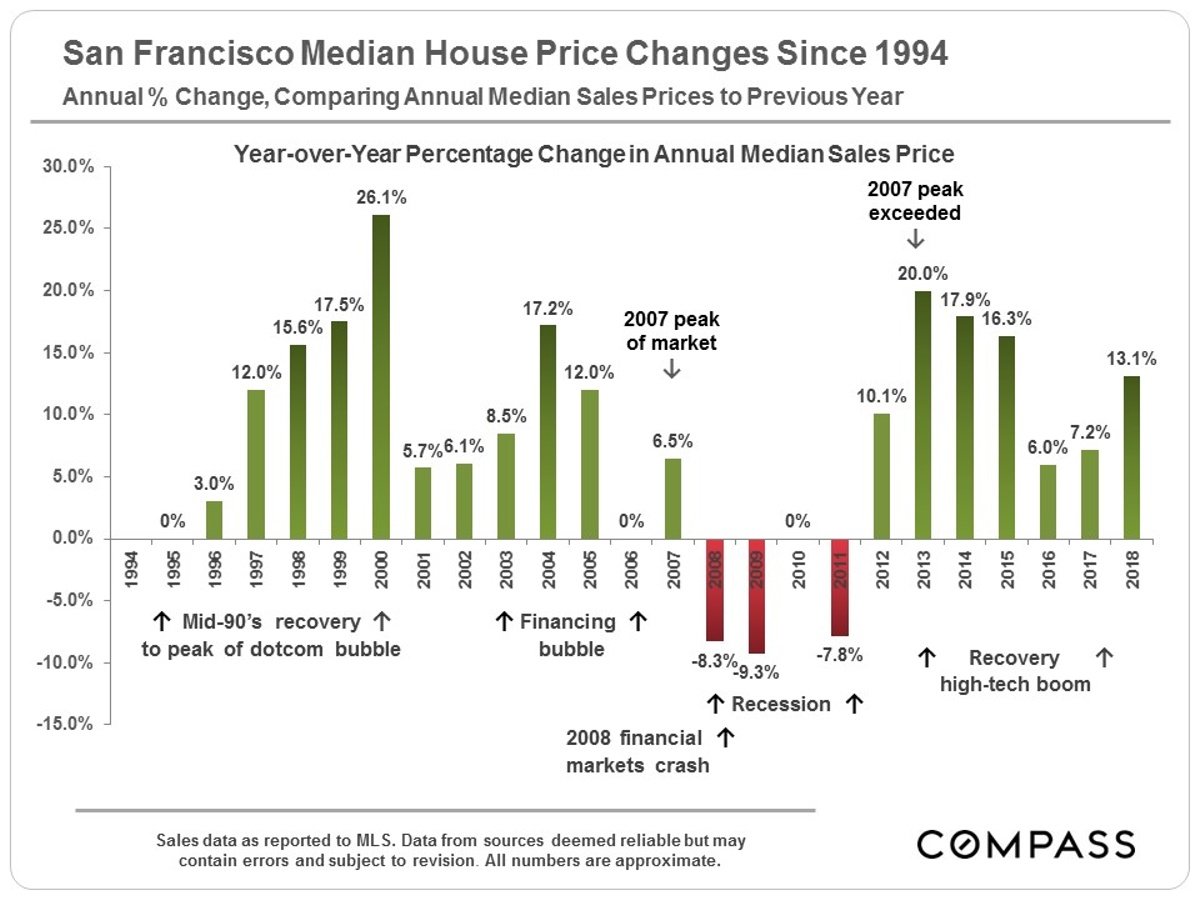
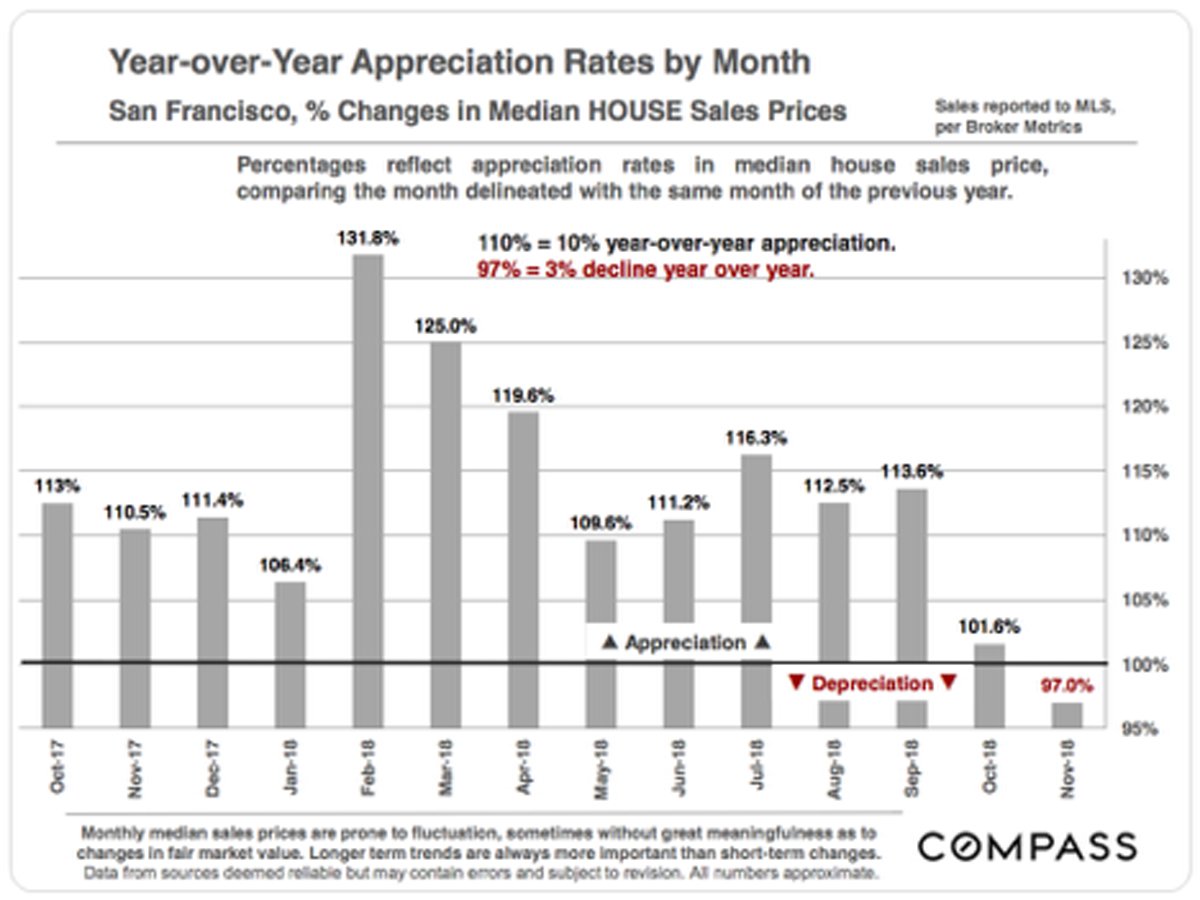
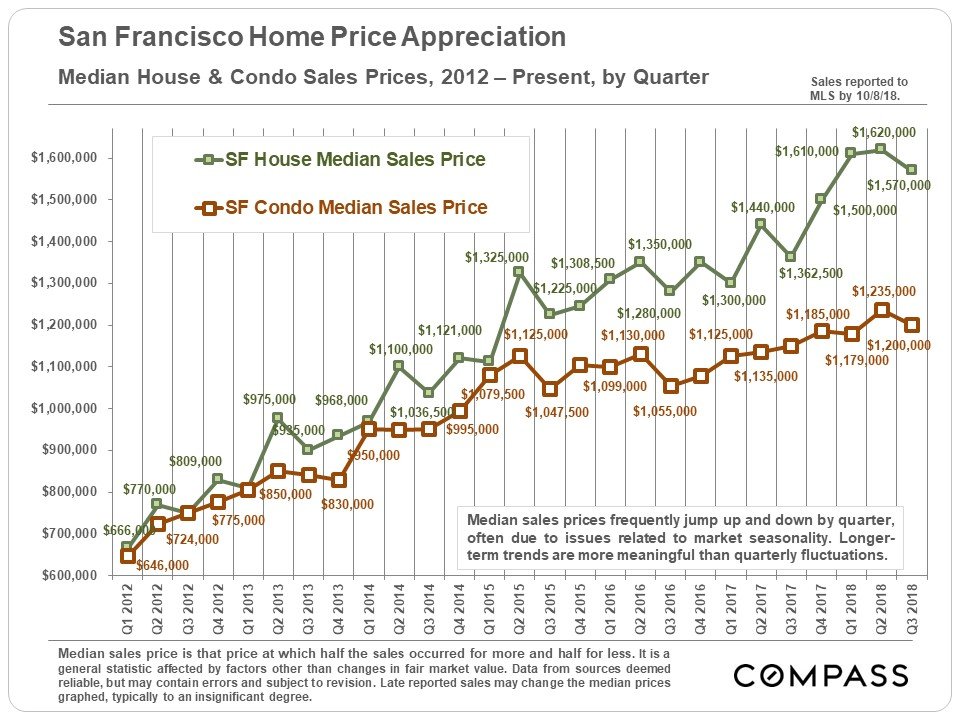
Let’s be clear, however:  2018 has been a very good year for San Francisco home sellers, with solid year over year price increases until very recently, especially for single family homes (see charts below).  So it remains too soon to predict whether we are witnessing a “wobble,” a seasonal pause, or the start of a meaningful decline in home prices.


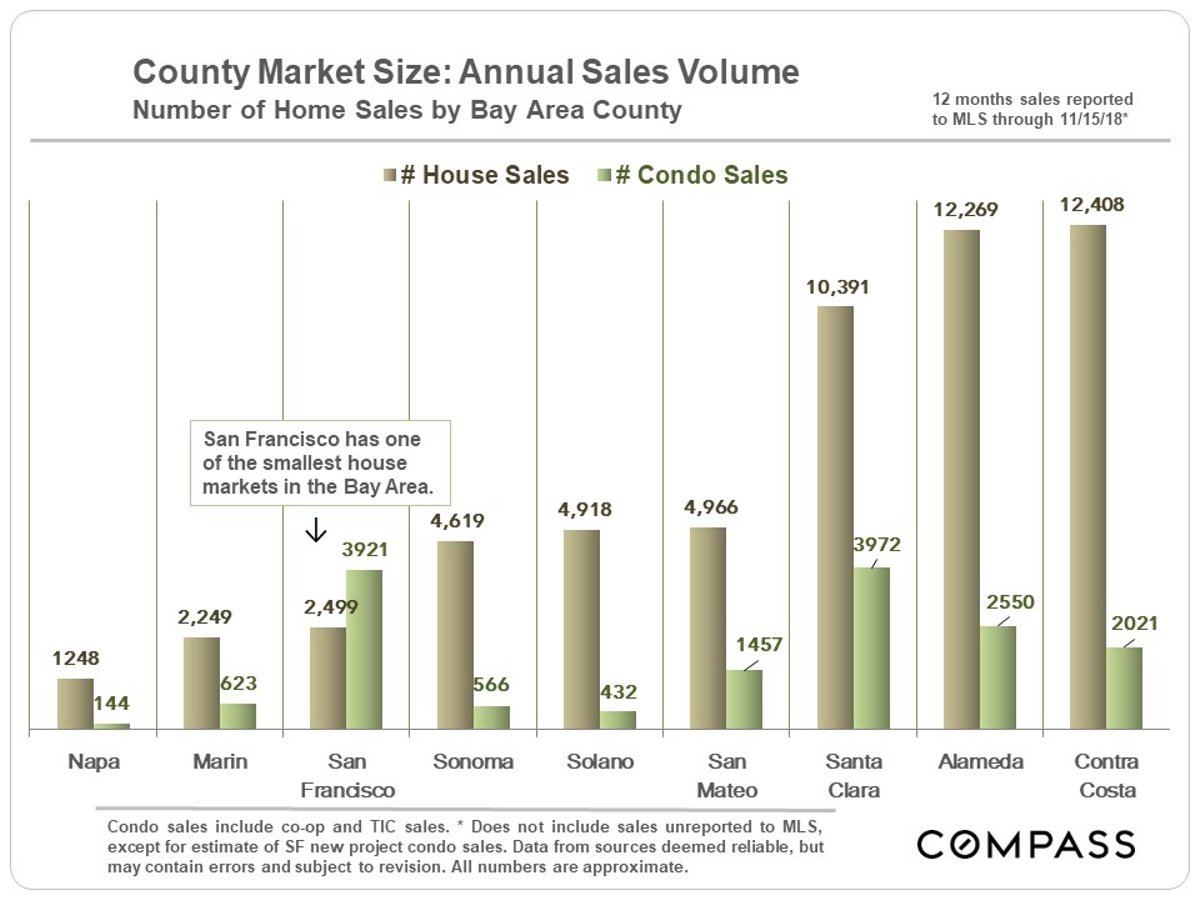
In addition, with a handful of Unicorns (Uber, AirBnB, Lyft) moving up their timelines for going public, there could be several hundred newly minted millionaires vying for higher end homes.  In a market where we estimate there are only about 2,500 single family home sales per year, these buyers could provide substantial support for home prices.

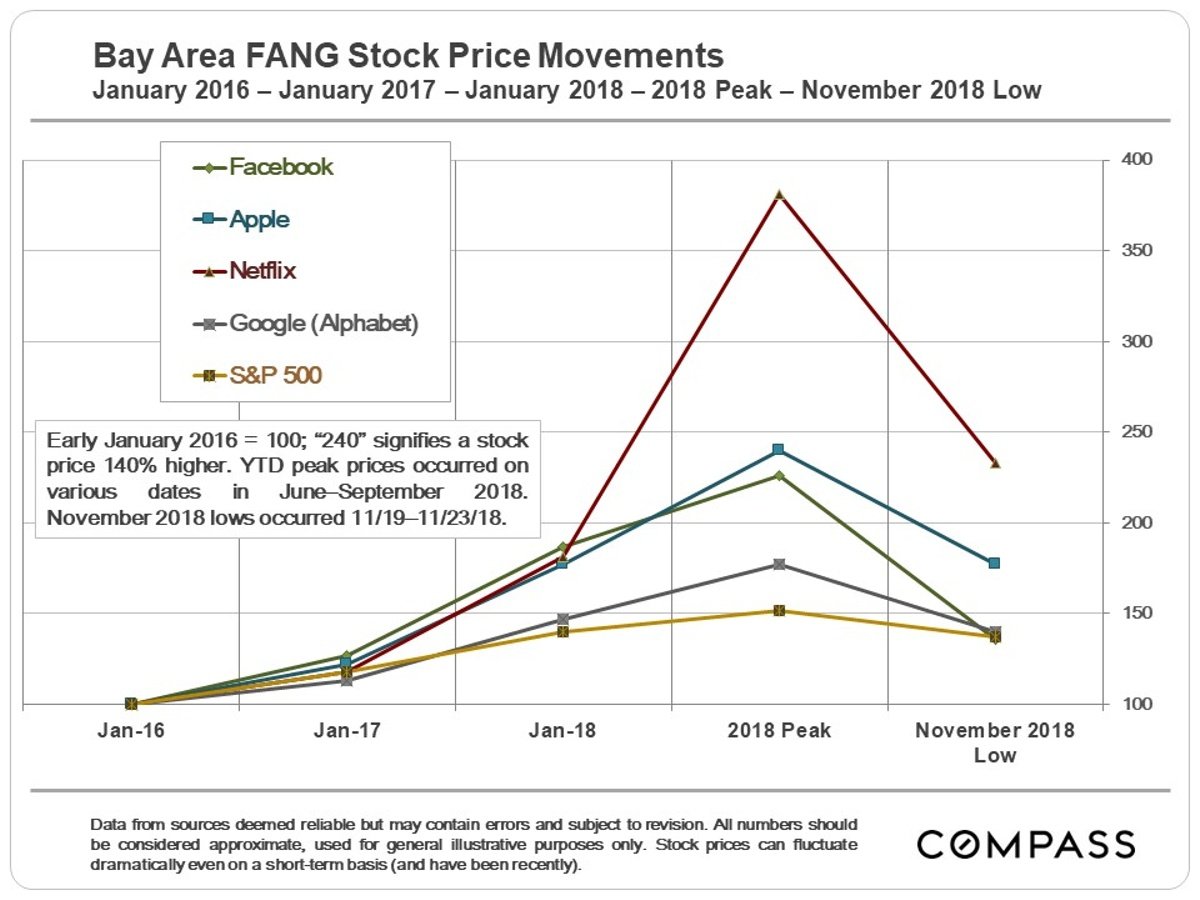
At the same time, with the recent hard decline in the stock market  — and in Bay-Area tech stocks in particular – many people may be feeling a lot less wealthy.

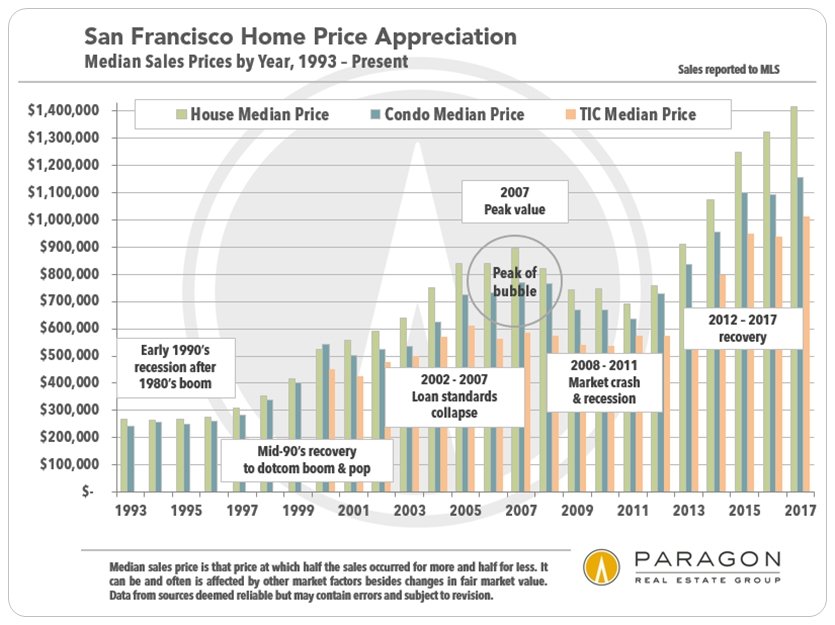
How all these vectors ultimately intersect is anybody’s guess.  Personally, I think a market balanced more evenly between buyers and sellers would be a good thing.  Sure, maybe sellers would prefer the breathtaking price acceleration and frenzied multiple offer market of recent years to continue, but, as we saw in the Great Recession of 2007/2008, that sort of market tends to end up with an equal and opposite effect down the road.  I’ll take a slowdown over a crash any day.

As always, your comments, questions and referrals are much appreciated!  And Happy Holidays to all my readers!

Misha

Signs of a Slowdown? – “Ask Again Later”

Every couple of weeks, around a hundred (formerly Paragon, now Compass) agents get together to discuss the market and share their sense of what’s going on.  Is there lots of activity at open houses?  What’s selling? What’s not?  Are buyers active – or tired?  Are sellers getting greedy?  That sort of stuff.  We also receive regular updates from our stellar Chief Market Analyst, Patrick Carlisle – the best in the business – who puts together the charts that I use in these newsletters.

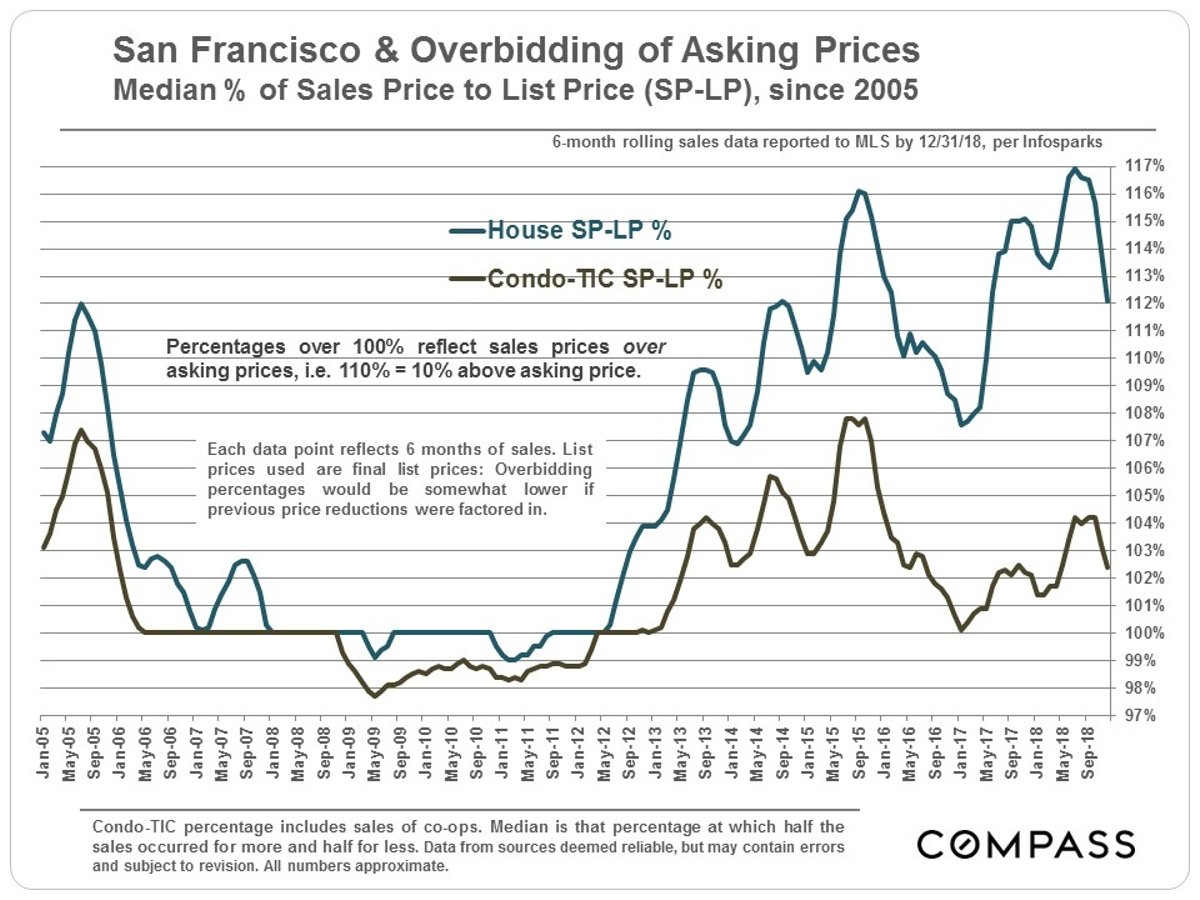
The last few meetings have been interesting.  More than a few agents have talked about slow open houses on week-ends and buyer-clients that are choosing to look outside of San Francisco (I myself have one couple who are considering a move to Seattle).  And rather than listings receiving a dozen offers, agents are happy to have two or three.  Or one.  The practice of creating a blind auction by calling for offers on a specific date may be starting to backfire.  Some properties are receiving no offers at all.  That puts the buyer in the driver’s seat, so more and more agents are returning to the almost ancient way of taking “offers as they come.” Who knows, maybe we’ll even start seeing offers written with contingencies again.

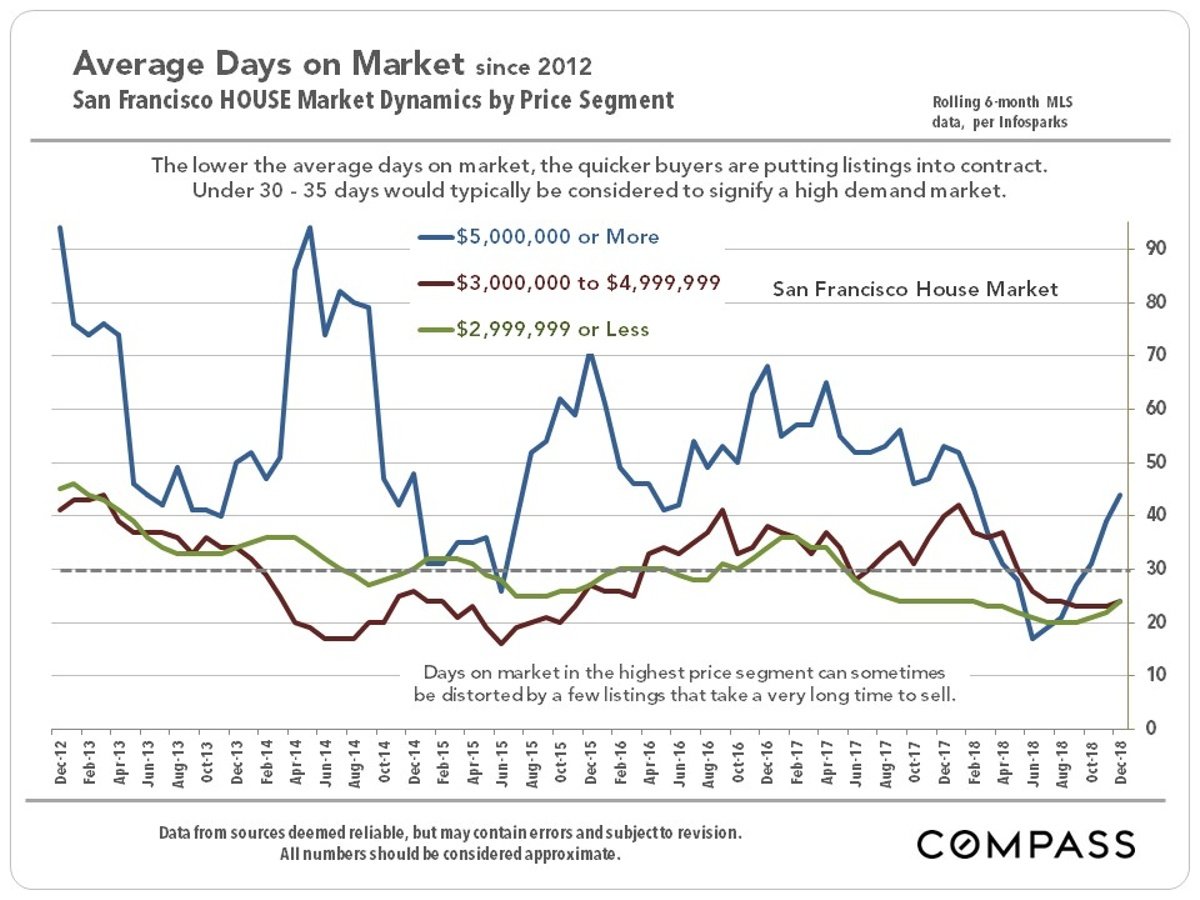
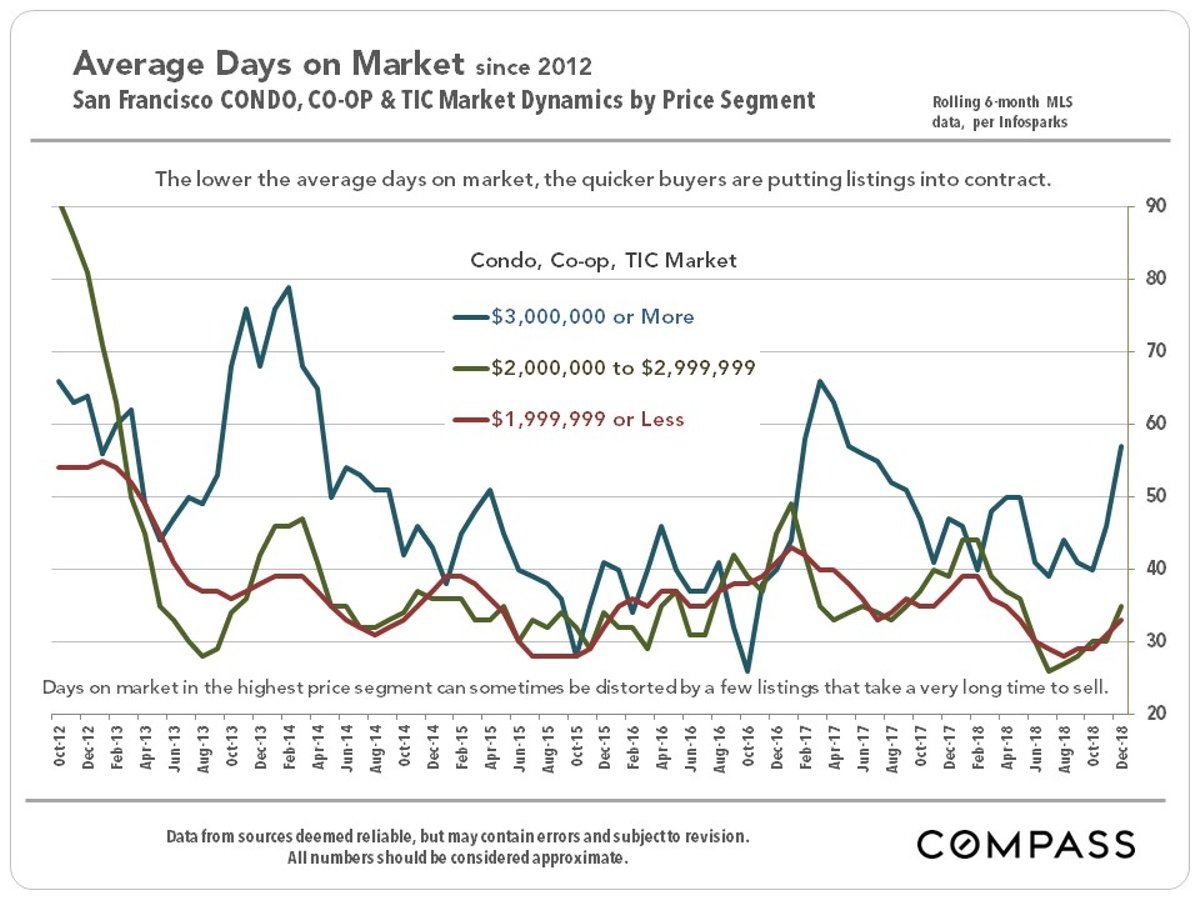
This feeling “on the street” that we may be experiencing the start of a slowdown or correction has been in the news as well.  The New York Times reported recently on cooling markets in New York, Seattle, Denver and “even” San Francisco.  Yet – so far, at least – it hasn’t shown up decisively in the data.  The biggest reason may simply be that data is backward-looking – by about 45 days, which is about how long it takes for a property to get from “on market” to “sold.”  A second reason is seasonality.  Sales, particularly at the higher end, always slow down during the summer.  This results in the data showing fewer new listings, fewer sales, and lower average prices during the summer months and through to September and even October.  Thus, seasonality can itself obscure an underlying slowing trend.

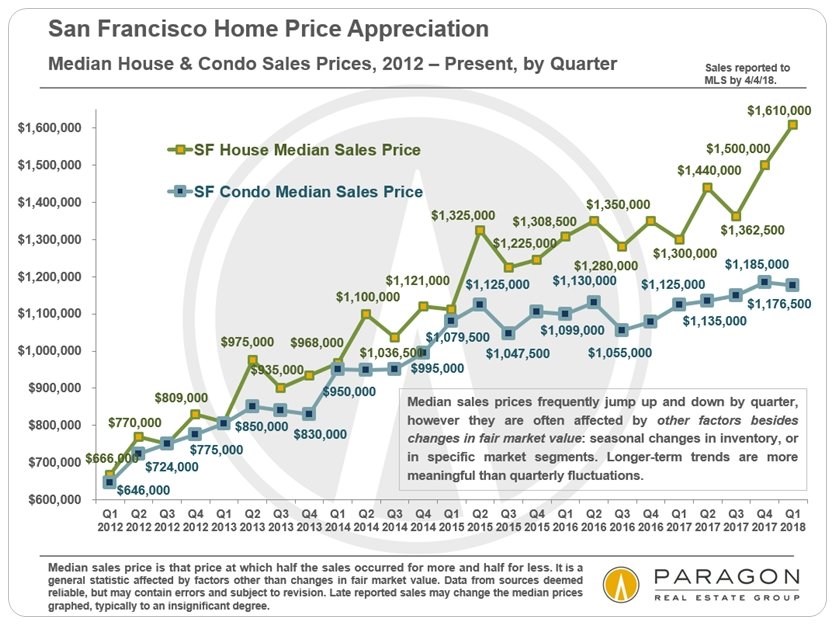
So while median single family home prices dropped to $1,570,000 in the third quarter from their all-time high of $1,620,000 in the second quarter, this could be nothing more than a recurring seasonal effect.  (Median condominium prices dropped from $1,235,00 in Q2 to $1,200,000 in Q3.)  And before anyone panics, it’s worth noting that home prices were up 15% over Q3 2017 and condos were up 4%.

Supply – Increasing (Maybe)

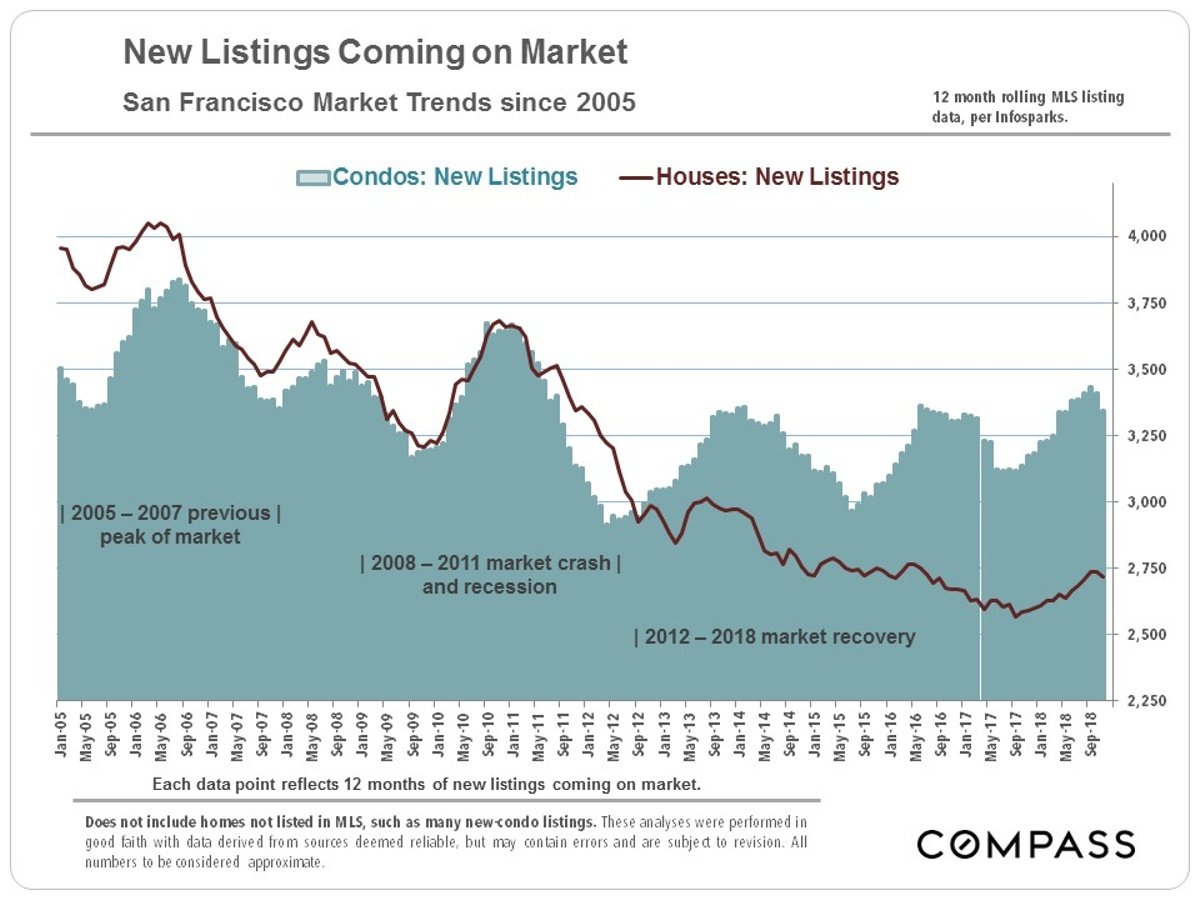
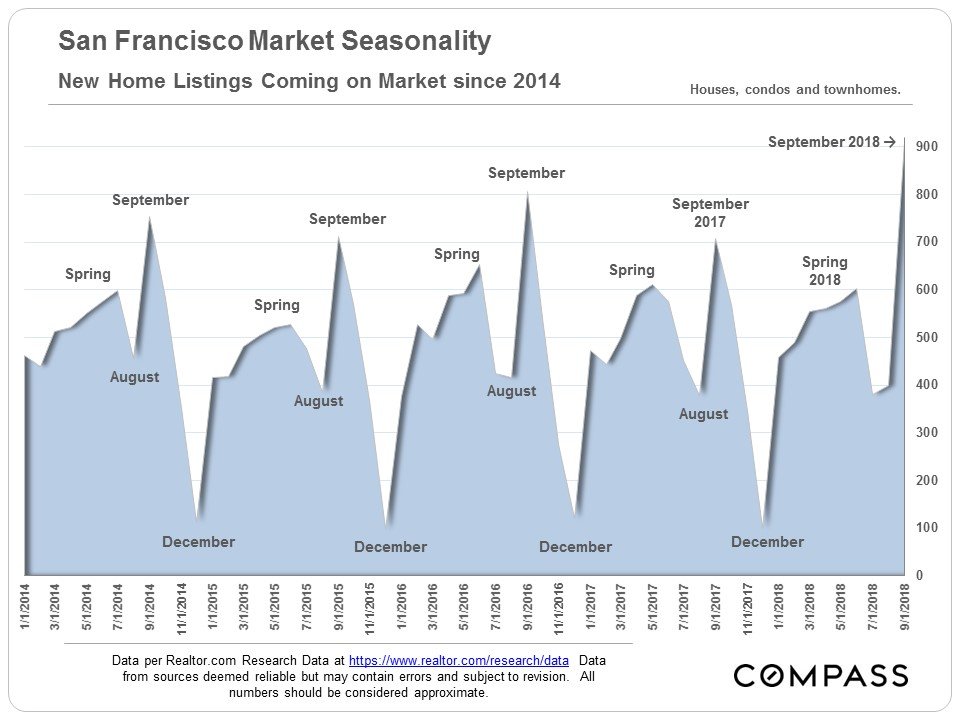
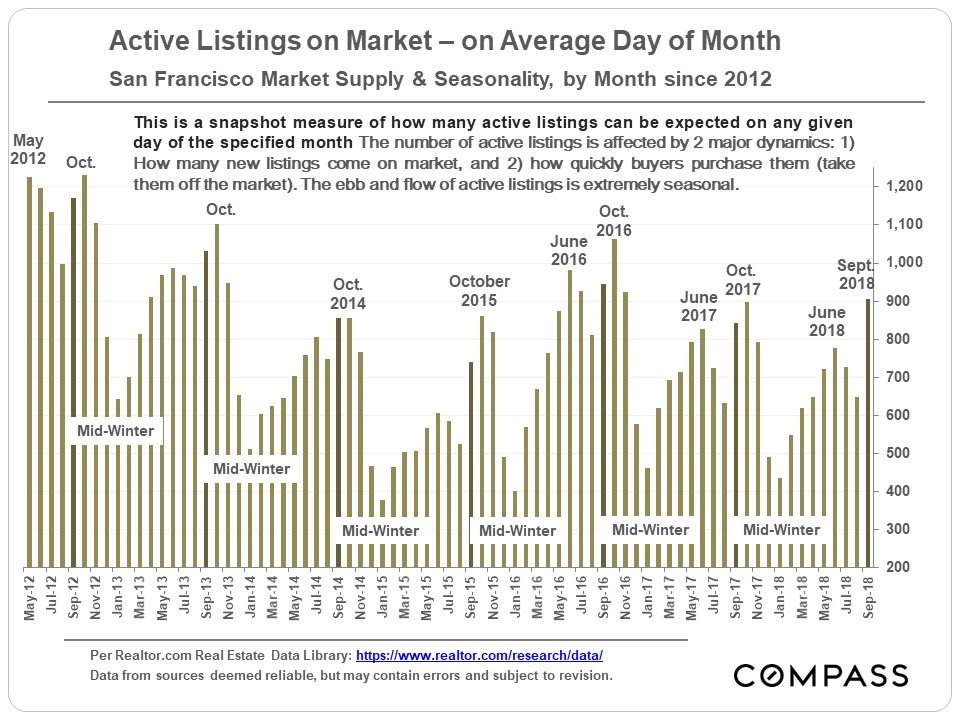
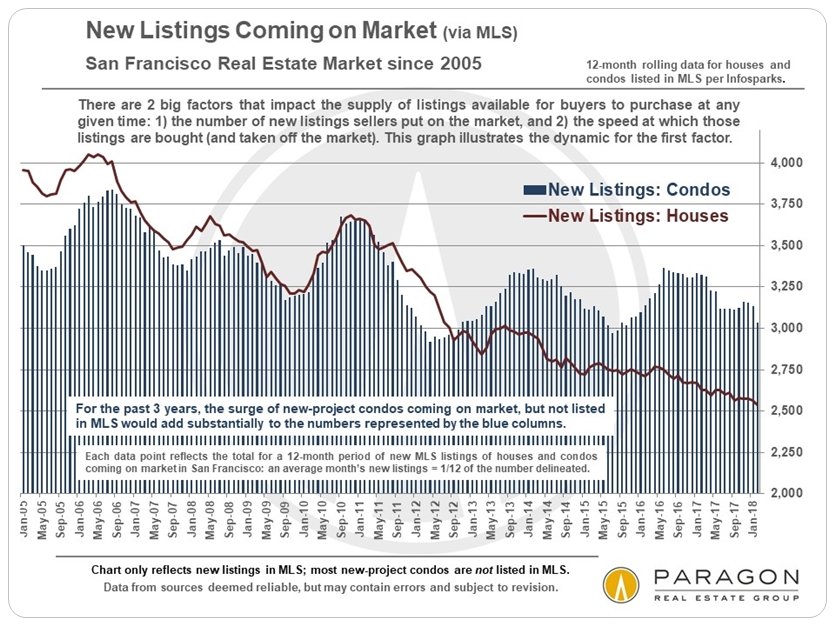
But take another look at the top chart.  September typically brings the largest number of new listings to market as folks try to sell before the market goes into hibernation during the winter months following Thanksgiving.  This September was no different in that regard.  But the number of new listings jumped 28% over September 2017 and hit its highest point in years.

Since constrained supply is one of the things that has been driving San Francisco prices higher, a jump in total active listings – as opposed to new listings — could signal a slowdown. Yet we haven’t seen any dramatic jump in total active listings (see chart below).  While active listings in September were up slightly over 2017, year to date they are about on par with last year and lower than 2016.

Demand –  Decreasing (Maybe)

One of the metrics we look at to measure demand is the number of properties that see a reduction in their list price while on the market.  Some properties are just priced too aggressively to begin with, but for a long time now the reverse has been true:  agents price properties low and expect competing buyers to bid the price up. So a jump in the number of listings with price reductions can signal that the market is cooling off.  If there is the whisper of a chill wind starting to blow it may be in the next chart, which shows a 37% jump in price reductions in September 2017 over the previous year and an 18% increase in reductions over September 2016.  And, perhaps significantly, the higher number of price reductions in 2016 overall (see October 2016 especially) relative to the two previous and subsequent years was in fact accompanied by a market slowdown – albeit a temporary one.

Headwinds

If, in fact, a slowdown has arrived or is on its way, rising interest rates and the recent tumble in the stock market is not going to help.  The NY Times article I mentioned suggests that wage increases simply haven’t kept up with price increases.  And buyers may be starting to realize that the tax law changes enacted earlier this year will result in a decrease in the tax benefits of owning high-priced homes.  Here in SF, that’s pretty much all we have.

The bottom line is that it’s too soon to tell whether September will prove to be just a blip or the start of a meaningful shift towards a market that’s a little kinder to buyers.  As the wise 8-Ball says, “Ask again later.”

As always, your comments, questions, and referrals are much appreciated!

Misha

And a PS.  Some of you may know of my interest in photography.  I’ve started posting a few photos to my Instagram account.  They’re typically of urbanscapes, buildings, or related to interior design.  You can find me at instagram.com/mmmmisha

Prop 10 and How Your Own Home Might Become Subject to Rent Control

I don’t mean to sound alarmist – well yes I do – but there’s a California ballot measure up for vote this November that could significantly curtail your rights as an owner of a single family house or condominium if you should ever decide to rent it out.    

Most people are aware that San Francisco has rent and eviction control legislation.  Briefly summarized and simplified, if you own a multi-unit building (ie. two units or more) which was completed prior to the date the Rent Ordinance was passed, June 13, 1979, you cannot increase the rent of an existing tenant by more than 60% of the annual Consumer Price Index each year. In addition, you can only evict a tenant for a limited set of reasons enumerated under the Ordinance.  In practical effect this means that a lease for a fixed term has no meaning:  once the lease is up, a tenant who is otherwise paying rent on time can stay as long as she wants to stay. And, for as long as she stays, the maximum annual amount that her rent can increase is determined by the Rent Ordinance, not by you. 

Now, some might support Rent Control as way to support affordable housing in the context of an apartment building.  However, they might feel differently if owners of single family homes or condos are subject to the same set of rules as those that govern buildings with two, three, or thirty tenants. 

That’s why Proposition 10 is important: it could mean that in the future San Francisco’s Rent Ordinance will apply to every kind of residential property in San Francisco, including single family homes and condos.

Costa-Hawkins Protects Single Family Homes and Condos from Rent Control

In February 1995, the California Legislature passed a law known as Costa-Hawkins that prohibited local governments like San Francisco from imposing rent control laws on single family homes and condominiums, while leaving rent control regulation on multi-unit buildings intact.  The second important aspect of the legislation was that it prohibited the imposition of rent control on newly constructed residential buildings or, in the case of municipalities that already had a rent ordinance in place, buildings constructed after the date of the local ordinance.  This “new construction” exemption was intended to allay fears that apartment developers would simply stop building in areas where rent control was in effect — thus exacerbating the housing crunch precisely in those areas that needed more housing.

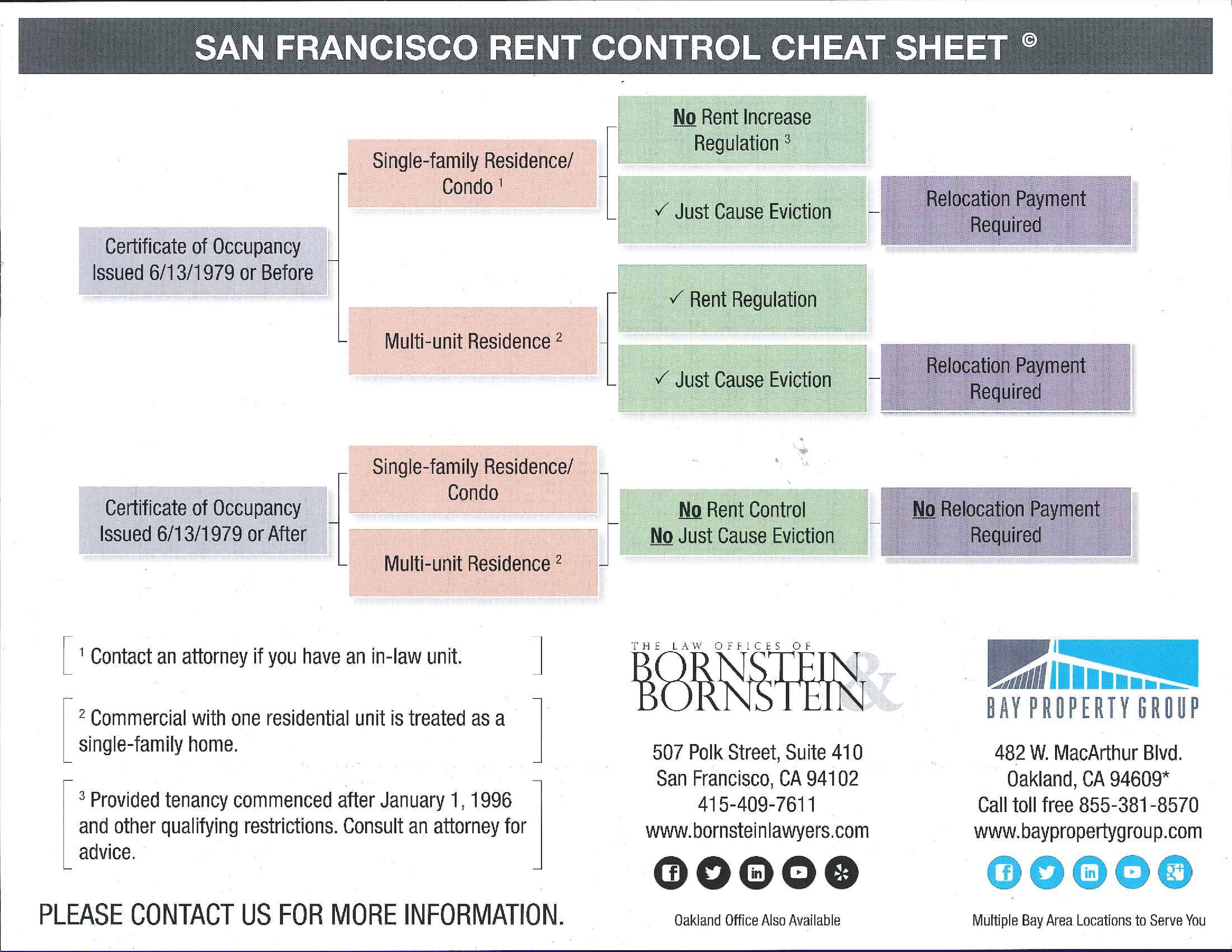
As a result of Costa Hawkins, if you own a home or a condo in San Francisco and you decide to rent it out, it is not subject to rent control – regardless of when it was built.  As for eviction control, it depends on whether the home or condo was built before or after June 13, 1979, when the Rent Ordinance was passed.  If built before, it is subject to eviction control; if built after, it is not.   Complicated?  You bet.  Here’s the best graphic I’ve found to describe how things work now, courtesy of the law firm of Bornstein & Bornstein.

Other important and potentially expensive ramifications follow from whether a property is or isn’t subject to rent control and/or eviction control.  I’ll briefly touch on one – Relocation Payments – which are mentioned in the chart. Say you’re thinking of buying a condo in a building constructed in 1925.  The condo is occupied by a couple with a school-aged child whose original lease has expired and who are now protected from eviction under the Rent Ordinance.  You want to move into it yourself.  This is called an “Owner Move-In Eviction.”  The Rent Ordinance controls every aspect of this process, including: when you can evict the tenant (not during the school year); how much notice you need to give them; and the amount of the “Relocation Payment” you’d be required to pay (for this family, it’s about $25,000 and goes up from there depending on particular circumstances).  Take the same situation but imagine that you’re looking to buy a condo in a new high-rise: none of those same requirements currently apply. 

Prop 10 Would Repeal Costa-Hawkins

Prop 10’s purpose is to repeal Costa-Hawkins and to leave it to local governments to decide which kinds of properties are subject to rent and eviction control. For example, San Francisco could extend its Rent Ordinance to most or all of the residential properties that are currently exempt. Here’s what the Law Firm of Steven Adair MacDonald wrote in its recent bulletin about Prop 10:  (Please email me for a copy.)

If Costa-Hawkins were repealed, local governments could create or expand their existing rent and eviction control ordinances so that all residential units, including, new apartments, single family homes, and condos, are treated alike. Vacancy control could also be implemented, which would limit what a landlord can charge when a unit becomes vacant.


Are such additional regulations likely in San Francisco?  I offer Exhibit A:  In June 2018, San Francisco voters passed Proposition F by a 56% margin.  It requires the City to provide free legal representation to every tenant that is served an eviction notice, regardless of the tenant’s economic means or the circumstances of the eviction.

While proponents of Prop 10 argue that it will give local government the power to protect and expand affordable housing, “opponents argue it will ultimately reduce the housing stock given that landlords can no longer get a reasonable return on their investment and will instead, opt to remove their units from the already shrinking housing market.”  How do you “remove a unit?”  You “Ellis Act” it. That’s a subject unto itself.

Will it Pass?

Proponents and opponents are both spending at a furious rate.  While California’s home-ownership rate is 54% according to the US Census,  a recent UC Berkeley study found that 60% of likely voters support rent control.  I haven’t been able to find any current predictions on whether the measure will pass but given the general and understandable frustration about high rents in many parts of the state, I’d say that there’s a better than 50/50 chance that it will.

Why it Matters

It’s one thing to believe that the owners of multi-unit buildings who have chosen to be “in the business” of owning residential income property should be subject to rent control legislation.  It’s quite another to apply those same regulations to someone who originally bought a home or a condo for their own use and who then later decided to rent it out.  People move away temporarily for work reasons and want to rent out their home to cover the cost of their mortgage.  Others want to “downsize” but get income from their home for their retirement. Others may simply want to eventually pass the home on to their children.

If Prop 10 passes and San Francisco extends its Rent Ordinance to homes and condos, perhaps more people will choose to sell once they no longer intend to occupy their homes or condos themselves.  Others who can afford to may simply keep their homes vacant rather than subject themselves to the Rent Ordinance. Yet others, may think twice about owning property in San Francisco at all.

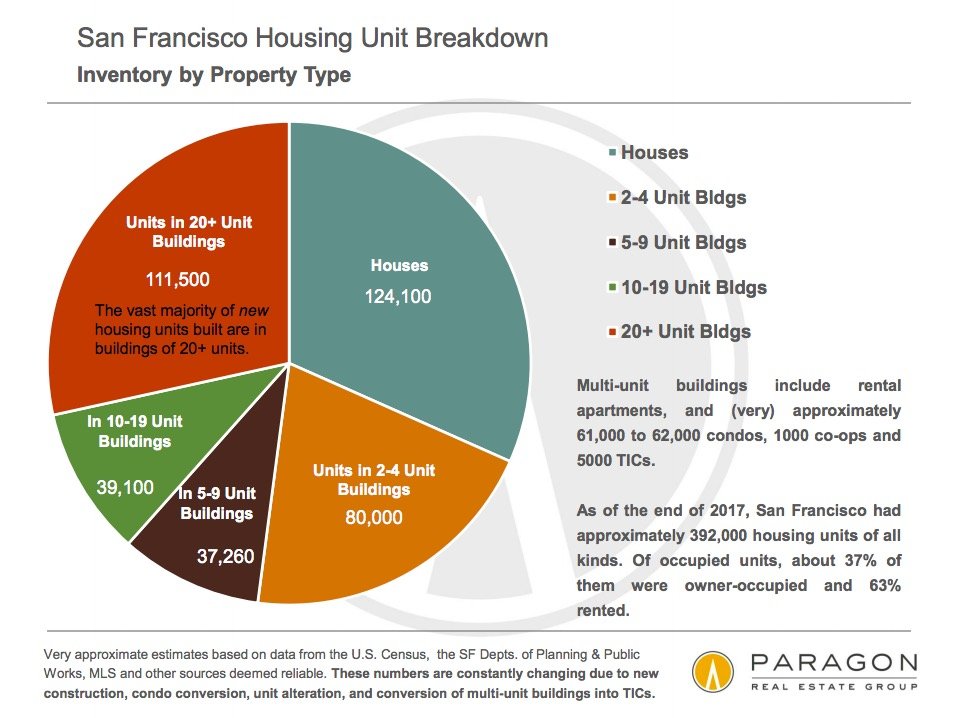
My purpose in this newsletter is not to bash rent control.  Housing affordability is a real and complex issue.  Is rent control a good policy solution?  Academicians and economists seem on balance to think it is not, but I’m in no position to judge their conclusions. Still, considering that about 37% of SF’s 390,000 housing units are owner-occupied, I think it’s fair to say Prop 10 could have an enormous effect on San Francisco’s homeowners.

What to Do?  Talk to an Attorney, Really

It should be abundantly clear by now that buying, selling or owning a property in San Francisco that is tenant-occupied – or even that has previously been tenant-occupied — can be a veritable legal minefield.  If you own or are thinking of buying residential income property in San Francisco or elsewhere in California, I urge you to read this excellent non-partisan article about Proposition 10.  Then sit down with an attorney that specializes in residential real estate law.  Please call or email me if you need a referral.

For people who might be thinking about renting out their home or condo for a while – say, during a temporary relocation – again, I urge you to consult with an attorney and to consider delaying the rental until we see if Prop 10 passes.  You might find that getting your home back when you want it is more difficult and expensive than you anticipated.

Thanks for your patience on this especially long newsletter.  As always, your comments, referrals and suggestions are much appreciated.

[Note, this newsletter is not to be construed as legal advice on any of the matters discussed within it and is intended for general informational purposes only.]

2018 San Francisco Mid-Year Real Estate Report: Hot and Hotter

(Writing this from Prague, possibly one of the most beautiful cities in Europe.)  Our mid-year report is out and it reflects nothing less than a sizzling seller’s market for single family homes, one that has re-ignited after something of a two-year lull — if that’s the word for a market that’s “only” been increasing by 6 to 7 percent per year.

Year to date, median prices for single family homes have increased by 14.5% over 2017.  The median price is now $1.62 million (see next two charts).

Meanwhile, condos prices have also accelerated albeit at a slower pace.  After a flat year in 2016 and a 5% increase in 2017, the median price has increased 6.2% year-to-date and now stands at $1.221 million (see chart above and below).

And these increases come against a backdrop of rising interest rates (though still at historic lows), not to mention recent tax law changes that limit the benefits of home ownership tax deductions.

Why such increases?  Well, the booming local and national economy certainly suggests that the “demand” side of the supply/demand equation remains healthy.  Meanwhile, the “supply” side remains at historically low levels — for reasons that, as I’ve written about previously, indicate a secular shift in the market, particularly for single family homes.

I could throw more charts at you, but they all point to the same thing:  no relief in sight for increasing home prices in the immediate future.  Will the party (for sellers) ultimately come to an end?  Of course it will, but it’s hard to see it happening any time soon based on current trends.  For buyers that are squeamish about entering the market, my counsel remains the same:  if your time horizon is a minimum of 5 to 7 years, you should be OK.  San Francisco, is a global city and, having seen it go through a number of recessions, I remain bullish on its long-term future.  But if you think you might need to sell in less than that time period, be careful:  you could get caught during a downturn.

And finally:  some of you may have read the news that Paragon is going to be acquired by Compass Real Estate.  The merged company will easily be the dominant residential real estate brokerage in San Francisco, and one of the leaders throughout the Bay Area.  To be honest, since the announcement was made while I’ve been out of town, I haven’t had the opportunity to learn all the details yet.  I’ll get back to you when I’ve learned more.

As always, your comments, questions, and referrals are much appreciated!

Misha

Will the Last One Leaving the Bay Area Please Turn Out the Lights?

Media Reports Sound the Death Knell of the Bay Area
– a Mite Prematurely

“49 % of Bay Area residents were looking to move out.”
Business Insider

“San Francisco is such a boomtown that people are leaving in droves.”
Wall Street Journal

“Silicon Valley is over…. In the last three months of 2017, San Francisco lost more residents to outward migration than any other city in the country.”
New York Times

“San Francisco is so expensive that more people are leaving than moving in – and it could mean disaster for the nation’s tech capital.”
SFGate

As our oft-quoted Chief Market Analyst, Patrick Carlisle,  says in his recent report, “That sounds really bad.”  It turns out that the sensational headline stories quoted above were largely based on questionable and selective data and then amplified in the media in the ways that we’ve all become accustomed to.  This month, I’m reposting an abbreviated version of Patrick’s report.  The bottom line:  if everyone’s leaving the Bay Area in droves, you’d think it would be showing up in real estate prices.  It’s not – on the contrary, Bay Area prices, including San Francisco, continue to hit new highs.  Read on!

The sources of the data behind the above (and many more) articles: an online survey by a PR company; an analysis of traffic on a real estate website; the alleged cost of a U-Haul to Las Vegas; anecdotal opinions from a handful of venture capitalists on a mid-west bus tour; and new U.S. census data, more often than not selectively or misleadingly quoted to sound most ominous.

Bad news, predictions of crashes, the arrogant finally getting their comeuppance: These stories grab eyeballs and get re-posted on social media. And much of the country finds the Bay Area insufferably smug – its wealth, home prices, unicorns, Google buses, 26-year-old billionaires, liberal politics, and much else – and if it is finally getting its just deserts, that is entertaining news. I get that: Sometimes, I find us insufferably smug myself. But let us investigate the issues a bit deeper.

First of all: Without argument, there are big economic and social challenges facing the Bay Area: high housing costs; high state income taxes; recent federal tax law changes; the hostility of the current federal government to foreign immigration; rising income inequality, poverty and homelessness; growing commute times and other quality of life issues; national and international concerns; and, yes, population migration trends too. This was covered in some detail in our recent report Positive & Negative Factors in Bay Area Markets. It is certainly true that places like Austin and Seattle, with much lower housing costs and no state income taxes, are actively luring our businesses to relocate or expand there, and doing so with some significant success.

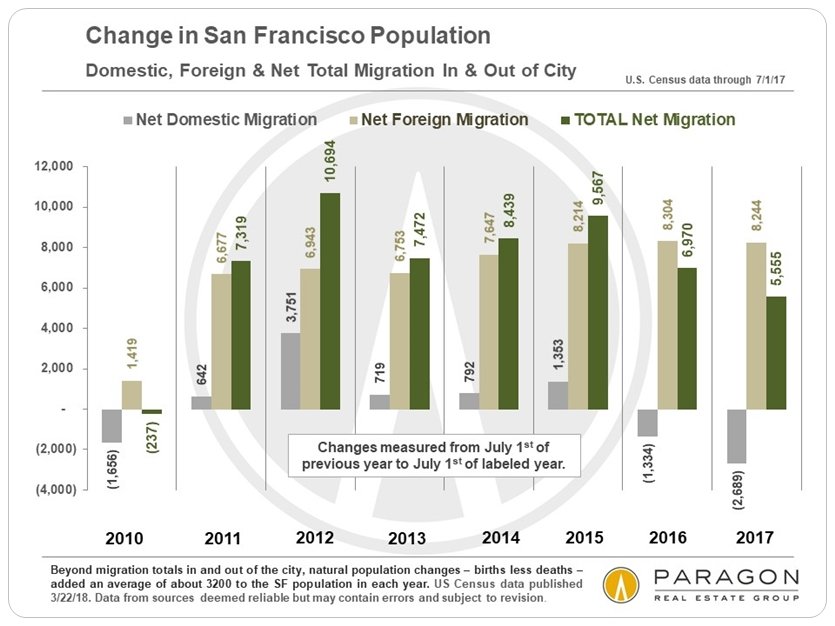
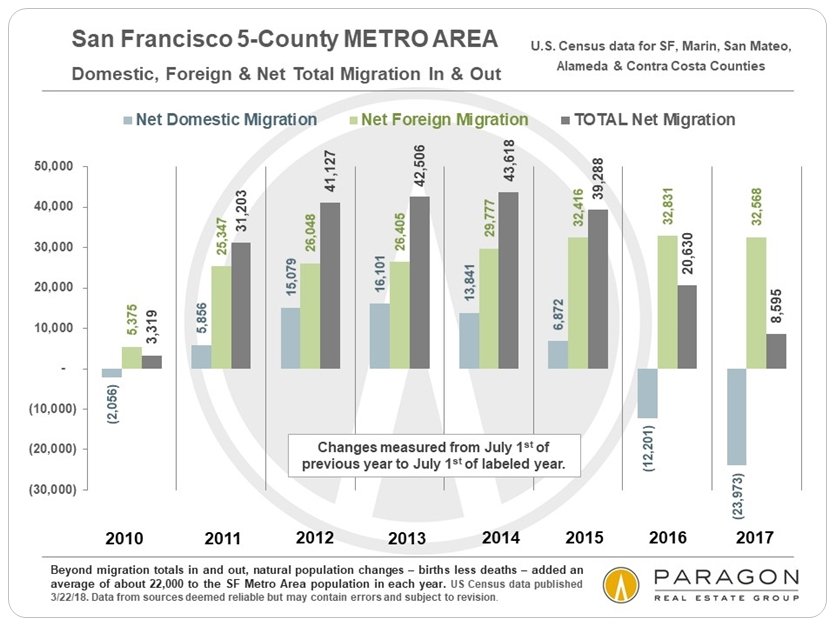
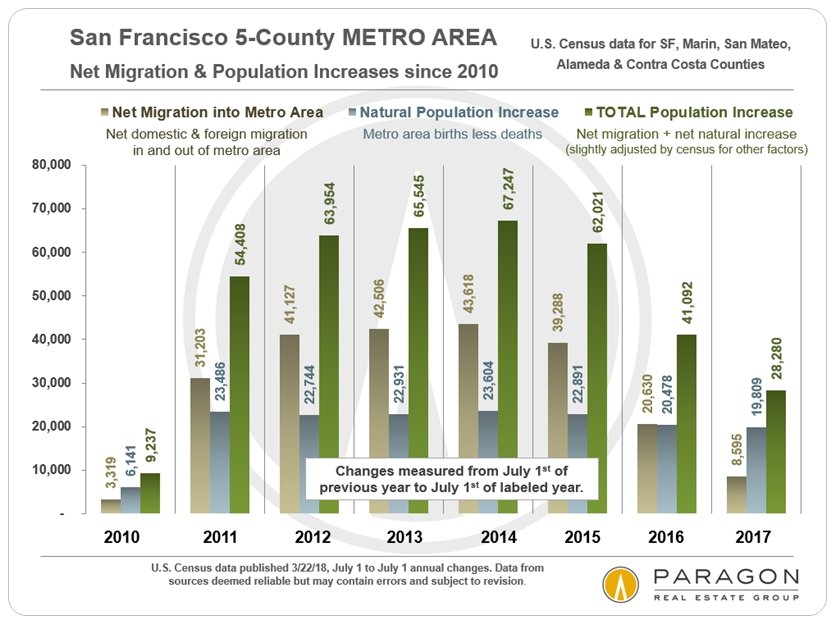
But, for a much more realistic illustration of what is going on in the Bay Area, here is some hard data from U.S. Census and CA Employment Development Department data released in March:

More people are NOT leaving San Francisco or the Bay Area than arriving. When you tally both domestic migration and foreign migration, more people are arriving than leaving. It is true than in the past 2 years, domestic net migration has shifted to a net loss, but that deficit is still overcome by the large positive in foreign immigration. Is the shift in domestic migration worrisome? Yes, if it continues to grow. But it is not cataclysmic in its current proportions, and there are further underlying factors to consider, which shall be discussed later in this report.


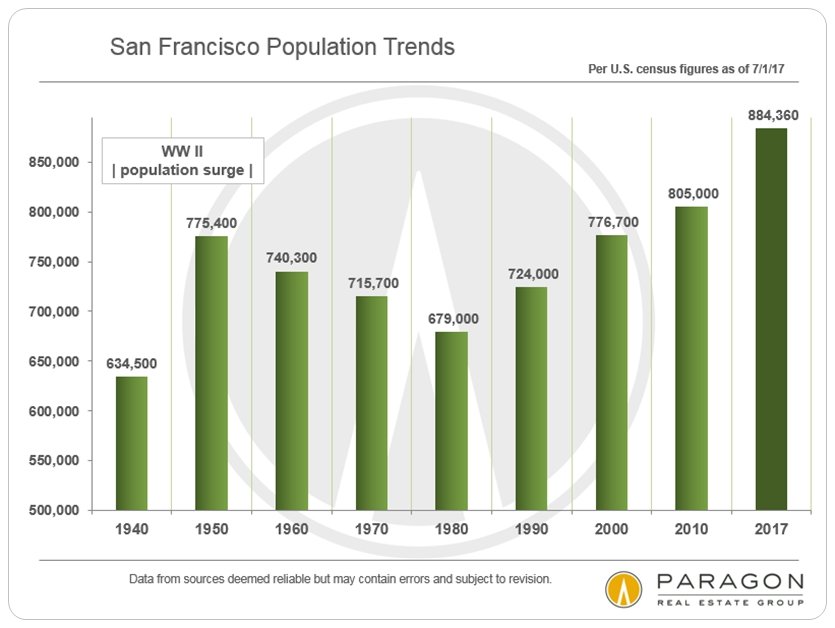
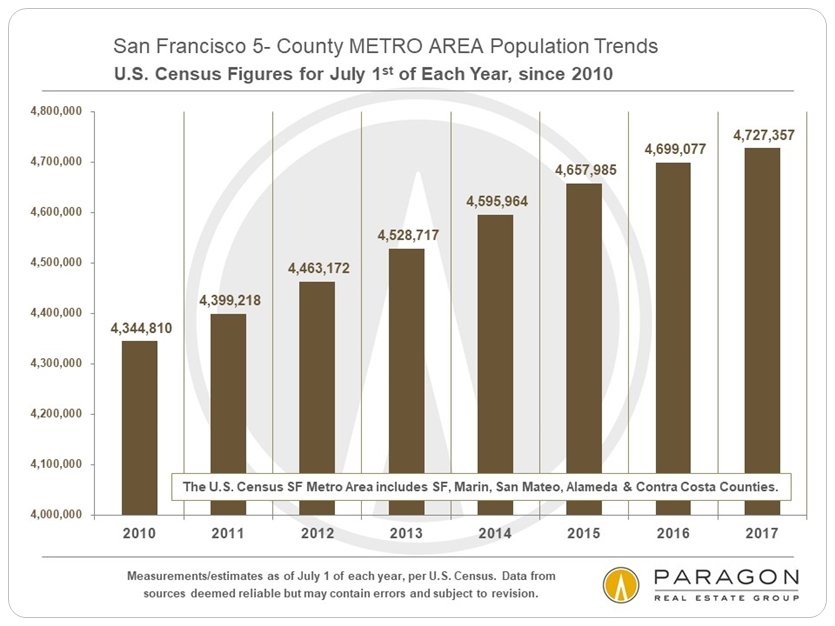
The Bay Area population is still growing both from migration and natural factors (births less deaths), albeit at slower rates than the torrid pace of previous years. As the WSJ admits in its article, SF and SF metro area populations are not shrinking: The SF Metro area population increased by .6% in the last 12 month period, as measured by the census through 7/1/17, which is one tenth of 1 percent lower than the .7% national average. A slower rate of growth than our recent population explosion is actually a good thing, since the Bay Area is bursting at the seams from growth without concomitant improvements in housing supply and infrastructure.

The representation by Business Insider that 49% of residents were looking to move out is simply absurd. Really? Every other person? If people were fleeing or planning to flee in the proportions suggested, one would expect every other home in the Bay Area to sport a “for sale” sign, while the percentage of homeowners selling their homes is actually at historic lows: Less than 2% of SF house owners sold their homes in 2017. (The ratio was higher for condo owners, but still low at something over 4%.) I suppose it is possible that in the frenzy to get away, people are simply abandoning their homes instead of selling them.

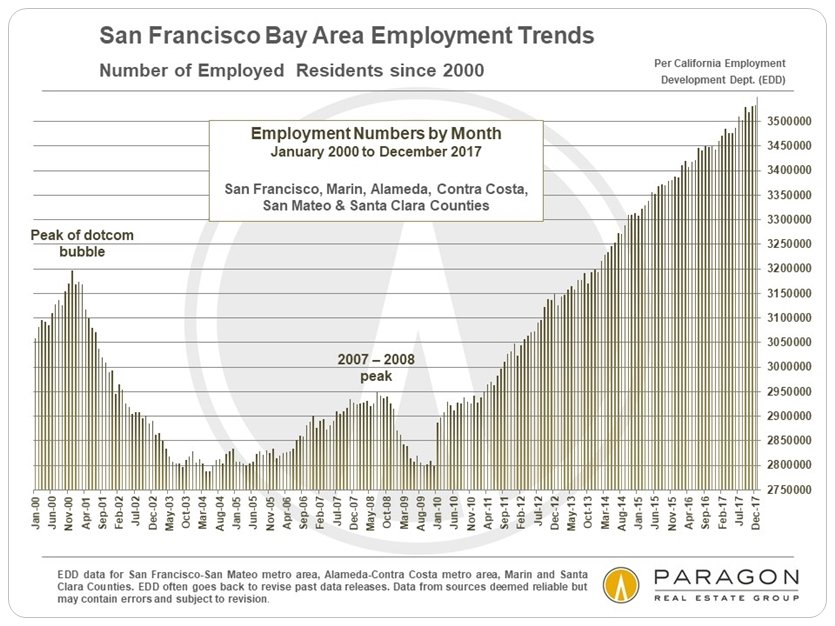
Bay Area employment growth remains extremely strong. According to the CA Employment Development Department, for the six big Bay Area counties (the 5-county SF metro area plus Santa Clara County), no matter which month of 2017 one looks at, the year-over-year increase in Bay Area employed residents ranged from 60,000 to 90,000. As the WSJ notes: “The broader Bay Area is the most robust metro region in the nation in terms of payroll job growth, according to the most recent regional analysis from the University of California-Los Angeles Anderson Forecast, an economic forecaster.”

Some other factors to consider:

The Bay Area over the past 7 years has been one of the greatest new-wealth creation machines in history. With the recent Dropbox IPO, it seems to be cranking into gear again – and there are still dozens of other local unicorns such as Uber, Pinterest, Airbnb, Palantir, with total values in the hundreds of billions of dollars – that could yet go public. Uber has already stated its desire to do so in the near future.

A significant portion of those leaving the Bay area are retirees, cashing out on high home prices to move to less expensive locales, such as other counties in California, and Nevada, Arizona and Oregon. This is not a new phenomenon, as it has been going on for decades, though it may have accelerated in recent years, since cashing out has become so much more lucrative.

Most of those coming to the Bay Area are coming for new jobs, and the Bay Area remains a magnet for many of the best and the brightest around the world. Besides which, every year, thousands of Bay Area students graduate from schools like UC Berkeley, UCSF and Stanford, to take jobs locally as well. Economically, the Bay Area is trading many residents who are, to a large degree, checking out of employment for people in the prime of their working lives. A new 2018 study by BuildZoom (whose accuracy we cannot evaluate) found that the median income of people moving into the Bay Area was substantially higher than that of people moving out: According to the study, from 2010 to 2016, newcomers out-earned relocating residents by about $18,700.

Millions of square feet of new commercial office space continue to be snapped up as soon as they come on market, even before the buildings are finished, and the only possible reasons are new businesses arriving and existing high-tech, bio-tech and fin-tech businesses – such as Google, Facebook, Amazon, Dropbox – continuing to expand, both of which are fueled by continued hiring.

Last, but not least, neither Bay Area home prices nor rents have, so far, been dropping – most median home sales prices jumped in 2017 and early 2018, and rents stayed relatively unchanged – which one would expect to see if the doom-laden media articles were correct in their analyses.

The Bay Area certainly has substantial economic, social and demographic challenges to face and it is not sure it will overcome its problems. And it is true that people and businesses are moving out in greater numbers than any time since 2002. But, on the other hand, start-ups continue to start up by the 

hundreds, local business continue to expand, and the Bay Area undoubtedly remains one of the most innovative and dynamic economies in the world. 

And despite all its faults and problems, it is still, in my opinion – and the opinion of most of the people I’ve met around the Bay Area, the country and the world – one of the great metropolitan areas on the planet.  

As always, your questions, comments, “likes” on FB/LinkedIn, and referrals are always appreciated!

Misha

Who is San Francisco?


Every year we publish an in-depth look at San Francisco and the Bay Area told almost exclusively in charts.  The focus is not on real estate but rather on who we are, what we do, what we believe in.  While some of the charts simply confirm widely-known data– for example, that Asians as a group represent the largest minority in San Francisco (33.5%) — others reveal the most obscure and amazing things.  For example, did you know that there are almost as many dogs in San Francisco as there are trees?  Coincidence you say?  You can find all 32 charts, with links to dozens more, here.  I’ve cherry-picked some of my favorites below (Click the charts to expand them).


Continue reading “Who is San Francisco?”

The 2017 San Francisco Real Estate Wrap-Up: Data Sliced and Diced


2017 is a wrap, and it’s been another solid one for residential real estate in the City by the Bay.  For anyone so inclined you can read our full report —  complete with over 41 charts— here.  For those with less than a couple of hours to kill, I’ve sliced and diced the juiciest parts below.

Going Up

2017 was the seventh year in a row that the median price for a single family home in San Francisco increased.  It’s now over $1.4 million.  After taking a breather for the last couple of years, condominium prices also resumed their climb: their median price is $1.150 million.  Our data indicates that fourth quarter prices for both homes and condos are already above these figures.

Continue reading “The 2017 San Francisco Real Estate Wrap-Up: Data Sliced and Diced”

Winter: The Best Time of Year — for Buyers


I wanted to entitle this newsletter “Winter is Coming,” but decided that comparing buyers to the Dead Walkers might not go down well.  Besides, it’s buyers that have been getting the short end of the, um, spear for years now.  Prices really took off in 2012; with inventory relentlessly low (see my previous newsletter, it’s been a seller’s market ever since.

But everything slows down in winter.  There’s (even) less inventory, and buyers — being human — batten down the hatches from approximately Thanksgiving through early February.  Who wants to be out house-hunting when the weather’s turned cold and dreary? Besides, everyone is either preparing for or recovering from the Holidays.

Continue reading “Winter: The Best Time of Year — for Buyers”