San Francisco & Bay Area Home Values – in Maps

May 2013 Update

Below are 3 maps delineating recent median home sales prices and/or average dollar per square foot values for San Francisco neighborhoods and communities around the Bay Area. These statistics are generalities which may fluctuate for a variety of reasons, but still give an idea of comparative home values in and around the city.

Generally speaking, home price appreciation is continuing and indeed accelerating in 2013, extending the upward swing that began in 2012. This is being supercharged by increasing demand meeting inadequate supply. For more information about current market conditions and trends, please click on the “Market Dynamics Charts” link above.

In the maps below, “k” signifies thousands of dollars; “m” signifies millions; “$/sf” means average dollar per square foot; and “N/A” means there wasn’t enough data to generate a reliable number.

Home Values around the San Francisco

1

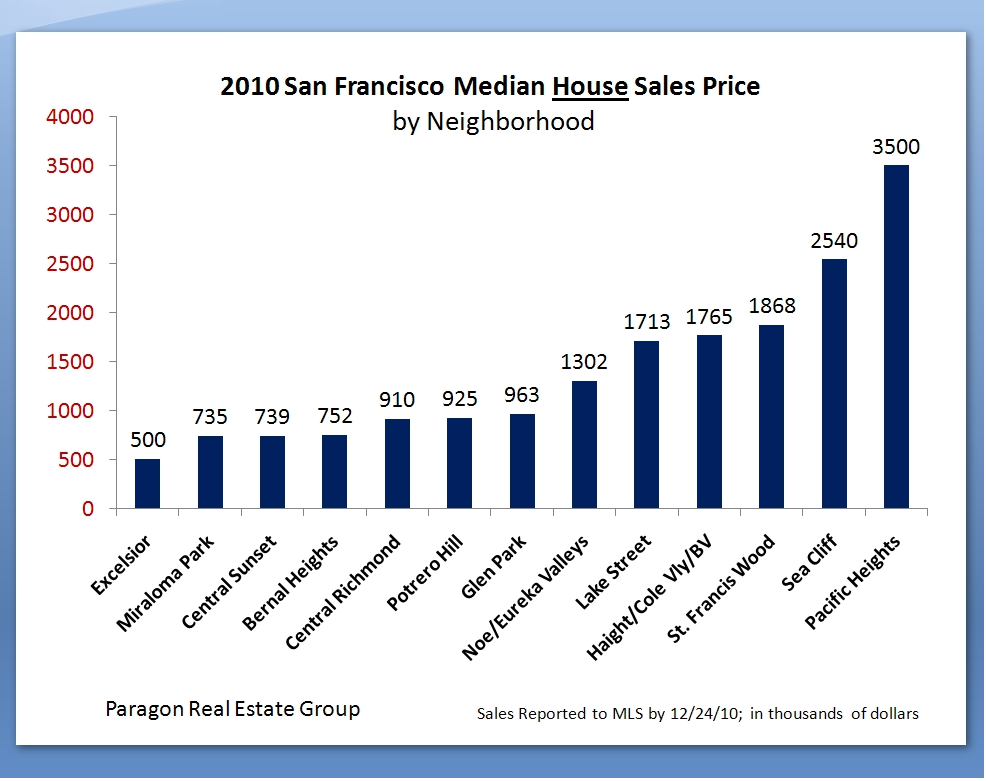
San Francisco Neighborhood HOUSE Values

2

San Francisco Neighborhood CONDO Values

3

Real estate statistics in the Bay Area are based upon that relatively unique basket of homes that happen to sell within any given period, so instead of being exact measurements applicable to specific properties, they should be considered indications of the direction and approximate scale of market trends.

Median price is that price at which half the sales occurred above and half below – a single additional sale can sometimes make a 3-5% difference in overall median price, especially when the number of sales is low. Dollar per square foot is based on “livable space”, which should not include decks, patios, yards, garages, unfinished basements and attics, or rooms built without permit (“bonus rooms” and “in-law apartments”). Square footage figures are often unreported, measured in different ways or simply unreliable. Both these statistics can be affected by other factors besides changes in value, such as seasonality, available inventory, variations in buyer profile, changes in the distressed and luxury home markets, and variations in average home size (all things being equal, a smaller home will have a lower sales price but a higher dollar per square foot value than a larger home).
These analyses were performed in good faith with data derived from sources deemed reliable, but they may contain errors and are subject to revision. If you have any questions, please contact us.

March Newsletter: What Costs How Much Where in San Francisco

San Francisco Home Values by Neighborhood & Bedroom Count

The March 2013 Paragon Market

1

We’ve just completed our semiannual review of SF house and condo values by average and median prices, average size and average dollar per square foot for sales occurring September 1, 2012 – February 28, 2013, as reported to MLS.

The maps contain median sales price data only, while the tables include the full range of value statistics. (The tables are easier to read, but they’re not as colorful.) If a price is followed by a “k” it references thousands of dollars; if followed by an “m”, it signifies millions. Remember that medians and averages are very general statistics.

Further down in the newsletter are charts tracking supply and demand dynamics and price appreciation trends for the city’s residential real estate market. Statistical definitions can be found at the very bottom. For the smaller images, you’ll need to click-to-expand them to really make them decipherable.

2
 
4-Bedroom House Values
This is the table for 4-bedroom house sales over the past 6 months. This link goes to the full analysis by property type, neighborhood and bedroom count.
Neighborhood, Property Type, Bedrooms

3


2-Bedroom Condo Median Price Map
A map of median sales prices for 2-bedroom condos around the city. The table in the full analysis provides further statistical measures.
Full Analysis

4
 
Trends in Inventory & Sales Volume
Sometimes there’s nothing like a chart to depict trends. Here one can clearly see the drastic decline in inventory. And this link goes to a chart on Months Supply of Inventory, another statistic of supply and demand:
Months Supply of Inventory

5New Listings Coming on Market
The quantity of new listings ebbs and flows by season, however even accounting for seasonality, the number of new listings coming on market is much lower than usual. And this link shows the increasing demand since the market recovery really got underway in 2012:
Percentage of Listings Accepting Offers

6Median Price Trends by Month
Monthly price data often fluctuates due to a variety factors. For example, median and average prices almost always drop in January since the higher end of the market usually checks out for the holidays: Values haven’t changed; the demographic of buyers and available inventory changed. However, the clear upward trajectory of prices over the past year is clear in both median and average sales prices.
Average Price Trends

The MEDIAN SALES PRICE is that price at which half the properties sold for more and half for less. If there were 3 sales, at $1, $2 and $10, the median price would be $2. If there were 4 sales at $2, $2, $5 and $10, the median would be $3.50. Median sales price may be affected by seasonal trends, and by changes in inventory or buying trends, as well as by changes in value.

AVERAGE DOLLAR PER SQUARE FOOT is based upon the home’s interior living space and does not include garages, storage, unfinished attics and basements; rooms and apartments built without permit; decks, patios or yards. These figures are typically derived from appraisals or tax records, but can be unreliable, measured in different ways, or unreported altogether: thus consider square footage and $/sq.ft. figures to be very general approximations. Generally speaking, about 60-80% of listings report square footage, and dollar per square foot statistics are based solely on those listings. All things being equal, a house will have a higher dollar per square foot than a condo (because of land value), a condo will have a higher $/sq.ft. than a TIC (quality of title), and a TIC’s will be higher than a multi-unit building’s (quality of use). All things being equal, a smaller home will have a higher $/sq.ft. than a larger one. The highest dollar per square foot values in San Francisco are typically found in upper floor condos in prestige buildings with utterly spectacular views.

The AVERAGE SIZE of homes of the same bedroom count may vary widely by neighborhood: for example, the average size of a 4-bedroom house in Pacific Heights is much larger than one in Noe Valley; and the average of a Marina 2-bedroom condo is larger than one in South Beach. Besides the affluence factor, the era and style of construction often play large roles in these disparities.

Some neighborhoods are well known for having additional ROOMS BUILT WITHOUT PERMIT, such as the classic 1940′s Sunset house with “bedrooms” and baths built out behind the garage. These additions often add value, but being unpermitted are not reflected in $/sq.ft. figures.

Many aspects of value cannot be adequately reflected in general statistics: curb appeal, age, condition, views, amenities, outdoor space, “bonus” rooms, parking, quality of location within the neighborhood, and so forth. Thus, how these statistics apply to any particular home is unknown.

Updated San Francisco Market Charts

Sales Price to List Price Percentage & Days on Market

In November, the vast majority of San Francisco homes that sold, sold very quickly without any price reduction, at an average sales price 4% above the list price: That is a strong, hot market. Properties that had to go through price reductions took over 2 months longer to accept offers and sold at a significant discount to original list price. And even in a hot market, there are listings that do not sell at all, but expire or are withdrawn from the market: Many of these will ultimately be relisted at lower prices and eventually sold.

Average Sales Price

The average price is simply the total dollar volume of sales divided by the number of sales. Like median price, it is a general statistic affected by a variety of factors and often fluctuates without great significance on a monthly basis. Among other factors, a decline in distressed home sales and/or an increase in high-end home sales, both of which are occurring now in SF, can have an outsized effect on average sales price. October saw a big jump in average sales price, and then it went up again in November. If the market acts in its typical manner, it will now fall in December and January, since the more affluent home market tends to withdraw for the holidays. (We limit this analysis to sales of up to $3m because the 5% of home sales above that – going up to $12m – $20m – severely distort the overall average by hundreds of thousands of dollars.)

Median Sales Price

The median home sales price is that price at which half the sales occurred for more and half for less. It is a very general statistic and what’s important is the trend over the longer term — monthly fluctuations are normal. Still, October-November saw a large increase over the relatively static median prices seen in the previous 6 months, which followed the big jump in early 2012. Usually, median prices will fall in December and January as the higher end market checks out for the holidays. Remember that sales prices reflect accepted offer activity in the 4 to 10 weeks prior. (The small decline from October to November is probably not statistically significant – unless substantiated as a longer term trend.)

Months Supply of Inventory: Very Low

MSI is a measure of how long it would take to sell the current supply of listings at the existing rate of sales. In October and November, it was about as low as it has ever been. This would typically be interpreted as a strong “seller’s market.”

New Listings & the Inventory of Listings for Sale

After the inventory spike in September from the large influx of new listings, in October and November the number of new listings (the first chart below) and the total number of homes for sale (second chart below) are markedly declining and will almost certainly continue to do so until early 2013.

Percentage of Listings Accepting Offers (Buyer Demand)

The statistic used on this chart boils down the supply and demand dynamics into a single statistic. The percentage of listings accepting offers in October and November was probably about as high as it has ever been, far above the level of previous years. The decline seen in September was the result of a large influx of new listings hitting the market in mid-month – these were snapped up at the same fast rate, but many didn’t accept offers until October, after a reasonable marketing and showing period.

San Francisco Residential Market Trends in Realtor District 5: Noe/ Castro/ Haight

A statistical market overview for Noe Valley, Eureka Valley & the Castro, Cole Valley,
Mission Dolores, Haight Ashbury, Ashbury Heights, Clarendon Heights, Parnassus Heights,
Corona Heights, Glen Park, Twin Peaks & the Duboce Triangle

Below are a variety of charts detailing market conditions and trends in the neighborhoods of San Francisco’s central Realtor District 5. District 5 is one of the more homogeneous districts in San Francisco in terms of property values, but still any analysis of an area with so many properties of different type, location, condition and quality can only be a very general overview.

District 5 soared in value between 1996 and 2008 and was one of the last districts to peak in value before the market meltdown in September 2008. Values fell 15% to 20% very quickly and then stabilized in 2009 and 2010. The market started to turn around in 2011 and, now in 2012, the competition between buyers has become ferocious: inventory is very low and many of the listings are selling very quickly in multiple-offer, competitive-bidding situations. This is exerting considerable upward pressure on prices: generally speaking, values are soaring once again.

******************************

MEDIAN SALES PRICE is that price at which half the sales occur for more and half for less. It can be, and often is, affected by other factors besides changes in market values, such as short-term or seasonal changes in inventory or buying trends. Though often quoted in the media as such, the median sales price is NOT like the price for a share of stock, i.e. a definitive reflection of value and changes in value, and monthly fluctuations are generally meaningless. If market values are truly changing, the median price will consistently rise or sink over a longer term than just 2 or 3 months, and also be supported by other supply and demand statistical trends.

AVERAGE SALES PRICE is calculated by adding up all the sales prices and dividing by the number of sales. It is different from median sales price, but like medians, averages can be affected by other factors besides changes in value. For example, averages may be distorted by a few sales that are abnormally high or low, especially when the number of sales is low.

DAYS ON MARKET (DOM) are the number of days between a listing going on market and accepting an offer. The lower the average days on market figure, typically the stronger the buyer demand and the hotter the market.

MONTHS SUPPLY OF INVENTORY (MSI) reflects the number of months it would take to sell the existing inventory of homes for sale at current market conditions. The lower the MSI, the stronger the demand as compared to the supply and the hotter the market. Typically, below 3-4 months of inventory is considered a “Seller’s market”, 4-6 months a relatively balanced market, and 7 months and above, a “Buyer’s market.”

DOLLAR PER SQUARE FOOT ($/sqft) is based upon the home’s interior living space and does not include garages, unfinished attics and basements, rooms built without permit, lot size, or patios and decks — though all these can still add value to a home. These figures are usually derived from appraisals or tax records, but are sometimes unreliable or unreported altogether. All things being equal, a house will sell for a higher dollar per square foot than a condo (due to land value), a condo higher than a TIC (quality of title), and a TIC higher than a multi-unit building (quality of use). Everything being equal, a smaller home will sell for a higher $/sqft than a larger one. (However, things are rarely equal in real estate.) There are often surprisingly wide variations of value within neighborhoods and averages may be distorted by one or two sales substantially higher or lower than the norm, especially when the total number of sales is small. Location, condition, amenities, parking, views, lot size & outdoor space all affect $/sqft home values. Typically, the highest dollar per square foot figures in San Francisco are achieved by penthouse condos with utterly spectacular views in prestige buildings.

What Costs How Much Where in San Francisco

San Francisco Home Values
By Neighborhood, Property Type & Bedroom Count

MLS Sales February 1, 2012 – mid-August 2012

The charts below apply to non-distressed home sales with at least 1 car parking. Distressed home sales — bank-owned property and short sales — typically sell at a discount, but as the market recovers the number of such listings is rapidly declining.

If a price is followed by a “k” it references thousands of dollars; if followed by an “m”, it signifies millions; “N/A” means that there was not enough data to generate a reliable statistic. Where abnormal “outlier” sales were identified that significantly distorted the statistics, these were deleted from the calculations. Within each chart, the neighborhoods are sorted by median sales price, highest to lowest.

Very generally speaking and varying widely by city neighborhood, thus far in 2012, San Francisco home prices have increased by 5% to 15% over 2011 values.

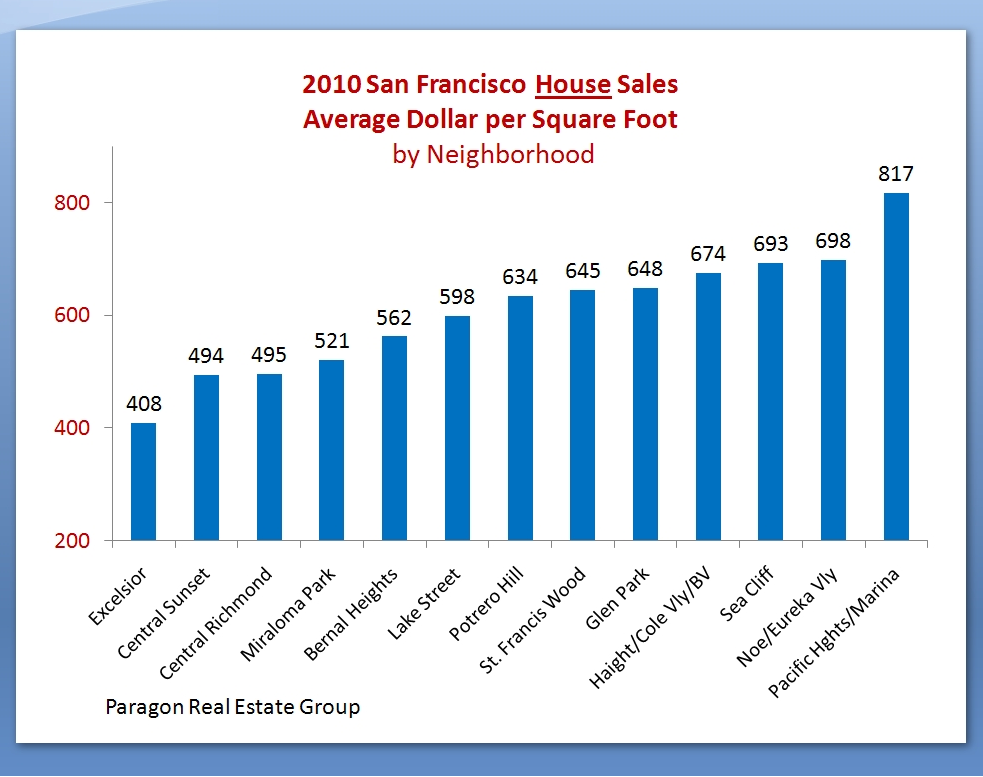
Trends in Dollar per Square Foot Values for Non-Distressed Houses
in Selected San Francisco Neighborhoods

2012 Numbers reflect 2nd Quarter Sales Only


Trends in Median Sales Prices for Non-Distressed 2-Bedroom Condos
in Selected SF Neighborhoods

2012 Numbers reflect 2nd Quarter Sales Only

The MEDIAN SALES PRICE is that price at which half the properties sold for more and half for less. If there were 3 sales, at $1, $2 and $10, the median price would be $2. If there were 4 sales at $2, $2, $5 and $10, the median would be $3.50. Median sales price may be affected by seasonal trends, and by changes in inventory or buying trends, as well as by changes in value.

AVERAGE DOLLAR PER SQUARE FOOT is based upon the home’s interior living space and does not include garages, storage, unfinished attics and basements; rooms and apartments built without permit; decks, patios or yards. These figures are typically derived from appraisals or tax records, but can be unreliable, measured in different ways, or unreported altogether: thus consider square footage and $/sq.ft. figures to be very general approximations. Generally speaking, about 60-80% of listings report square footage, and dollar per square foot statistics are based solely on those listings. All things being equal, a house will have a higher dollar per square foot than a condo (because of land value), a condo will have a higher $/sq.ft. than a TIC (quality of title), and a TIC’s will be higher than a multi-unit building’s (quality of use). All things being equal, a smaller home will have a higher $/sq.ft. than a larger one. The highest dollar per square foot values in San Francisco are typically found in upper floor condos in prestige buildings with utterly spectacular views.

The AVERAGE SIZE of homes of the same bedroom count may vary widely by neighborhood: for example, the average size of a 4-bedroom house in Pacific Heights is much larger than one in Noe Valley; and the average of a Marina 2-bedroom condo is larger than one in South Beach. Besides the affluence factor, the era and style of construction often play large roles in these disparities.

Some neighborhoods are well known for having additional ROOMS BUILT WITHOUT PERMIT, such as the classic 1940′s Sunset house with “bedrooms” and baths built out behind the garage. These additions often add value, but being unpermitted are not reflected in $/sq.ft. figures.

Many aspects of value cannot be adequately reflected in general statistics: curb appeal, age, condition, views, amenities, outdoor space, “bonus” rooms, parking, quality of location within the neighborhood, and so forth. Thus, how these statistics apply to any particular home is unknown.

What’s A Better Value in San Francisco, A Condo or a Home? (Part 2)

In my last post, I included a chart that showed both single family homes and condos stuck in relatively narrow price ranges over the last 18 months or so.  At the end of 2010 the median price of a single family home ($744,000) was about $80,000 more than that for a condo/TIC.

But that doesn’t tell us anything about “value.”  Now, let me count the ways we could argue about what “value” means, but I think we’d agree that how each property type has weathered the market battering over the last few years has to be relevant.   Take a look at this table: Continue reading “What’s A Better Value in San Francisco, A Condo or a Home? (Part 2)”