Updated Bay Area Home Value Map

Median prices almost always conceal large disparities in the prices of the underlying individual sales – this is particularly true for larger cities: in San Francisco for example, median house prices by neighborhood range from $465,000 to $4,000,000, and there will be similar disparities in Oakland and San Jose. But median prices can be valuable to show appreciation trends, and to some degree, to compare general home values between different areas. The last quarter was a period of rapid price appreciation virtually everywhere on this map.

Untitled

January Newsletter

San Francisco Rankings, Real Estate Prices & Trends, and the Biggest Home Sales of 2012
January 2013 Paragon Market Report

Here is a look at how a diverse group of major and minor organizations have recently ranked San Francisco on a wide variety of important and whimsical measures. Where disagreements existed — 3 different surveys ranked SF as the 1st, 2nd and 3rd “Greenest City” in America, and 2 surveys ranked us as second and third smartest city in the country — we naturally chose the highest grade as most accurate.

The ranking report is followed by some fascinating snapshots of the San Francisco and Bay Area real estate markets.

1

Median Home Sales Prices around the Bay Area

This mapped analysis calculates median prices from both distressed and non-distressed property sales around the Bay Area as reported to MLS. Median price is a very general statistic and many cities include districts of wildly varying value. For example, San Francisco contains neighborhoods whose median prices vary by over $4,000,000: The overall statistic mixes them all up together and comes up with $810,000. Maps with SF neighborhood values are included later in this report.

2

The 2012 Rebound

Exactly a year ago, we suggested that, based upon the changing market and economic dynamics we perceived developing in 2011, the SF real estate market was on the cusp of a major turnaround in 2012, possibly similar to what occurred in 1996 when the market blasted off after years of doldrums. And that is what happened, not only for the city, which led the way early in the year, but for the Bay Area, state and country somewhat later. Note that the SF house median price quoted here for 2012 is for 4th quarter non-distressed sales only.

3

4
San Francisco Neighborhood Values
This map charts median sales prices and average dollar per square foot for houses by city neighborhood. And this link goes to a map for SF condo values:
SF Condo Values Map

5
 
 
Year over Year Changes in Values
Very generally speaking, and depending on neighborhood and property type, SF home values have risen by 10% to 20% over the past year. Here is a chart assessing the surprisingly consistent change in overall SF condo value statistics and this link looks at SF house statistics.
SF House Value Statistics

6
SF Homes Sales by Price Range
One client once called this the “high-heel shoe” graph of San Francisco home prices. One of the big components of the 2012 market was the resurgence in luxury home sales, the chart for which can be found using this link:
SF Luxury Home Sales

7
Sales by Property Type
Gradually, with the addition of the big new developments in the SoMa-South Beach district (and other areas of the city), condos have become the largest single category of property type sales in the city. This trend will only accelerate with the new burst in construction plans. And this link leads to a chart showing the resurgence in unit sales. Unit sales would have been much higher in 2012 if inventory had not been so drastically low:
Unit Sales Trends

8
Distressed Sales: Goodbye to All That
Distressed home sales have been a market aberration caused by the collapse in loan underwriting standards and the refinancing frenzy of the bubble years. Fair market value is defined as “the price a willing, able and reasonably knowledgeable buyer would pay to a seller not under distress.” But bank and short sales radiate distress: underwater sellers, overwhelmed and unresponsive banks; often the physical condition of the homes themselves is distressed. Buyers demanded a huge discount to deal with them. In SF, this market segment was largely confined to the lower price ranges and less affluent neighborhoods. Now, with the market recovery, the city’s distressed home market is rapidly dwindling and should soon disappear altogether.

9
Percentage of Listings Accepting Offers
This one statistic provides the context to everything we’ve seen in the market this past year: ferocious, pent-up, buyer demand met a drastically inadequate inventory of homes for sale, leading to much more competition for listings and strong upward pressure on prices.

10

Median SF home prices vary on some of the charts above, depending on whether the price specified is for both distressed and non-distressed properties together, only non-distressed homes, for the last 4 months of 2012 or for the last quarter of the year, or whether price limits were placed on the analysis (limiting sales to under a certain sales price). This is natural: the statistics will change depending on the parameters of the analysis, and it’s always useful to look at the market from slightly different angles.

Statistics are generalities and should be considered approximations: How they apply to any specific property is unknown. These analyses were performed in good faith with data derived from sources deemed reliable, but they may contain errors and are subject to revision. If you have any questions, please don’t hesitate to contact us.

© Paragon Real Estate Group, January 2013

Case-Shiller Sounds a Cautiously Positive Note

Last week, Case-Shiller released January data for its closely watched national housing index.  Nationally, things are looking up – well, make that flat.  And that’s good news. In the wonderfully backward language of the report, the index’s year over year rate of decline “improved.”  Basically, we are back to where housing values were a year ago.

Since for most of us our homes represent our biggest asset, that’s pretty good news when you consider how bleak things looked back in March of 2009.  Just think of how you were feeling about your 401(k)s.

But before you break out the champagne, consider that national home prices have now “recovered” to levels last seen in Autumn 2003.  That’s over six years of appreciation wiped out.

The San Francisco Metropolitan Statistical Area (that’s 5 of the 9 Bay Area Counties, folks) is up 15.2% from its trough value. Case-Shiller does not break out San Francisco proper from the much larger MSA.  However, I calculate that median prices in January were up just 10% from the lows reached in March 2009.  (I use 3 month moving averages, which approximates the seasonal adjustments the CS Index uses.)  To see how SF did through 2009, check out my blog and charts here.

Looking Back at 2009: Half-Empty or Half-Full?

Less than two months into the new year and a brand new decade and already 2009 may seem as far away as a bad dream – assuming you still have a job.

It’s hard to remember just how close to the brink of catastrophe we seemed to be just a year ago.  Major financial institutions – failed.  Credit – impossible to get. Sales—anemic.

With the benefit of hindsight, not to mention survival, some are now criticizing Paulsen, Bernanke, et al., for their haste in rescuing the financial system, but I, for one, will reserve my scorn for the appalling judgment of the likes of Morgan and Goldman and their obscene bonuses.

How did the San Francisco market do?  Here’s where we are for single-family homes (click to enlarge).

We ended the year still down 18% from our all-time high of June of 2007.  That puts us at around the price levels of the spring of 2005.  Not great, but during those scary first months of the year when there was no bottom in sight, we were down to price levels not seen since early 2004.

It’s also interesting to see how Days on Market (DOM) inversely correlates with price, at least over longer periods.  In addition to the very regular seasonal dips in price every December/January, it’s easy to see that as DOM lengthens over time, prices decline.  While DOM remained less than 40 days, prices stayed high.  The correlation isn’t perfect – and certainly not on month-to-month time-scales — but it looks pretty good to me.

So for the “half-empty” crowd, the bottom line is that we’re still down 18% from our all-time highs.   The story looks much more positive, however, if you look at 2009 in isolation.

Now a 23% gain for the year ought to be making people feel pretty good.  Note that median prices have been in the $700,000 to $800,000 bandwidth for the last three quarters.  The dip in the waning months of the year can be attributed to seasonal factors.

I can already hear the nay-sayers arguing that looking at year end numbers is arbitrary  or, worse, distorts the picture.  (These are the same people who don’t believe in celebrating their birthdays!).

I’m certainly not arguing that happy times are here again.  But , if nothing else, that 23% increase confirms just what a wild ride the last two years have been.

As for 2010, I confess I’m beginning to feel a bit more optimistic than I was a few months ago.  Manufacturing seems to be continuing to expand.  There are some signs of job growth.  Still, Europe is now looking shaky and, closer to home, one should never discount the ability of our politicians to screw up the recovery.

All things considered, though, I’ll take my glass half-full please.

Focus on Noe Valley

It’s been a few months since I took a look at my own stompin’ ground, Noe Valley, and how prices have been doing compared to the city as a whole.  We dispensed with the notion that Noe Valley was somehow “immune” some time ago.  Sadly — at least for home-owners — and happily for buyers, Noe hasn’t bounced back over the last few months, even though city-wide median prices have improved.

Noe Valley Vs. SF All Districts Percent change August 09

Bear in mind that “Noe Valley” means a very small area.  What’s more, there were only 7 sales in August, down from 14 in May and June, and 22 in July.   Sure, there’s been a bit of an improvement over the previous month, but there’s still an 11% difference between how far prices have fallen for the city as a whole (19%) versus Noe Valley (30%).

Arrian Binnings over at Inside SF Real Estate also did a recent update on Noe Valley, looking at median prices in a different way.  (I’ve forgiven him for appropriating my term, “getting granular” to discuss what I now have to refer to as “focusing” on a particular area. Sniff.)  Here’s one of his charts.

insidesfrealestate_01-sep-01-18-55

Not much comfort there either.

People will continue to point out that this doesn’t mean that your beloved home has fallen in value as far as the data suggests  — and that’s probably true, unless you bought a median-priced home at the top of the market.  Still, Noe Valley seems unseasonably cold right now, and it’s not just the fog whipping down off Diamond Heights.

Noe Valley Postscript: Median Price Chart

I’ve been having an interesting discussion with a regular reader of theFrontsteps, where I first posted my chart on Noe Valley Percentage Change from All-Time High.  He disputes the fact that Noe Valley has fallen by 30% from its all-time high (reached in March of 2008) because he claims — I think — that March was aberrational.  I’ve looked again at the data for that month and I disagree.  What’s more I think that if you look simply at median prices (moving averages), they show a pretty extended upward trend from the beginning of 2006 through March 2008, with the exception of a dip during the Fall of 2007.  Here’s the chart (click to enlarge).  Enough said.  I’m moving on to another subdistrict.

noe-valley-median-prices

“San Francisco Property Sales and Prices Rebound in February”

…or so proclaims my venerable data-crunching guy at the REreport.  All the data is available and updated monthly under my  “Market Trends” tab, organized by MLS District, or city-wide, annual or monthly, single family or condo — it’s all available here.

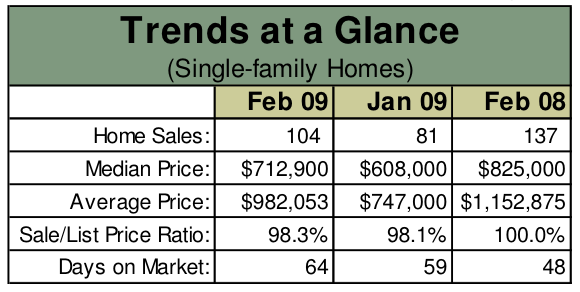
This chart, from the lead-in page, shows unit sales and median prices for both homes and condos are up from Jan 09, but down year over year.

picture-7

But not so fast.  Much as I’d love to believe we’ve hit bottom, it’s hard to know whether this is anything more than the usual seasonal uptick in sales now that we’re coming out of the winter doldrums.  Here’s the chart for single family homes sales.  See those incredibly regular troughs right around Jan/Feb each year?  I’d say it’s way to early to declare a bottom.

picture-8