A Faltering Housing Market?

George may have left office a year ago, but there appears to be a growing consensus that the likely shape of the recovery will be a “W.”  How appropriate, if you believe that we are reaping the bitter fruit of his administration’s policies.

A front page article in the Business Section of last Wednesday’s New York Times, grimly entitled An Upturn in Housing May be Reversing,” pulls together recent and contradictory data from various sources, including Case-Shiller, Moody’s, and The National Association of Realtors.  The conclusions are sobering.

There is a growing consensus that the positive national sales data that we’ve seen over the last few months is faltering.  Much of the recent activity, for example, was stimulated by the anticipated expiration of the “First Time Home-buyer Tax Credit,” originally set to expire in November, and now extended through April of next year.  Essentially, this means we’ve “borrowed” from future sales.

Also, despite some positive economic news and decent sales volumes, there’s been little improvement in sales prices because inventory levels – read “foreclosed properties” – remain so high.   Mary Maitland, VP of the S & P Index that publishes the Case-Shiller Index foresees a “W” pattern for the housing market, with prices this winter testing the lows we saw earlier in the spring.  Am I allowed to say “I told you so?”

The NY Times article has a cool interactive chart for specific MSA areas including “San Francisco” — remember this covers 5 of the 9 Bay Area Counties.

Continued Improvement in the Housing Market or Borrowing from the Future?

CB104955

The National Association of Realtors (NAR) reported yesterday that existing home sales in October rose to their highest level in more than two years.  Nationally, sales were up 10.1% over September and up 23.5% year over year.

Most of the increase in sales, however, was not in the western region, where sales were  only up 1.6% from the previous month.  (Oh, the devil is always in the details.)  And more “good news”:  The western region median price of $220,200 — clearly this is not San Francisco — was down 14.7% year over year.

Not surprisingly, the article stresses the positive.  Inventories are shrinking, especially at the lower price levels where foreclosures and REOs are slowly being digested by the system.  Prices have fallen by the smallest amount in over a year (don’t you love that!).

You can argue that any press release by NAR is going to be self-serving, but its Chief Economist, Lawrence Yun, doesn’t mince words when he says that a lot of the sales surge was fueled  by the anticipated expiration of the First Time Homebuyer Tax Credit.  The $8,000 tax credit was originally scheduled to expire in November, but has now been extended  through April 30, 2010. Yun goes on to caution that “with such a sale spike, a measurable decline should be anticipated in December and early next year before another surge in spring and early summer.”

We can only hope that he’s right about that surge….

TICs, San Francisco’s Involuntary Reflex — Part 3: The Condo Premium Per Square Foot? Or not…

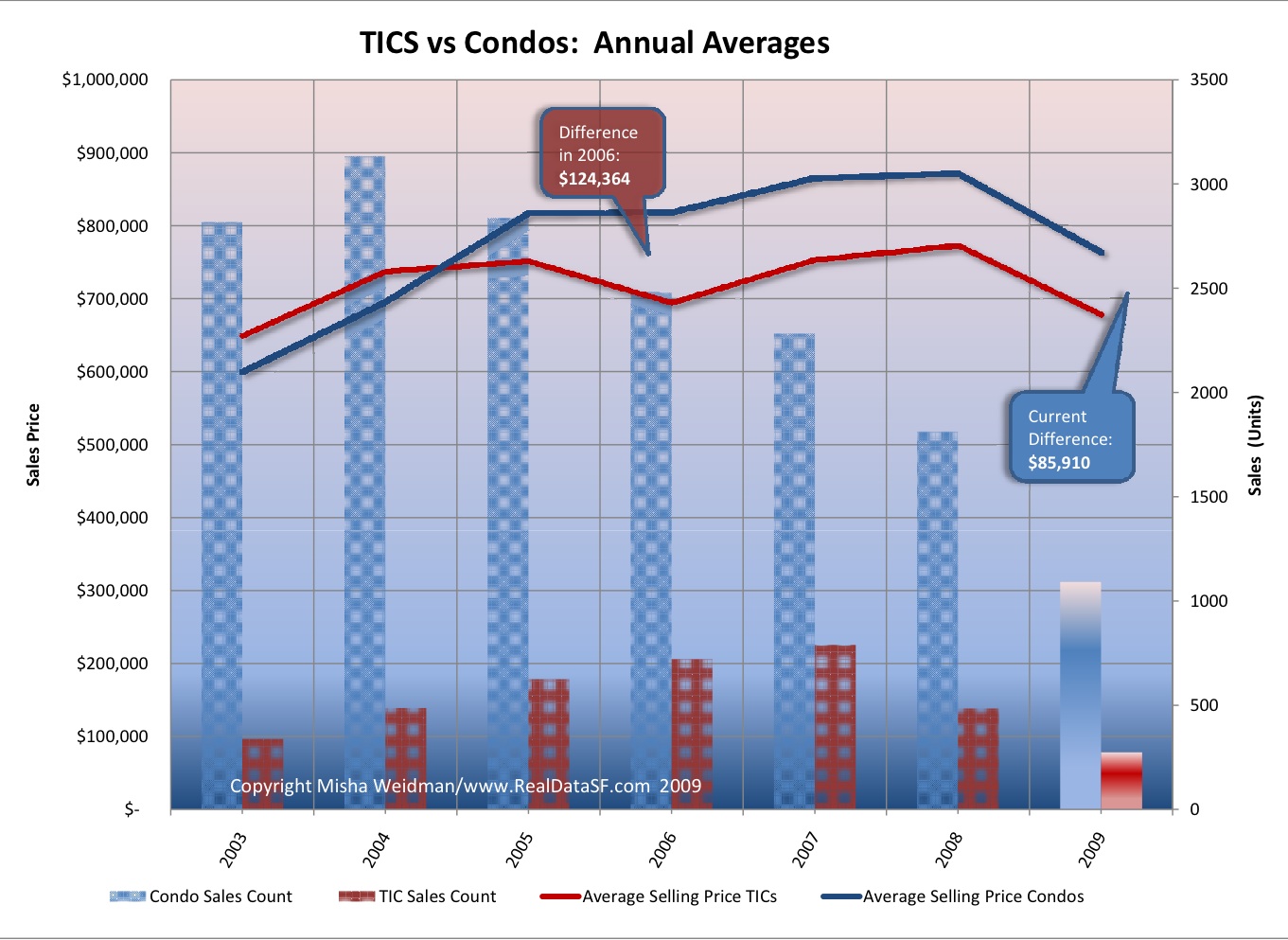
Last post, we determined that the current difference between the average (annual) price of a condo and that of a TIC is  $86,000, down from a high of $124,364 in 2006.  (That’s a 30%+ drop, by the way.)  Here’s the chart again (sorry for the funky transparency on the sales volume bars).

Condos vs. Tics Annual Average Sales Prices

That’s useful if you’re looking at an average-priced TIC and you’re curious about how much of a premium you’d have to pay for an average-priced condo.  But how about reducing that to a per square foot premium?

For those who just want the bottom line, here’s the answer, but it’s worth reading on for the caveats.

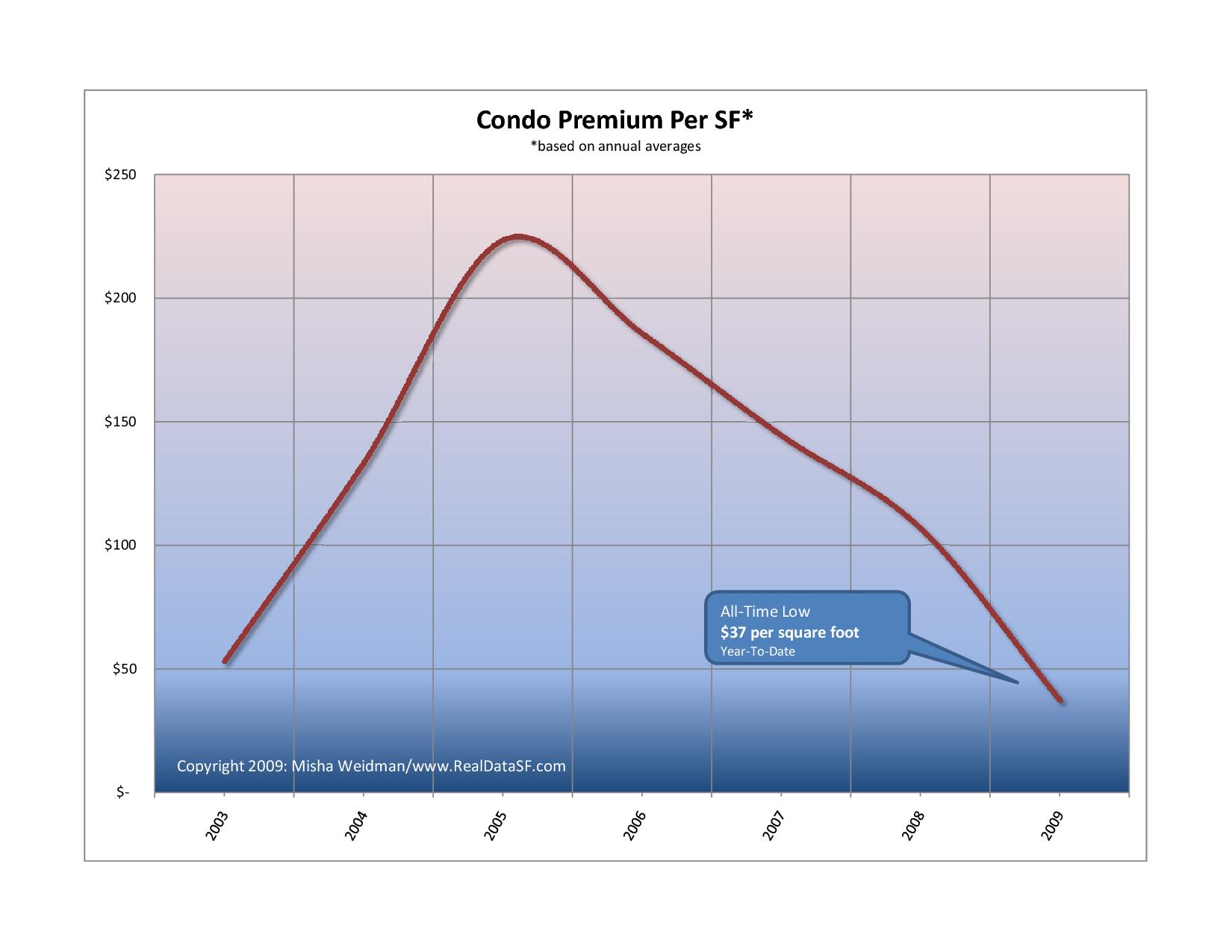
Simple Condo Premium Per SF

$37 a foot doesn’t sound like much of a condo premium to me, that’s for sure.  And as my astute readers will note, the drop in price on a per square foot (from around $225 per sf) is obviously much more than the drop in median sales prices shown in the previous chart.

What’s going on?  It’s really simple:  there’s a lot less information on sales price per square foot for TICs.

All my data comes from the MLS (Multiple Listing Service) that real estate brokers use to find and market properties.  When a sale’s completed, they are required to enter the sales price.  If there’s information on the square footage of the property — provided by the owner or more frequently from the property records — the database calculates a per square foot price.  Roughly 80% of condo sales have a recorded price per square foot in the MLS.  Only 45% of TIC sales have a recorded price per square foot. How bad is that? In September 09, there were just 27 TIC sales.  Only 9 of them had a recorded price per square foot.  For all of 2009 through September, there were 275 TIC sales.  Only 113 – 41% – show a per square foot price.

There are lots of people — mostly on other blogs 🙂  — who love to trash statistics and say they’re meaningless.  Medians don’t reflect home values, etc etc.  I disagree.  Provided you have enough data  and you understand what you’re measuring, statistics help make sense out of what is otherwise undifferentiated data.  But I am afraid that in the case of measuring the condo premium on a per square foot basis, we are in dangerous low on data.

One final reminder:  For this series of posts, my TIC data includes the handful of stock cooperative sales that occur in this market.

And thanks for sticking with me on this long series of posts….


TICs, San Francisco’s Involuntary Reflex: Part 2 — The Data

There are weeks when I look through the new listings on the MLS (Multiple Listing Service) and it seems like there are more TICs for sale than condominiums.  Turns out, this just isn’t true.  Here’s a chart showing relative sales volumes since 2003 (click to enlarge).

Units Sold By Month
Look at that!  Excluding those wonderfully regular dips every Xmas, condo sales are generally at around 200 units per month.  TICs rarely break 40.

Here’s how TIC and condo median prices stack up against each other on a monthly basis.

Condo vs TICs Median Prices By Month
Dueling spaghetti you say?  That was my reaction, too.  The huge variability in prices from month to month on the TIC line is a direct result of the paucity of sales.  And this chart certainly doesn’t help get at the key question, which is this:

Given that TICs are riskier and less flexible than condos, what’s the premium that you pay for buying a condo vs.  a TIC?

In fact many TIC buyers do so with the hope of being able to realize this “premium” by converting their TICs into condos down the road.  Fat chance unless you’re buying a TIC in a two unit building which — for now at least — remain exempt from San Francisco’s byzantine annual lottery system.

Luckily, I have a bona fide statistician mathematical genius phd for a wife, and she always lends a hand on methodology when I need it.  She suggested that where one set of data (condos) is so much larger than another, using averages provides a more reliable “apples to apples” comparison than medians.   Also, with so few monthly TIC sales, I decided to look at annual rather than monthly trends.

Here’s attempt number two.

Condos vs. Tics Annual Average Sales Prices

Much more useful!  (By the way, the fact that TICs were more expensive than condos in 2003 and 2004 can be explained by a few massively (in excess of $8 million) expensive TIC sales in those years.  This is a great example of how using medians or averages can really affect the results.)

So, can we drill down further and come up with a condo premium per square foot? Stay tuned….

TICs, San Francisco’s Involuntary Reflex: Part 1

Inconvenient and Ugly

A tic is an involuntary and habitual muscle spasm, frequently in the face.  If you live in San Francisco, a TIC is also what many people end up with when they buy a flat in one of San Francisco’s classic 2-4 unit buildings.  Like the medical condition, TICs are inconvenient at best and can be downright ugly at worst.

TIC stands for “Tenancy-In-Common,” a form of legal title by which multiple owners take title to a single property.  In San Francisco, this form of taking title has come to be used as an end-run around the City’s restrictions against converting multi-tenant buildings into condominiums.

When you buy a condominium, you’re basically buying your particular unit and that’s all. But when you buy a TIC interest, you’re buying an interest in the building as a whole, along with your other TIC owners.

Lawyering Has Its Limits

Why does it matter?  Because buying a roof over your head is expensive.  Most of us need to borrow money to do it.  And the major disadvantages of TICs over condominium ownership relate to financing issues.

  • When you buy a condo, you get a loan on your unit and that’s all.  If you don’t pay your loan and the bank forecloses, they have the right to sell your condo to get repaid, but they don’t have the right to sell the building the condo is in.
  • But when you buy a TIC, in the vast majority of cases you and your co-owners become co-signers on a loan for the entire building.  You qualify for the loan together and you are “on the hook” together for repaying it.  If one of the co-owners stops paying his share of the loan and the others don’t feel inclined to make up the difference, the bank has the right to sell the entire property at a foreclosure sale.  That itself would be enough to give many prospective buyers a twitch or two.
  • There are a few banks that will finance separate TIC interests.  This pretty much puts the TIC on a par with a condo.  But interest rates are higher than on a regular condominium loan; and the building itself needs to “qualify” for the program.  Also, although these kinds of loans have been around for a while and seem to have survived the credit crunch, there’s no guarantee that they’ll continue to be around.
  • Selling a TIC interest can also be more difficult than selling a condo. If the lender doesn’t permit the buyer to take the seller’s place as a co-signer on the loan, the owners may be forced to take out a new loan to accommodate the new buyer.  If the lending environment isn’t good, that can kill the sale.  Or the bank can use the sale to try to extract better terms for itself.

It’s true that clever lawyers – and I say that without any irony – have developed legal structures to mitigate these risks.  Andy Sirkin and Andrew Zacks are two prominent attorneys who specialize in this stuff.  (See their websites for excellent in-depth material on TICs.) But TICs remain inherently riskier and more complicated than condominiums, and no amount of legal engineering can fix that.

Tomorrow we look at the market data for TICS and condos.

Fears of a New Chill In Home Sales

winter home

That was the title of an October 27 article in the New York Times, and, as one of my readers and clients pointed out, it’s what I’ve been tentatively suggesting as a possible scenario for this winter. See here, for example.

And, ironically, the gloomy head-line announced yet another “positive” month of data from the Case-Shiller Home Price Index. The little up-tick in the index from last month’s July data that I discussed as a possible “dead cat bounce” continued in August.

Picture 4

“San Francisco”  — remember, this is a Metropolitan Statistical Area (MSA)  consisting of 5 of the 9 Bay Area Counties — improved 2.6% on a seasonally adjusted basis from July 09.  The New York Times has a cool inter-active chart that shows the CS Index for various MSA’s here.

So why so glum?  The NY Times article points to a number of factors that suggest the improvement may not continue:

  • an unexpected fall in consumer confidence in October.
  • the end of the stimulus provided by the first-time home-buyer tax credit (though there’s pressure to extend this).
  • doubt about how long the The Fed will keep interest rates so low.

Especially troubling for California is “strong evidence that foreclosures may be spreading from sub-prime inland areas to the more exclusive coastal region.”

My view hasn’t changed.  If you’re thinking about buying, this is probably a good time to be out there looking, with a view to buying some time during the winter months when activity slows and prices tend to soften somewhat.  Nobody knows how long interest rates are going to remain low — and some economists think that they may well remain low for a while — but with the government having thrown so much money at the economy to keep us from the brink of disaster, it’s hard to argue that the long-term trend is going to be anything but up.

As for whether we’ve hit bottom yet, it’s anybody’s guess.  While Mr Case of Case-Shiller continues to think that the worst is over, the NY Times article quotes another eminent economist who thinks that the recent improvement in the CS Index is an aberration and who wouldn’t be surprised by another — if limited — down-leg.

It’s a fool’s game to try to time the market to the nth degree.  And in this environment, with so many contradictory signs pointing in so many directions, you might as well flip a coin, or an economist, and see whether he lands on his head or his arse.

Me, I’m dusting off my magic 8-ball.

magic_8_ball_3

One of the Other Things I Do: Windsor Live+Work

I’ve been itching to do some posts and I have some interesting info coming on TICS (Tenancy-In-Common Interests) vs.  condos.  However, the last few weeks have been taken up readying my development project, Windsor Live+Work, for a major re-submission to the Town of Windsor (we’re talking just north of Santa Rosa, folks, not the seat of the British Monarch).  Windsor Live+Work is a 12 unit live/work project that combines some beautiful and innovative architectural design with forward-thinking urban planning ideas and “green” construction standards.  Here’s the 3D rendering, which I received just last week (click — it looks really good big!).

Windsor Live+Work
Windsor Live+Work

Stay tuned for new posts and charts in the next few days.

Enough about Owning — How about San Francisco Rentals?

I came across a site recently that not only provides a database of available rental units for many US cities, but also has nice, easy-to-read charts on rental trends for specific areas.  Unfortunately, you can’t get very precise in terms of zip code or neighborhood, but it certainly give you a good sense of rental trends.  And trends, as we all know, are what it’s all about!

Welcome to RentBits.com:

I’ve added them to my blog-roll.